Have you ever heard the concept of, “so close to being great, but one omission makes it a failing grade?”
That’s my opinion on the Golf.com article featuring Kellie Stenzel, outlining the top ten fundamentals needed for a great golf swing.
Have you ever heard the concept of, “so close to being great, but one omission makes it a failing grade?”
That’s my opinion on the Golf.com article featuring Kellie Stenzel, outlining the top ten fundamentals needed for a great golf swing.
I wrote a post a few weeks ago about how I’d been looking at Jack Nicklaus’ very vigorous and aggressive leg action and that I think it’s the way one must perform one’s leg and hip action for maximum efficiency.
In the intervening two months, I’ve been looking at the setup and the pivot itself (not the leg action, but the back swing pivot angle with regards to arms and hands going back), and while doing that, I re-affirmed the overwhelming importance of that leg and hip action.
I got a fresh look at Bryson DeChambeau’s driver swing from the weekend when he drove a 384 yard Par 4 green, and it looks pretty good, form-wise, compared to what he’s been doing before when I’d have a look.
I don’t know if there was a stiff following breeze (there is a good breeze and I doubt it was against, but it could have been a cross-wind) or if it was significantly downhill, but 384 in any conditions is a pretty good pop!
Back in 2016, I had a swing that largely resembled John Daly’s with regards to the back swing length and top position, and I’m curious about one thing.
That thing would, could I match the club and ball speed I was generating back then with the new, rebuilt swing upon which I’ve been working the last year?
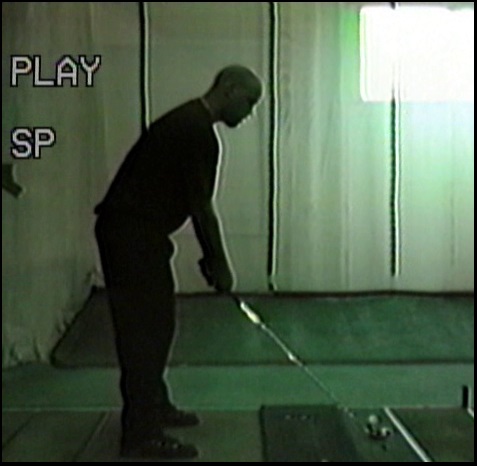
I will swallow my distaste for any face-on views of my swing back in 2017 (the right hand grip is all wrong) to illustrate just how easy it is to hit one’s irons and wedges with a vertical swing mindset.
I have a Pitching Wedge in this particular swing in real speed and slo-mo, and all I’m doing is making a back pivot to the top and then swinging down and through to the finish with no mind of the ball whatsoever – it just gets in the way.
It amazes me how far away from the proper MCS setup I strayed in the years since producing and releasing the “E = MCS” swing video (which is no longer available because there were certain things about my swing at the time that I detest, so I’ll have to re-shoot it).
I talk about how the swing is vertical and not rotary, which if you wish to swing in this manner requires the proper setup shown down the line, and I actually nearly nailed it when I was making the video.
I might add as well that in addition to setup being crucial to a stable golf swing, you also require proper mechanics – which are impossible without the correct setup.
So it all flows from one thing, the setup.
When you get that right, then all you have to worry about is the actual swing motion, which is nothing more than a back pivot to prime your swing machine to swing down and through from the top.
I have been going over the changes to my stance as shown down the line (** more on this at the end of the post), and it has been a while since I looked at any of my archived video from the “E = MCS” video released in 2017.
While I would not consider the setup shown down the line as what I want to see today, I was still surprised by how close I was to it 6 years ago – not too bad at all.
Having struggled for years with an over the top down swing, I’d like to share some trouble-shooting tips for those who are still having issues with it even though they have been following MCS Classic Golf Swing principles (or think they are).
That part in brackets is not a dismissal or put-down of one’s efforts – I myself, even though I built the MCS Classic Golf Swing model and have improved many others’ swings doing so, have struggled with thinking I was adhering to MCS principles when I wasn’t.