
 You’ll all recall from a couple of weeks back that, when I realized that I had to make the difficult decision to delay the release of the upcoming “MCS – The Power Of The Pivot” video, it was because of discoveries about the pivot drills while I was going through and making notes.
It was probably inevitable that I would arrive at this junction, since I haven’t stopped thinking about golf swing mechanics from the time I began to study and analyze golf swings.
Things began falling into place when I figured out the mechanics involved in all three of the pivot types I’ve identified. Mechanically-correct pivots, I might add. There are many others but if they aren’t mechanically-correct, I’m not interested.
I had 1) The Traditional Classic Golf Swing Pivot, 2) The Transitional or Late Hogan Pivot and 3) The Post-Modern or Mike Dunaway Pivot.
I then posited that by changing the setup, you could go from the 1st to the 2nd to the 3rd pivots.
That hasn’t changed.
What happened was a natural progression – once the pivot drills began to show me how to improve my own setup and swing, I found that my above statements on the 3 pivots was still operable.
In fact, the upcoming video will feature both of the first two pivot actions because the are so close to one another that a simple change in spine tilt is the only difference with the setup, but that change drastically alters the pivot action.
They are so close that I can’t say which one is optimal, because they are the same swing with one minor difference.
In fact, I had already mused that they could be two roads to the same place, so that depending upon personal preference, either one could be what one calls “optimal,” to different individuals.
I already had some evidence – when I was swinging with the traditional Classic pivot action, I was achieving over 180 mph in ball speed in my mid-40’s:
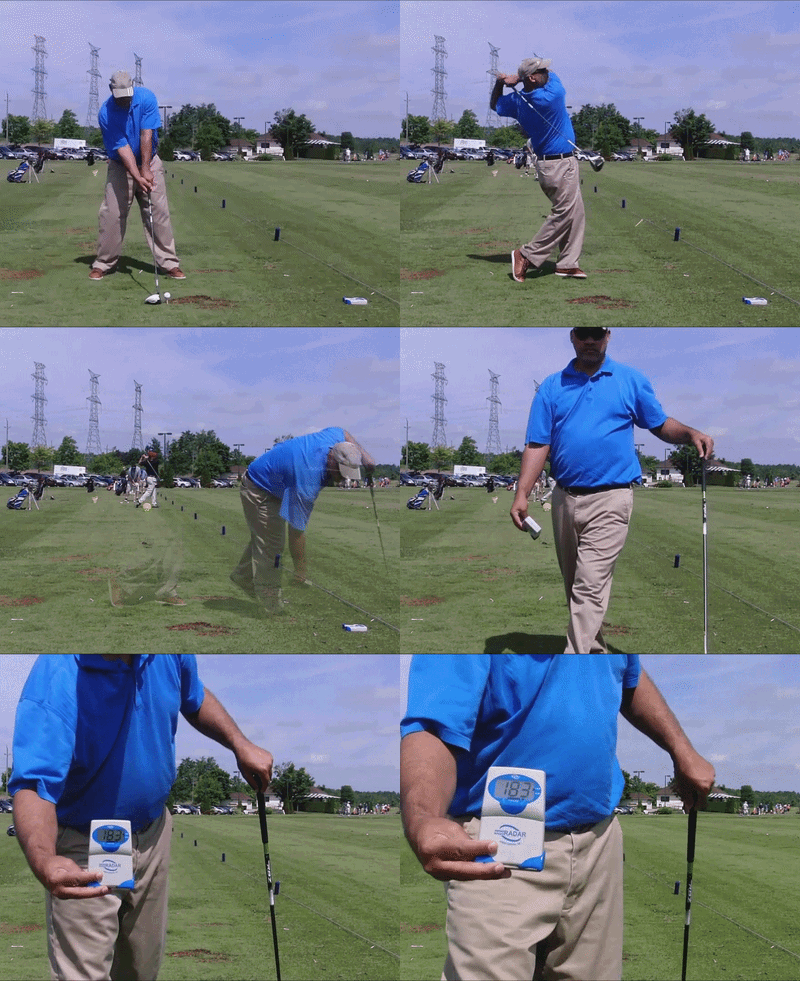
That wasn’t even a great swing action, but it was only year after having studied Ben Hogan’s rotary pivot action that I called the “Perfect Pivot.”
A couple of years later, I was swinging better than that and actually exceeded that speed with the Transitional or Late Hogan pivot action with the much lower leading heel lift:

There really is no point in making two separate videos on a golf swing that has two versions separated by one single setup adjustment.
The pivot drills work the same with both models, with the one setup adjustment determining which pivot will occur, and again one difference in the initial back pivot move.
They are also locked – if you set up for one, you won’t be able to make a pivot of the other model. You can’t set up for the Classic pivot and then make a pivot like the Transitional action without creating a problem like a shifting head, and I can’t find a way to set up in the Transitional and get a Classic higher-heel action.
This explains why, during my swing research years, I was able to make both pivot types, as you see above – I unknowingly changed my setup, which resulted in a different pivot type.
I have more than one instance where I have gone back to look at swings in my archives and found both pivots during the same swing session!
The change is subtle but yields a dramatic difference, as you see.
Yesterday, I was using the pivot drills to perform traditional Classic Golf Swing pivots and I realized that my best pivots in past years really didn’t come close to how I would do so now with the aid of those drills.
I came up with them this past spring, worked on them over the summer in preparation for the video, and discovered the true nature of what I had done in the early days of autumn.
They make the pivots so simple, I am interested to see if I’ll ever be able to improve on them.
Even though I don’t think so, I will still try, because a theory is only a conclusion that hasn’t been proven wrong. If you are afraid to test the theory, it can’t be any good.

