
 Here’s something interesting – I’ve spent years trying to change from a left-dominant swing (pulling the swing down with the leading arm) to a right-dominant swing action (pushing or throwing the club with the trailing arm), but the adjusted model of the MCS Golf Swing based on the Pivot Drills enables one to simply make a full-body swing.
I first had to re-build my setup with some slight changes, after which I began to make pivots, then to make slow motion back swings and down swings with a club.
I’ve been swinging lightly recently while continuing to allow my left shoulder to recover fully from the Frozen Shoulder Syndrome, but today I began to make some heartier swings and to my frustration, I noticed I was swinging left-dominant.
Instead of switching to a right-dominant action, I said to myself, “why not just swing with both arms?”
AKA the entire body.
I’ll tell you all something – from the first time I swung that way, I was having trouble maintaining my grip on the Heavy Iron I was swinging, even with the molded grip to prevent slipping.
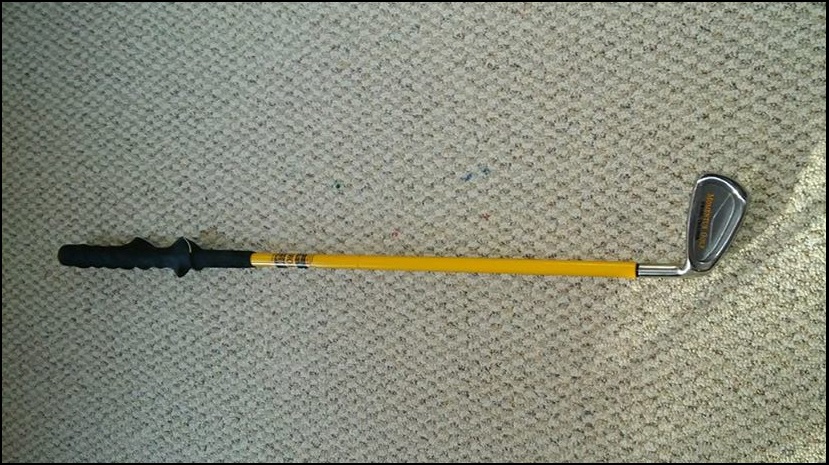
That’s how much force I was generating into the swing bottom.
I shouldn’t have trouble holding onto regular clubs because the issue with the Heavy Iron is that it’s much heavier than it should be. That increases the force dramatically at the bottom. Makes for great training and conditioning however.
As for the back pivot action, it looks very much like this version of Sam Snead’s below:

You’ll see that this swing of Snead’s was vertical and not rotary.
Notice how his hips tilt on the back pivot (I’ve talked about this aspect with the Late Hogan model) instead of turning like a barrel, and creates a motion with the entire body unlike the Modern Golf X-Factor separation.
That’s exactly the action you will want and what the Pivot Drills will teach you to perform.
The down swing action is of course much cleaner than Snead’s because of his leading leg hyperextension and snap caused by keeping his right or trailing foot anchored in place.
Hey, even the best had some flaws in their action, but considering Snead was a humble country boy who taught himself to swing without the aid of modern technology, still an awesome swing action.
I won’t ever claim to have a perfect swing, only to have built what I consider with twenty years’ research to be the optimal swing model, and to try to come as close to copying myself.
The work continues.


Can’t wait for the drills DJ. I have a hunch that for me, the L or R dominance is connected with the grip. If I simultaneously apply equal pressure with both hands to the grip at address (i.e. the feel of evenly “squeezing” the grip) I experience no or very low dominance. But if I grip with more attention to the L or R hand I don’t have that “unified” sensation.
Hello Neil!
I liken the motion to swinging an axe or a bat – even though you are swinging right or left-handed, you are using both hands and the entire body.
I used to have a big bugaboo in that, being cross-dominant, I would swing using my leading arm. As long as I kept the right arm passive, no problem.
However, when I really went after a ball, the initial motion would be leading arm, but then I would activate the trailing arm and hand into impact- my hands would turn over rather than holding off the release and I’d snap-hook the ball off the planet.
If we can get ourselves to build the stance and fashion that neutral grip to allow a double-arm or full body swing, power increases dramatically, as well as consistency. 👍🏼
I’m experimenting with my set up every time i go to the range & look forward to seeing what difference your new drills make. Too much instruction I feel focuses on what good looks like & doesn’t include enough of what good feels like. Right now I believe I need to calibrate & get more feedback from the feelings & kinaesthetics