
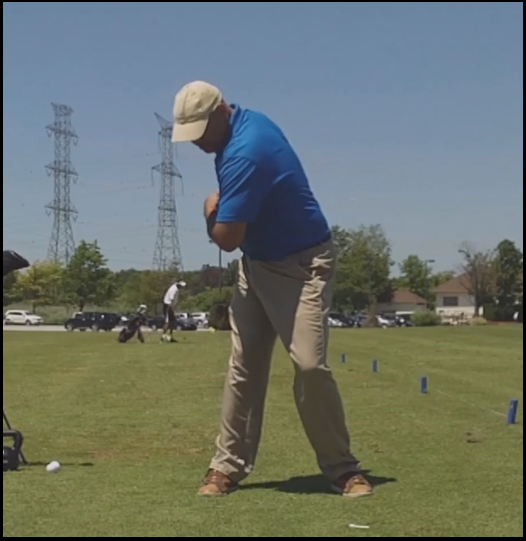
 I have talked about the difference between the “turning” back swing of the traditional Classic Golf Swing and the “non-turn” pivot, and I can show you from one of my prior videos (E = MCS) what I mean by “turning.”
Here below, I am demonstrating the way the turning back swing works – you turn the hips and the legs together which is nearly all you need to achieve a 90 degree or more shoulder turn, and the rest of the turn is completed with the natural 5-10 degree turn in the lower spine.
First, I begin the turning of the lower back with a bit of hip turn – notice that when I pause where the lower back doesn’t want to twist any more, I have to finish the turn with the hips and legs.
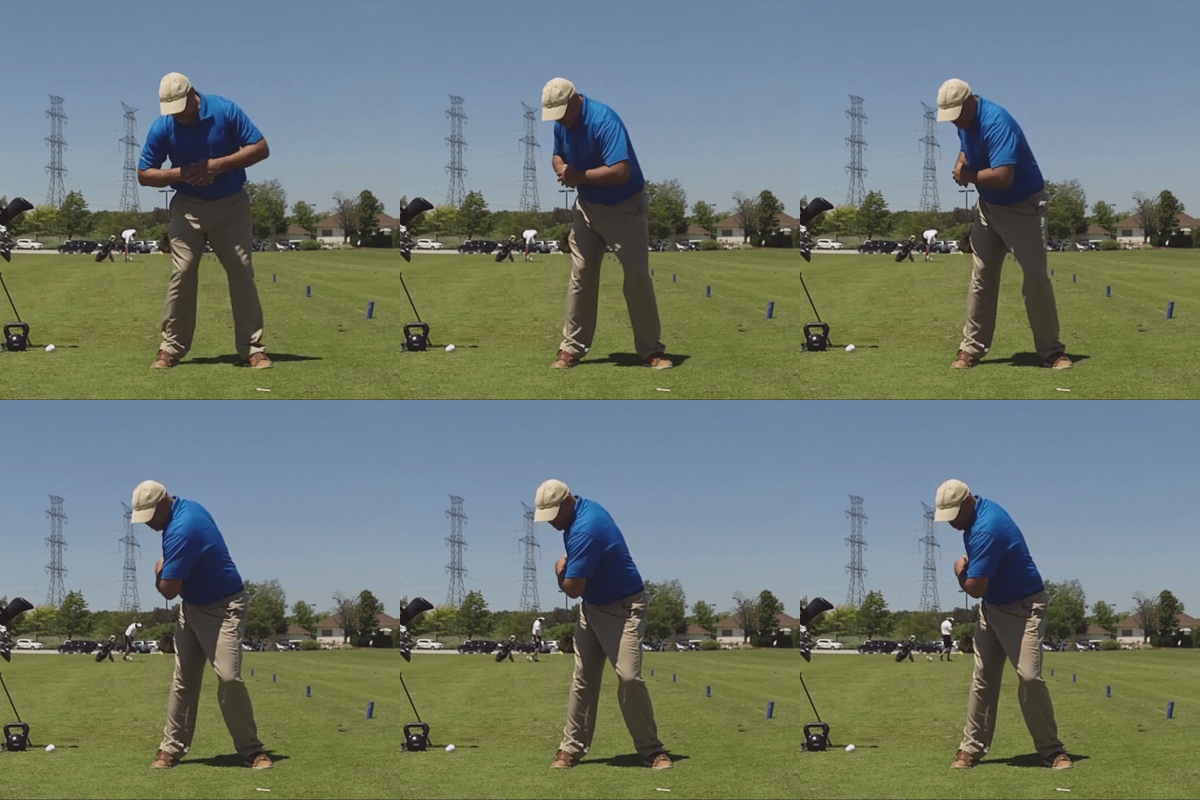
This is why the Modern Golf Swing is so harmful when golfers restrict their hip turn and force the shoulder turn by twisting the lower back past where it is naturally supposed to stop.
By using the hips and legs however, with the lower back’s natural 5-10 degrees of rotation, I easily achieve a 90 degree shoulder turn in this traditional manner.
As I said in the title, there’s absolutely nothing wrong with this mechanically-correct swing method – it’s the way golfers turned in the back swing for decades before someone decided that they would re-invent the wheel, and doom thousands of golfers to completely avoidable back and other injuries just for the sake of making a back swing without lifting the leading heel (thereby restricting the hips and legs in the back swing).
Compare this:
… to this:
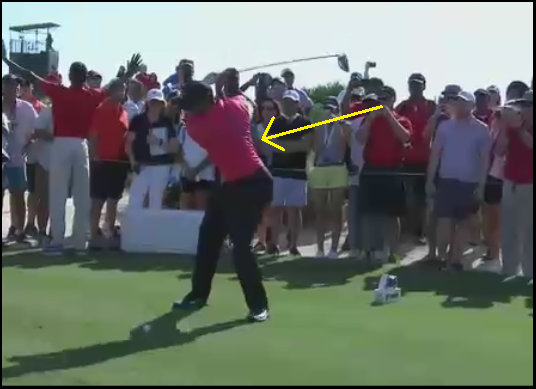
… and you can see at a glance why Tiger Woods has had to undergo 7 spine surgeries:
- March/April 2014 – Microdiscectomy: Performed by Dr. Charles Rich to relieve a pinched nerve.
- September 2015 – Microdiscectomy: A follow-up procedure to remove a disc fragment pinching a nerve.
- October 2015 – Microdiscectomy: A second procedure in a short span to address continued back pain and nerve compression.
- April 2017 – Anterior Lumbar Interbody Fusion (ALIF):
Performed by Dr. Richard Guyer at the Texas Back Institute to fuse his lower spine (L5–S1) and relieve severe sciatica and back pain.
- December 2020 / Early 2021 – Microdiscectomy: Performed to remove a pressurized disc fragment pinching a nerve.
- September 2024 – Lumbar Microdecompression: Performed by Dr. Sheeraz Qureshi to relieve nerve impingement in his lower back.
- October 2025 – Lumbar Disc Replacement (L4–L5): Performed by Dr. Sheeraz Qureshi at the Hospital for Special Surgery in New York to address a collapsed disc, disc fragments, and a compromised spinal canal.
All of these surgeries would have been absolutely avoided by swinging in a mechanically-sound manner. They are all because of the way he swings and has swung since his youth:
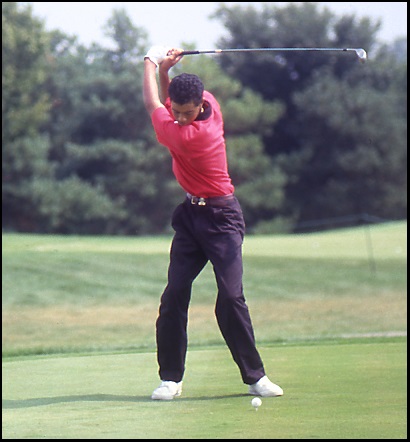
Eventually, the bill comes due.
I showed how the non-turn pivot works in my last video, which I have removed from the downloading platform when I began the new video on how to perform the non-turn pivot action using pivot drills, so you won’t ever see me swinging in the manner I was above ever again.
The pivot drills show how to perform both the optimized Classic Golf Swing pivot and the Late Hogan or Transitional type of pivot, and I’m working on bringing this video to everyone once I’ve recovered full mobility in my left shoulder and arm (having been stricken by “Frozen Shoulder Syndrome” sometime in March of ’25), hopefully in not too long a time.
I used historic swing clip video for the last project because I was nowhere near having recovered from the Frozen Shoulder, but I delayed making this new video and having it available for two reasons:
- I had to completely revamp the video after the discoveries I made about how these “simple” pivot drills optimized my swing models and
- I absolutely want to make new swing clips, even if it’s indoors at a Launch Monitor facility, to show exactly how the models work with the work I’ve done with the pivot drills.

