
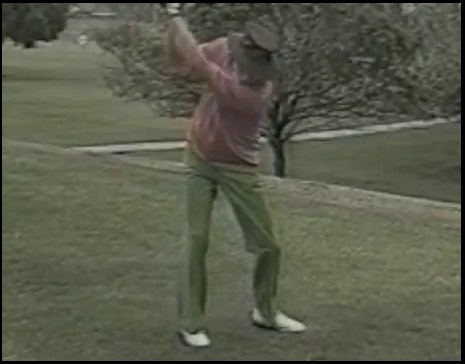
 Looking through some more Mike Austin and Mike Dunaway swing clips, I ran across two swings from Mike Austin sometime in the 80s (he suffered a stroke in 1989 which partially paralyzed him, so it was before that year), and you won’t believe what you’ll see when you look at his pivot action then.
I hadn’t seen these swings in over ten years, because although I continued to look at Mike Dunaway’s swing up until now, I would make mention of Austin after 2013 but didn’t really look back on his library of swings – until this spring.
I’ll tell you all what, even if I break down and one day divulge how to perform the stable-headed version of the Mike Dunaway swing model – let’s call it the “MCS Post-Modern Golf Swing” – this swing model that I have been calling the Late Hogan pivot swing model will likely be THE MCS Golf Swing model that I feature most heavily and recommend over the Post-Modern and the traditional Classic Golf Swing.
Why?
Because it falls between the easiest model – the traditional Classic – and the hardest one (I’m still going over it), the Post-Modern.
Basically, it is still a version of the rotational hip action of the Classic, but also incorporates a posting action of sorts onto the trailing leg on the back pivot. It is where the Classic model begins to transition to the pure posting action of the Post-Modern model
If you want to play great golf with precision ball-striking and loads of effortless power, the transitional model (The Late Hogan) is your best bet, even though I know some enthusiasts will want to learn the Post-Modern model.
First, let’s look at the two swings from a certain diagonal view that I have been breaking down in my “The Basics Of The MCS Golf Swing” video:
Late Hogan – 1953

And the swing clip of mine that, when I saw it again last year, showed me that I could already perform this Late Hogan pivot action, making it the feature pivot action for the MCS Golf Swing model of today:

Not the same golf swing, but the same pivot actions, right down to the low-heel raise of the leading foot on the back pivot to the sliding trailing foot release through impact.
Right, now let’s take a look at two swings of Mike Austin I watched earlier today:
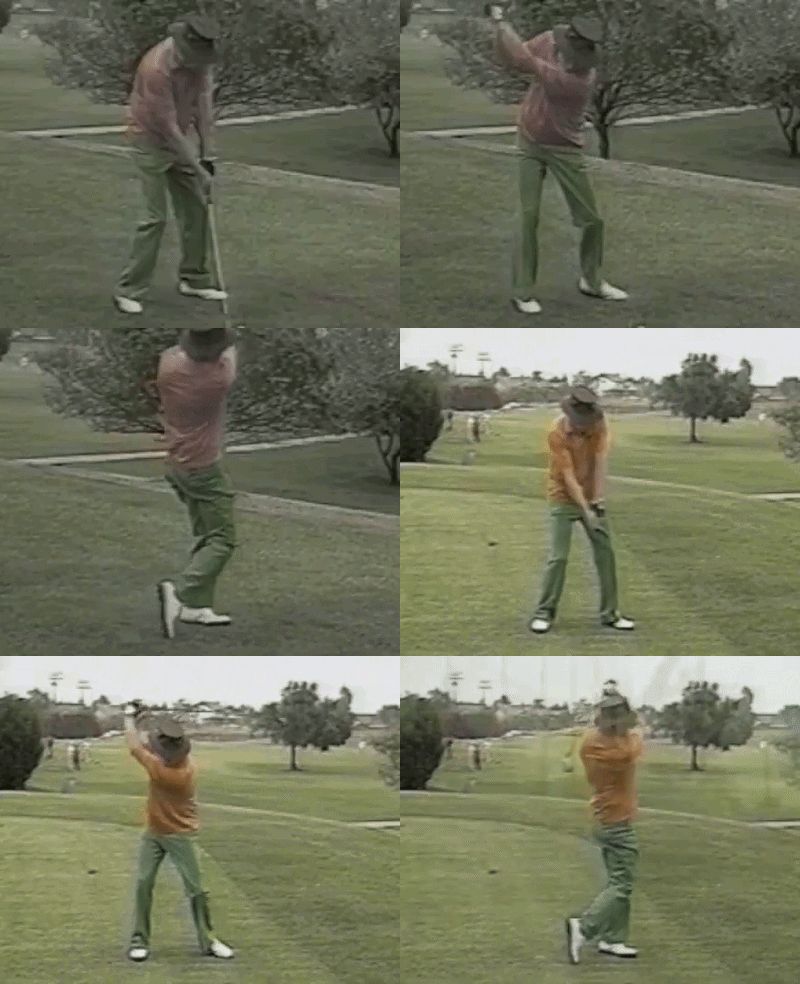
You’ll see the familiar head shift on the back pivot, which is actually something Hogan also did (and Hogan also shifted back towards the target starting the down swing), but you all know my “Athlete’s Rule” of motion – a stable head provides more repeatability and consistency of ball-striking with less effort.
Remember that Hogan hit balls all day to maintain his precision, and that while Austin was super-long, (told to me by someone who knew him when I met him in California back in 2016), he was always playing out from the trees.
A stable head in a golf swing is better than a moving one – try doing anything that requires precision keeping your head still, and then again while moving, and see which one is better.
Now, let’s take a look at a slo-mo of the diagonal view of the two:
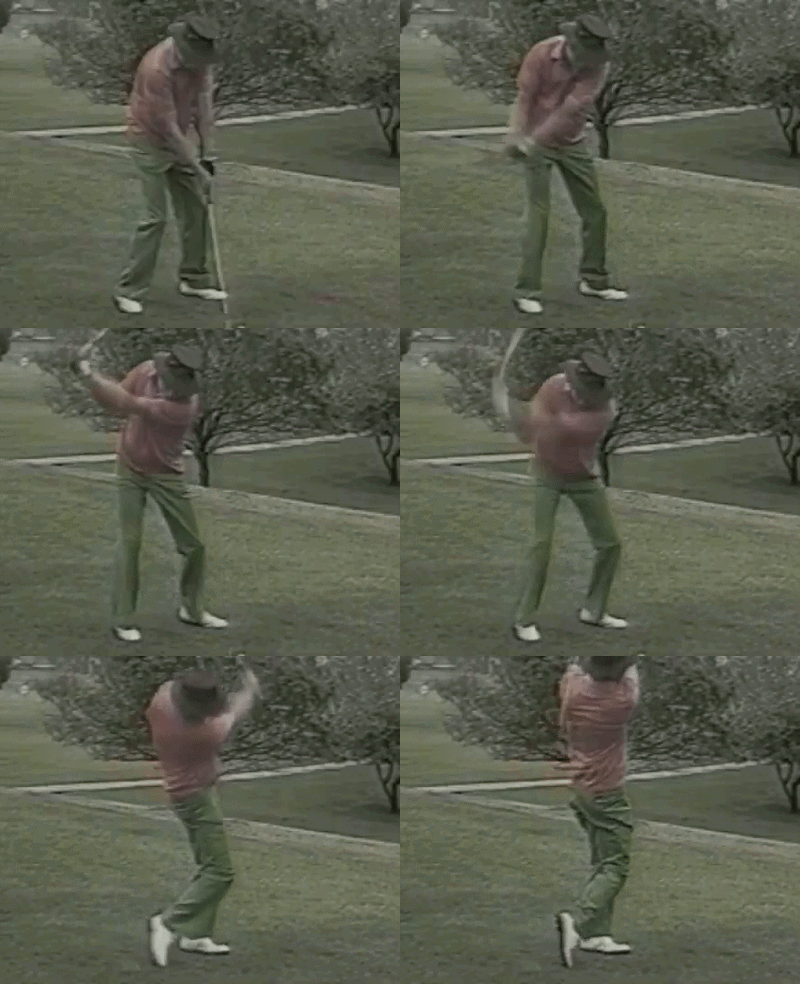
Again, if you replay the part of the pivot drill in the “Basics” video, and listen along while watching this slo-mo swing of Austin’s, you’ll see that his action (minus the head shift) is what I’m saying to do to perform the pivot!
The shoulder action, the hips and leg action – all right there.
Note the low heel lift on the back pivot, the flatter plane at the top than his younger days, and the sliding trail foot release through impact, all hallmarks of a good Late Hogan pivot and swing action.
I’m loving this stuff, honestly.
Years and years of swing research and to thinks that I literally tripped over this pivot action and swing model because I couldn’t swing due to the Frozen Shoulder condition and had to content myself with watching clips of my swings and those of others and happened to see those swings of mine and Hogan’s from a similar angle.
I’ll take it.
Isn’t it funny that, when I was able to break down and isolate the Late Hogan pivot action, I explicitly stated that this action was easier for older swingers to perform (not to learn) than the high-heel lifting standard Classic Golf Swing, and here is Mike Austin in his 70s (he was born in 2015, not 2010 as he claimed, confirmed by family members), swinging in this manner??
Had he not had the stroke in 1989, Austin likely would have swung in this manner for the rest of his swinging days.
I know that, even if I break down and finish my work on the 3rd model, this transitional model is likely how I’ll play golf when I get back out there.
It’s not like it doesn’t have the power – 187 mph ball speed in my late 40s would confirm: