
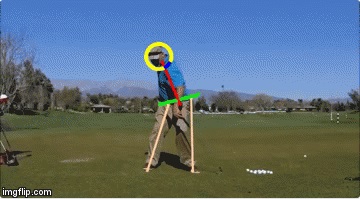
 Another one of these, “when you know, you know” situations I was blogging about last week, when I determined that the three pivots I’ve talked about are essentially the same action but from different setups.
I woke up this morning having done some great work with the progressive pivot exercises to teach the pivot, and I realized that I had come to the end of the road with my golf swing research.
I’ve thought I was finished before, but as long as I was working on pivots and studying the three, I was still researching.
I’m no longer researching – there’s nothing left, and here’s how I know.
When I said that you know you have an optimal motion when you can’t simplify it any further or remove any more parts from it without breaking it, I can also apply that to the “simple pivot exercise” I had devised.
I have further devised how to perform that “simple” exercise by building a progression of motions that begins with simply standing erect.
From there, I can show the first hip and leg move that allow one to establish the setup over the ball, and this is great, because just learning the first motion teaches you how to set up!
From there, you get the initial move of the back pivot just by reversing that first hip and leg motion from getting into the setup.
I won’t go through the entire progression, but by having gone through it myself, I found that there is no simpler way to build a pivot exercise – you can’t simplify the motion and you can’t remove any parts without breaking it.

Looking at the two things now together – the actual swing model and the progressive pivot exercises, they are one and the same.
So, if you swing exactly the way the exercises teach, you have the optimal swing model of both the Classic Golf Swing and the transitional Late Hogan Pivot that’s in my “The Basics of The MCS Golf Swing” video – I have already said that the Post-Modern or Dunaway-type swing model needs its own separate video and nothing I’ve done since then has changed my mind, so that will have to come later.
For now, when it comes to the first two of the three pivot actions, the swing motion matches the pivot exercises, and if you can’t simplify either nor remove any parts from either without breaking them, I really have nothing more to research.
I will always like analysis – how good is this swing, how could it be better or closer to optimal? I love looking at swings and seeing where they could be improved.
As for research – I could spend the next ten years trying and wouldn’t be able to find a way to improve the model through simplification or removal of parts.
The Fosbury Flop in high jump hasn’t been improved upon or changed in decades.

Dick Fosbury innovated the technique and once it was improved by adding arm action to increase takeoff lift in the jumping motion:

… there’s been nothing in the technical action to simplify or remove.
You can perform the jump with no arms, one arm or two arms providing lift, but other than those variations, there’s nothing to change without breaking the model.
With the MCS Golf Swing models, you can pivot with a high heel lift in the leading foot, less heel lift, all the way to no heel lift whatsoever, all performed with mechanical-correctness, all without requiring a twisting lower back, hyper-extension of any joints nor jumping or spinning on the leading heel.
You pivot in a box, you practice the pivot exercises in a box, the weight transfer using the hips and legs provide the pivoting action and the down swing leverage, there’s no lateral motion whatsoever nor any turning action until post-impact, and the exercises actually show and prove this assertion.
It’s all done with the hips and legs, the arms and club go along for the ride, and there’s no way to simplify the motions.
Game, set and match.
It’s been quite a ride.
Now, I need to set another course with this website, but first, there is work ahead with the video and eventually a book.
More to come.
 WAX Golf