
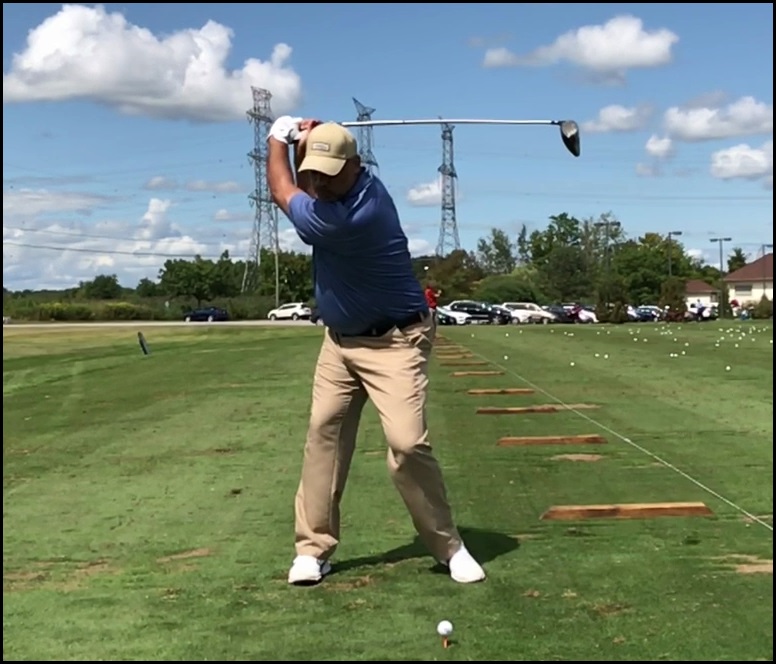
 What I gleaned from having my kids try the Classic Golf Swing pivot is that there is too much motion when people try to pivot.
Whether it’s lateral motion of the head, upper torso or the hips, it’s too much motion, because a mechanically-correct pivot action using the hips and legs should be quiet.
It also involves not “turning” at any point between the start of the back pivot and impact, and if that sounds strange or new, then here is the problem.
This is what I’m keeping in mind as I begin building the pivot exercise sequence that will take one from simply standing and looking straight ahead to the top of the back pivot, and then down to the swing bottom.
When I look at my own swing, the quieter it is, the better it is – there is no extra motion or movement in it, and there is no “turn,” either.
If you look at this swing from the diagonal angle:

… you can see that I am never turning in the back pivot – my head stays in place, aside from a slight lifting of the chin because it was too low in the setup, but I never turn away from the ball – I am facing it from address to impact.
Even that swing to me now has far too much motion in it, because while I was performing a proper pivot, I hadn’t nailed down the principles that I have now that would allow me to make a much cleaner and quieter pivot action.
Same with this swing:
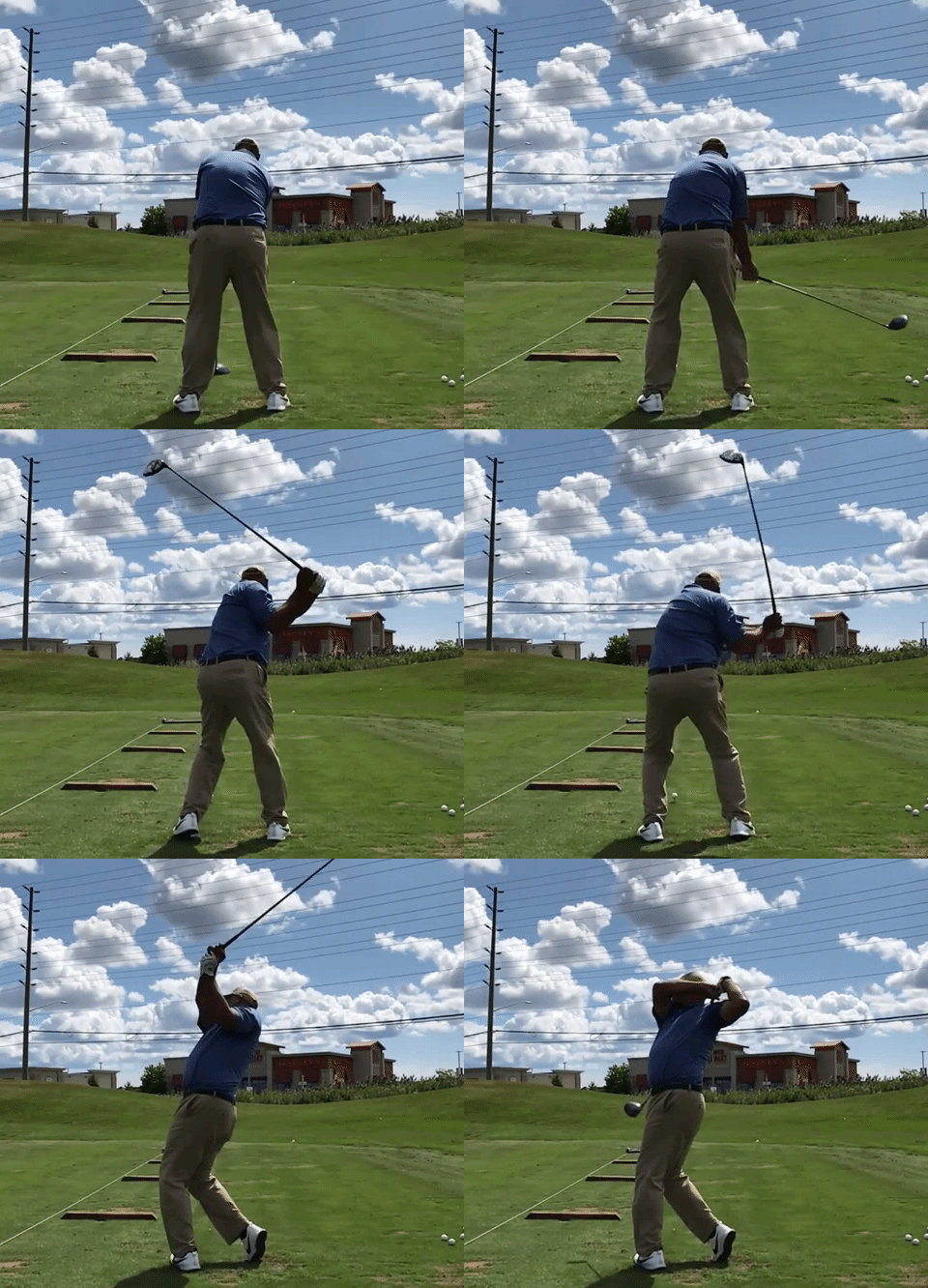
… a couple of years later, I was more proficient in my pivot action as there is virtually no motion of the head in the back pivot and I faced the ball from address to impact, only then turning to the target on the finish.
Better, but still with the left-dominant pull action from the top, which is why my head shifts ever so slightly on the transition – yet even with that, you can see how “quiet” the swing action is, without violence or lateral motion.
It’s as if I’m swinging in a phone booth whose walls allow the arms and club to go through them, but nothing else.
People, even some of the best pros (Rory McIlroy) get caught up in a lateral frame of mind – because they are trying to move the ball on a line from here to there, they feel they need to move off the ball and then back into it, probably a legacy of Ben Hogan’s swing model that will forever pollute the notion of a vertical swing action.
The C7 vertebra, that bony bump at the base of your neck, is the pivot point, and it should be fixed, like the pivot point of the Iron Byron:

Because we hold the club with our hands, attached to our shoulders, many people think that this is where the swing action occurs, but in a mechanically-correct swing action, it isn’t.
You can see the gear action working in that Iron Byron above, but it doesn’t move laterally. It is the same principle with a small difference in the human body – where the machine has gears and a motor to swing the arm holding the club, we have our hips and legs that should be providing the gear and motor action.
By building the stance and setup with the proper ball placement, the action of the hips and legs gear the swing, and you don’t need lateral action to absolutely pound the ball off the tee or zap a laser iron at your target, because the action is vertical:

If you watch my knees in this repeating swing gif., you can see that I was merely transferring pressure from both feet to having more in the right or trailing foot, and then transferring pressure back into the left or leading foot.
Now, if you would, watch my hips, and there you see the gear action caused by the pressure transfers, the hips taking the arms and club with them on the back pivot and down swing.
I finish balanced because I was never out of balance at any time while in motion.
This pivot action provides effortless leverage, as you can see.
Most of the swing occurs before you take the club back – it’s all in the setting up and being balanced over the ball. If you do it properly, the swing and result are a formality.
The swing itself is all in the pivot.
More to come.


DJ – Apologies if you’ve addressed this before – Would you kindly compare your understanding & approach, to the classic “Turn in a Barrel” teaching by Percy Boomer? Glad to see the fire and consistency in your posting again! 👍 🏌️♂️
Hi coach!
Thanks for the kind words 🙂 No need to apologize – I’ve used the phrase “turning the barrel” before in one of my videos, actually, but it had more to do with the torso rotation. I don’t know Percy Boomer, but the analogy isn’t a bad one.
Since I used the phrase back in ’16-’17, I’ve evolved my concept of the pivot – with the Classic Golf Swing pivot, the hips do turn like a barrel, if you observe the hip action on the back pivot – however, the hips shift and then turn on the down swing, so it’s not a pure turning action – I think Percy and I used the same word but for two different concepts.
I hope that helps 🙂
DJ