
 As I’m working through the “MCS – Power Of The Pivot” video for release this month, I am at a point in the swing where I explain how the natural motion of a mechanically-sound golf swing doesn’t require one to “swing left” or to try to pull the club to the inside.
It’s very simple, but the Modern Golf Swing people don’t seem to realize that – they think that Ben Hogan’s “swing left” move was some magical move, when all it was designed to do was let him fade the ball rather than hook it like he was wont to do.
Not only that, I’ve already written about how, if you aren’t going to do everything Hogan did, then you aren’t swinging like him – things such as having the ball in the same spot in the stance from wedge to driver, angling the stance from open with wedge to closed with driver, having a super-weak grip… etc.
It’s like saying, “I’m going to bake a cake the way this chef on TV is doing,” and then proceeding to add eggs like he has, but then adding sand, cologne and axel grease instead of flour, water and butter, and expecting the same cake.
See, Hogan basically over-complicated something and, because he was extremely good at what he did and achieved great success with it, doomed entire generations of current and probably future golfer to chasing smoke.
Here’s the simple and basic geometric and inescapable fact – we swing in an arc, all of us, whether we think we do or don’t – so the club swinging on an arc will come down and out then back up and in, without you having to do anything to make this happen.
The only questions are:
- Am I swinging properly without an over-the-top move and
- Is my ball in the correct position to allow nature to take its course?
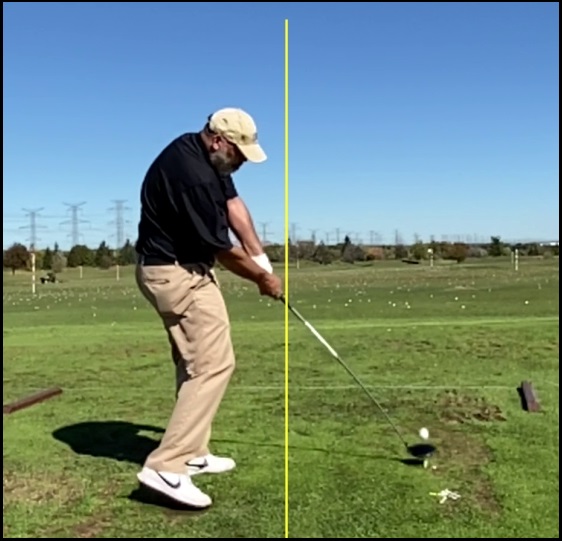
I have talked about hitting drive after drive after drive down the target line when I’m working on my swing, and that’s because I’ve found the correct ball position for me to just swing down and through and let that ball get in the way at the precise place it needs to be:

… and the digital artifact in the slo-mo clip shows you how precisely the club head moves down and out to reach the point where it will then come up and in post-impact:

What you want is to stand square to your target line and simply pivot, then swing down and through and let physics do the work.
That goes for fading and drawing the ball as well – Nicklaus-style, the target line is the line on which you want the ball to start, so you always stand square to that line, and then you close or open the club face in your grip at address so that the ball bends to the place you want it to.
The target line and the target are only on the same line if you’re trying to hit a straight shot. When you’re fading or drawing, the starting line of the ball becomes the target line and where you want the ball to go is your target. So you never have swing trying to push your club out or pull it inside.
Here’s my impact position on a driver swing:
If I’m hitting a straight shot, the club is square at impact. If a draw, it’s slightly closed and the ball will work left to my intended target – for a fade, the face is slightly open and the ball will work right.
But my hands reach terminus with regards to going down and out at impact, after which my hands move in and up.

If I’m swinging correctly, my hands reach that terminus point at impact, and they never cross that vertical line.
It’s the same for irons, which is the beauty of the MCS Golf Swing theory:
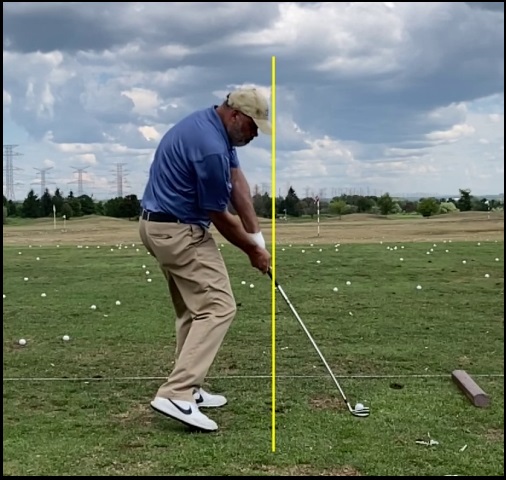
It doesn’t matter the club. Follow my guide on the setup, the pivot action and ball position and you’ll achieve consistency without conscious effort in a way you never thought possible.

I don’t have a perfect swing. Not even close to it. In fact, I would rate any of my swings from my archive as inadequately following the principles of the MCS setup and pivot because I’ve been unable to swing for a year and a half due to a shoulder condition.
I would swing even better than these examples with the work I’ve been doing on the pivot with the exercises I devised this past summer, but they are enough to show what I mean.
If draw this same line on a pro’s swing, you’ll likely see the same thing, but let me ask you a question – how much do they have to practice to get this consistency with the way they swing, compared to my being able to do it even when I only swing once or twice per week and sometimes take extended time off?
That still pic and gif from the launch monitor at the top of this post were from a one of only two sessions I was able to have this past spring before I realized that my shoulder wasn’t sufficiently recovered to swing again, and yet I was still able to do what you should be doing.
It’s not rocket science, just simple athletic physics, and it doesn’t take four hours of hitting balls every day or all day the way Moe Norman and Ben Hogan had to with the way they build their swings.
Keep it simple, keep it correct, and you’ll enjoy not only hitting balls just for the fun of seeing the consistency, but also lower scores on your card.

