
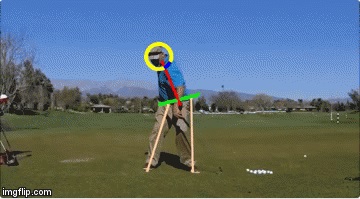
 The thing about the golf swing, as I’ve said previously, is that golf is both a sport and a game.
Meaning, there is a physical and athletic element in it, and then a separate skill-related element that really doesn’t rely on athletic prowess.
Because of the second element, you will get golfers who are very successful at golf even though they aren’t very athletic at all, just as you will find athletes who struggle to play golf in areas outside of athletic ability alone.
It is perhaps for this reason that golf is unique in one regard – you have some of the best golfers in the world (and even one of the greatest all-time in Tiger Woods) who, because their skill in the game overcomes the deficiencies in their mechanical swinging actions, achieve success yet don’t know how to swing a golf club in a mechanically-correct manner.
Literally.
A proper athletic motion doesn’t cause physical injury. I know of only one injury caused even when technique is mechanically-correct, and this is an injury caused by the body being unable to withstand the physical forces it creates.
I’ve seen great sprinters with flawless technique blow out a hamstring or quadriceps muscle because the tissues literally tear under the force created by the runner, and I’ve seen baseball pitchers blow out a shoulder or elbow because of the same thing – mechanically-correct motion that causes injury because of the sheer forces produced by such actions.
No one in golf is ever going to injure themselves in the same manner. Golfers injure themselves when they swing in a mechanically-unsound manner, period. The mechanically-sound action relies more on leverage than muscle strength, and there is nothing in a proper golf swing that will produce forces great enough to cause injury.
What is dangerous in golf is when someone is athletic and strong enough and swings very close to a mechanically-sound manner, enough to generate the force that will cause injury because of the flaws in such technique. Or, when golfers work out to build muscles strong enough to cause injury through improper technique that they wouldn’t incur without all of that built-up strength.
Basically, swinging in an improper way won’t cause injury if one is an accountant or office manager with low strength – take that same swing and have a very strong and athletic person do it, and disaster strikes.
Being strong and athletic will actually be very bad for someone who doesn’t know how swing properly.

Golf, again, is unique because of this. You will find very few if any at all in other sports who make it to the highest level of that sport and don’t have very mechanically-sound technique. You might in baseball, where once again an element of skill can overcome technical imperfection in swinging a bat, but it is nowhere near as egregious as it is with golf.
Additionally, the technique in question is most likely still more or less mechanically-sound, just not optimal, and that’s where you get swing coaches, pitching coaches and running coaches to improve that technique.
In golf, it just gets worse – you have players with unsound techniques being coached by coaches with unsound mechanical models, and instead of improving them, many times they make them worse or lead them to injuries. I know that Tiger Woods was ripping up his left knee since college but never injured his back until he was working with a certain swing coach, and that was game over for him.
This brings us back to my initial journey and mission, and how devising the pivot drills that I came up with this past summer brought me to full understanding of motion regarding the optimal golf swing.
It was very odd when it happened.
I would do the pivot drill swing and then pick up the heavy iron (I had switched from the SwingRite to the Heavy Iron because the SwingRite grip literally disintegrated on me and I have yet to go get it re-gripped, but now I prefer it because it’s heavier and shorter), and when I finally hit the same action, the first thought I would have was, “This is Dunaway’s back pivot action.”

So, where I was saying last year that I had finally been able to prove certain elements of the theory, I was missing one or two pieces for full completion – this brought me the rest of the way in my swing theory journey – I could more of less emulate a pivot like Dunaway’s in my living room but, when I would swing a club, I was missing something.
That something was what the pivot drills gave me – the optimal way of performing the pivot, and the drills not only got me moving in that manner, but serve to ingrain the back pivot motion.
The same thing happened with the drills for the down swing. By practicing the down swing pivot drill, I began to visualize the optimal motion as I performed it, so that any deviation from that motion had me say, “No, that’s not it. Focus now, and do it properly,” and I’d fix it right there.
I would then go from the pivot drills to the Heavy Iron and, without even having to swing it, a regular Driver. I’d just get into the setup with the Driver and know instantly where I had not been hitting it dead on.
The pivot drills reinforced for me the optimal setup and where I was lacking in that area at times – the setup, the posture over the ball, all of it.
I’ve taken a lot of words to get to my simple point – there are infinite ways in which you can swing a golf club, but there is only one optimal way, just as there is only one shortest distance between two points.
If you want to argue about wormholes being an even shorter way, then this is the wrong subject. We’re talking about real life and not theoretical astrophysics.
There are no wormholes in mechanical motions, and there can only be one optimal action, because that is what makes it optimal.
People get upset when I say that there’s only one golf swing. I will amend that statement because it’s inaccurate and is not what I’ve ever meant.
What I’ve always meant is that there is only one optimal golf swing motion.
Jack Nicklaus was so successful with so little effort because he was very close to that optimal model.
Tiger Woods chased Nicklaus’ major achievements and sacrificed everything to that mission, and still came up short while wrecking his body because he wasn’t swinging in a manner close to optimal. It’s that simple.
He was as good if not a better physical athlete, possessed a hundred times more determination than Nicklaus, was as skilled or more in hitting difficult shots, had a better short game…
But in the end, it was the golf swing models he was taught that broke his body and let him down.
The closer to optimal you get, the better you’ll be with less effort. In the arena of the full swing, at least.
So, if you believe that the type of swing you employ in golf doesn’t matter, then you can move on, because this blog isn’t for you.
If you do, then you’ll understand my journey and my determination to not only figure out the optimal golf swing motion, but also to try to save other people grief and injury along the way, as well as helping them to get better and enjoy or gain success in golf.
This is also why, at a certain point, making the pivot drill video morphed into, “This is the optimal pivot action for the golf swing,” and once I reached that point, I had to put the video on hold to deal with everything that this discovery entailed.
It began as a video project to teach people a mechanically-correct swing and ended as helping me prove the optimal golf swing using those same drills.
One journey has ended.
Another one has begun.

