
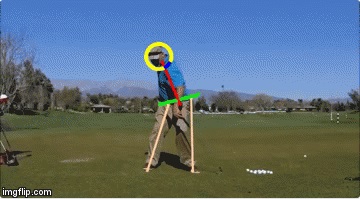
 It may just be a natural progression or evolution of concepts, but I’ve spent a great deal of time over the years talking about the setup with the “Leaning A” stance and the proper ball position.
I have even said that the setup is most of the golf swing – get that right and you’re 90% of the way there, correct?
Now, I have talked about the pivot and the mechanics of the Classic Golf Swing pivot – there is no pivot in the Modern Golf Swing, sorry to say, just lower back twisting and/or reverse-shifting as in the Stack & Tilt type models – and I’ve improvised pivot drills probably since 2015.
I could spend time wishing, as I write in the post title, that I had thought of a progressive series of pivot drills, but the hard truth is that I could only begin to do that after I’d just about finished my swing research, because until every piece of the puzzle was in place, they might not have worked as intended.
Just as I said I’ve changed something in the setup regarding the foot angles – I moved my feet back to the angles I’ve had over the years and immediately notice that the pivot drills wouldn’t work as well as they do with the new angles.
That would be due to the fact that the change I’ve made jibes with the way our lower body joints work – again, when you don’t have an education in kinesiology, things that might be obvious have to be learned through trial and error and constant re-evaluation.
A kinesiology education may not have worked anyway, because whenever I see someone with a degree or PhD working with the golf swing, as I stated earlier, they are trying to square a circle with the Modern Golf Swing models and I wonder how they earned their degrees if they don’t realize the fundamental flaws in MGS setups and mechanics.
I mean, if you go to your family doctor and they grab your big toe and tell you to say “ahhh,” while wiggling said toe – you might wonder how they earned their medical degree.
That, to me, is the equivalent of watching someone with a kinesiology degree talking about Jim Mclean’s “X-Factor” swing model with the lower back twisting… is it a failure of the actual kinesiology program, or the student’s, or both?
Probably both.
Old Foot Angles
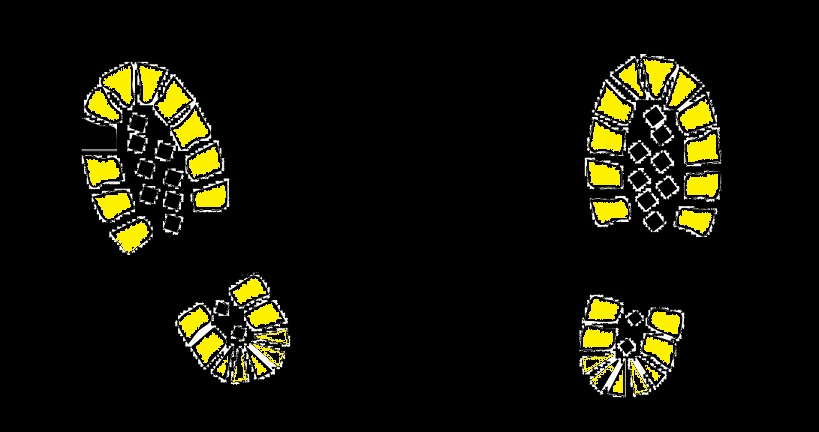
Anyways, I have found yet another little exercise to train the pivot muscles just going back and forth between the old foot angles (they are not bad or wrong, but the new angles are optimal for pivoting), and I can now see why Mindy Blake’s swing model had both feet angled towards the target – which are not my new foot angles, I will add right now.
No, they aren’t both angled towards the target, but Mindy Blake was an Olympic pole-vaulter and his athletic instincts were likely making him try a different foot angle than the above, in order to get the lower body motion he wanted.
The new foot angles actually presented themselves to me – I didn’t think of them. I was working on the pivot exercises and noticed a few days ago that I had changed my foot angles to make the movements easier.
Having noticed that, I thought about things, played with the angles and it was obvious – the optimal foot angles work because you need a certain foot angle for the back pivot, and again for the down swing from the top.
Change the angles and you can still make a very good pivot and down swing, but you all know that I am after the optimal model and I had actually changed the foot angle in the setup before announcing that I had finished my research.

When you see what they are and listen to the explanation, it will also seem like common sense.
The great thing is, like being a concert pianist – you may never play a piece absolutely perfectly, but the closer you get to it, the better you will sound.
In that same regard, having an optimal model with which to work means that, even if you can never absolutely nail the model (for any number of reasons, such as physical constraints), the closer you get to it, the better you will swing.
More to come.

