
 I was talking last week about the 3 pivot actions I’ve isolated, all of them related by having different hip and leg actions because of the subtle differences in setup and balance.
They all feature the “Leaning A” setup but it varies to produce the 3 different pivot types, but the variations are just the 3 major ones in a sequence of pivots from the traditional Classic Golf Swing (the first) to the 3rd, the “adjusted” Mike Dunaway type of pivot.
This isn’t new, but I’m just pointing out the direction the blog is going to be taking with regards to the mission change – this blog began as a journey of swing analysis and the search for the optimal golf swing, and now I will focus on the 3 different pivot types, all three of which can be “optimal.”
How is that, you may ask? Well, I believe that, because we all come to the golf swing with varying degrees of experience, athletic ability and aptitude (I would use Tiger Woods as someone with a high degree of athletic ability and low aptitude for learning a mechanically-sound golf swing), and one of the three models may suit someone over another.
I spent last evening swinging in all three manners, and changing back and forth was a simple matter of adjusting my setup and balance.
First Level – Classic Golf Swing

This one is the easiest mechanically-sound golf swing action to learn, and it’s no coincidence that it was the first one I figured out by studying Nicklaus, Hogan, Snead and others and delving into Hogan’s pivot action.
There is an optimal way to swing in this fashion, and even if you don’t get to optimal (that swing of mine above is not bad, but could be improved, I now know), you can still put a pretty decent swing on the ball.
Jack Nicklaus for example was very close to the optimal Classic Golf Swing and that is why he was such a great swinger. Power, accuracy and consistency. It’s that basic.
Second Level – The “Transition” or Late Hogan Pivot

This pivot type is moving from the Classic Golf Swing and changing the setup and pivot action to produce that low-heel lift on the back pivot even as it still looks very much like your standard Classic Golf Swing.
Again, no coincidence that I didn’t figure out this action before the Classic, but also no coincidence that it was the second one I got nailed down.
Ben Hogan had a great Classic Golf Swing before his car’s near-fatal meeting with a Greyhound bus:
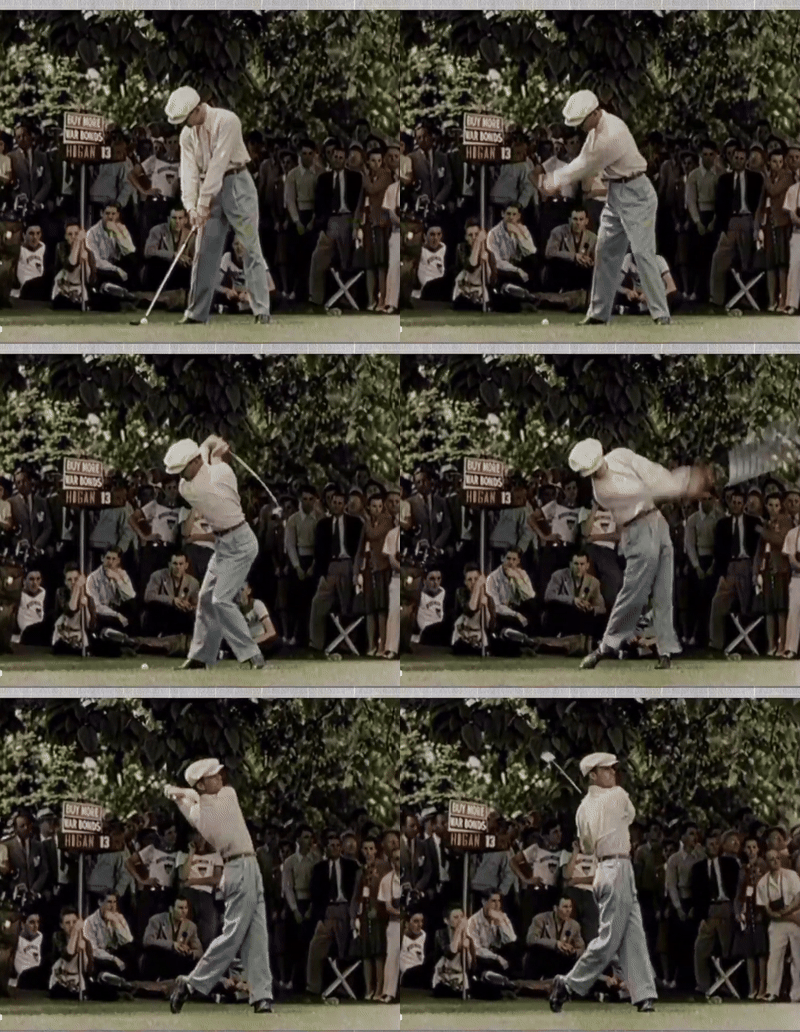
… but had to adjust his pivot action to one more efficient in order to accommodate the loss of mobility in his legs after his recovery, and he moved to that Late Hogan pivot action:

… which unfortunately also gave birth to the horrific Modern Golf Swing, because people misinterpreted both his description of the pivot and because people began to claim that he pivoted with a flat leading heel (obviously, he didn’t with the longer clubs), and the rest is bad history.
Aside – To be perfectly honest, I don’t think his “Five Lessons” is worth reading because, for one, he built so many anti-hook things into his swing that the hapless slicing amateur would not have been able to do anything with his model.
Second, it is now believed by many that the book was ghost-written entirely by Herbert Warren Wind and not co-authored, because there are things in there that run counter to what Hogan actually did, and some of the illustrations aren’t accurate.
That pivot action however, is the one I included in “The Basics Of The MCS Golf Swing”** video because it’s the most advanced pivot I could give everyone at the time I made the video, as I haven’t bee able to swing for a year due to Frozen Shoulder, and it a transition pivot.
**And it’s already available here on the site if this pivot action and swing interest you!
Third Level – The “Adjusted” Mike Dunaway Pivot

There is no swing of mine on video that falls into this category, because I have only just figured it out, but once again, it’s no coincidence that I figured it out very quickly after having nailed the transition Late Hogan pivot.
For now, you’ll have to just look at the unadjusted Mike Dunaway pivot, but let me show an angle that disguised his shifting head and it’ll look basically like this:

I stumbled upon the Late Hogan pivot by accident, having made swings on video with a slightly different setup from what I used for the standard Classic Golf Swing model that I was building.
It took me seeing that diagonal Late Hogan pivot to strike me that a swing of mine from nearly the same angle looked amazingly similar – once I was able to figure out what I’d been doing, moving to the Third Level took literal days and not years or months.
This is the most advanced pivot in this family of Mechanically-Sound Swing actions, and I will be working hard in the next few weeks to get the 3 three swings with the principles that would make them the optimal versions of each.
I will be focusing on the 1st and 3rd Level videos because a version of the transition Late Hogan pivot has already been broken down in my “The Basics of The MCS Golf Swing” video.
Fortunately, since I will be shooting video for all three, it will be much easier to produce the videos featuring these swings. The hardest work will be shooting the swings, and making a video with them will be a breeze.
I usually get a video done within a month of getting the swings on video, and I aim to shorten that process so interested parties can get them this golf season.
More to come.


You write, “I don’t think his “Five Lessons” is worth reading…”
But, he probably was consulted, in some fashing. From the book, “Five Lessons”:
1) Some measures long esteemed are really not important at all.
2) Trying to do a great many difficult things perfectly is neither advisable, nor necessary, nor even possible.
3) Doing things the right way takes a lot less effort that the wrong way does.
4) The goal is one smooth overall movement
5) The main thing is to keep any conscious hand action out of the swing.
Hogan is said to have participated extensively with Wind, going over every word for hours at a time on the phone, Steve. I won’t argue that, as I wasn’t there – I just get the impression from certain parts of it, and I’m not the first person to have suspected, that some of the things in there contradict how he actually swung.
Like his instruction on “turning your shoulders as far as they can go and retarding the hips.” He did no such thing – that’s the X-Factor right there, and Hogan always had a full and free hip turn. That sentence alone jumps out at me as a strange thing for Hogan to have personally said or written.
I mis-typed “fashing”…I meant “fashion.”
Basically, I agree with you about that book. In my review of it, I wrote, “It is possible to cherry-pick Five Lessons—to “prove” untruths as well as truths. When the book was good, it was very good. When it was bad, it was awful.”
“When the book was good, it was very good. When it was bad, it was awful.”
Good description 😂👍🏼
very exciting news!