
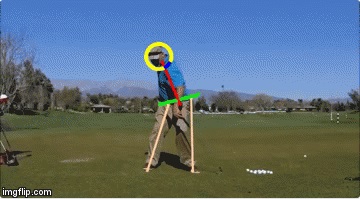
 Whatever one may think of Mike Austin, he got pretty close to figuring out the optimal golf swing model – he didn’t by any means build the “perfect golf swing” model because, as I have written, his swing didn’t even match the model he taught.
Mike Dunaway, with Mike Austin, nearly got there – but the optimal golf swing model wouldn’t have a shifting head, because as we all know, the admonition has been there forever not to let the head move during the swing, so the rightward head shift is something that wouldn’t be in an optimal golf swing.
The great Ben Hogan:

Great pivot, one I’ve called the “perfect pivot” because of its efficiency, but not by any means the perfect swing model or he wouldn’t have had to hit balls all day, every day, in order to hit the target. All of those idiosyncratic things in his swing end the “perfect” conversation before it begins.
Moe Norman, same thing:
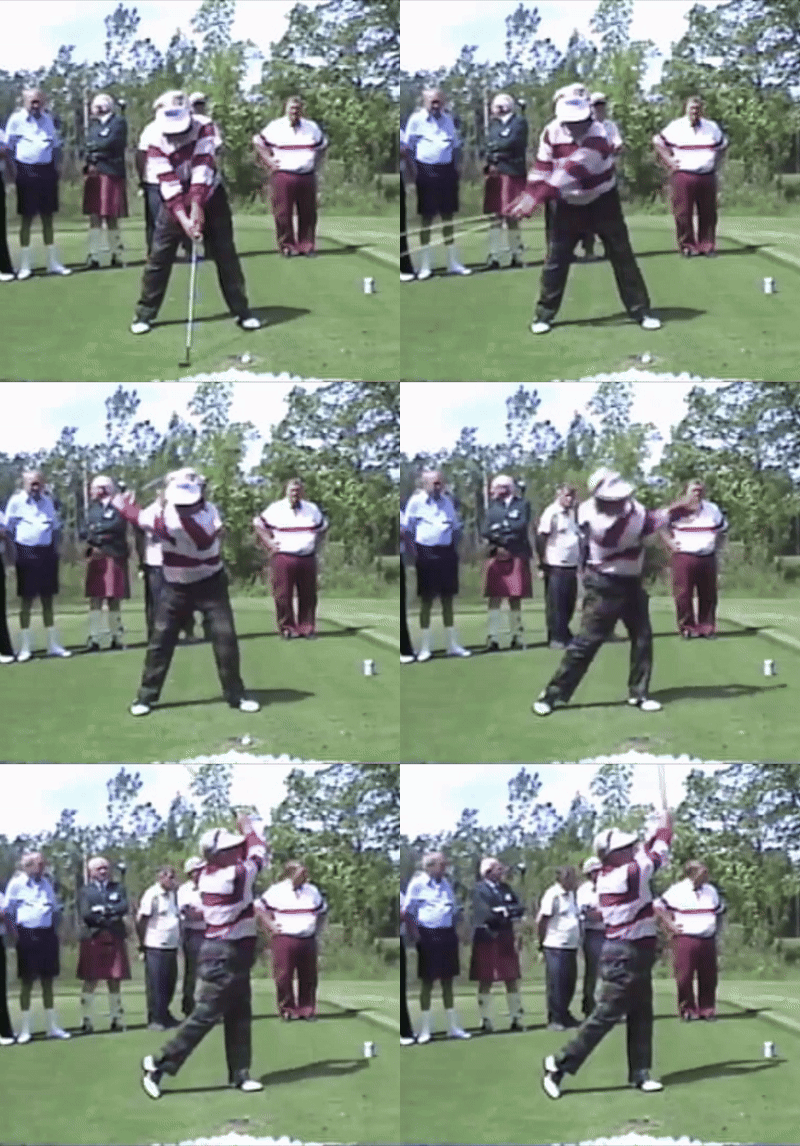
A great ball-striker, but the optimal golf swing model would mean he’d have been much longer-hitting than he was with a half-swing and he wouldn’t have had to hit balls all day, every day to be Moe Norman.
Jack Nicklaus – great swing, great champion, and a setup in “Golf My Way” would be the foundation of the optimal golf swing, but that setup is one he teaches in his book when, as a player, he never actually hit that setup perfectly.
He would have done so in 1963 with a narrow stance:

… but without having actually nailed it, and with the high-heel lift on the back pivot, which was perfectly mechanically-sound but not the optimal and most efficient pivot action, he didn’t get there.
And that’s perfectly fine, because you know what?
They were all golfers- they played golf, they didn’t study or teach the golf swing.
The average golfer, is also excused – it took my twenty years of nonstop thinking about the golf swing to learn what I have learned from watching swings and hitting balls myself – had I the benefit of a kinesiology degree, perhaps it wouldn’t have taken so long.
The average golfer isn’t going to spend twenty years studying the swing, they just want to learn a workable swing, go out there and play golf.
What I’m talking about is all of the swing gurus, analysts and model researchers who, especially the ones who studied and had education in kinesiology (I haven’t, but I know what I would have studied if I were to begin college tomorrow), couldn’t figure out the optimal golf swing.
Don’t tell me it doesn’t matter, either – when someone goes for a golf swing lesson or takes on a swing coach to help them get better as a pro, they aren’t looking for any old swing model – they want the best one they can be taught, correct?
Yet, look how pros are swinging today.
In fact, the longer golf has existed in the modern age (post First World War, I’d say), the further from proper mechanics the swing models have become, until we we’re now here with golfers being taught all sorts of ridiculous moves instead of simple and proper mechanics.
Again, Mike Austin, a man who never played professional golf, who didn’t have the education he claimed to have (kinesiology) and who never gave lessons to any professional golfer of any note and whose most famous student (Mike Dunaway) swung differently from him, is the man I’d now say came closest.
I don’t care about swing politics and camps and favorite golfers – I want the goods, and wherever I find them is where they are.
The closest swing modeler and the closest swinger to optimal, happen to be Mike Austin and Mike Dunaway, and I’m saying after twenty years of swing research and modeling and knowing now what I now know and having re-watched parts of their swing videos.
These two right here:
The Model Maker & The Swinger
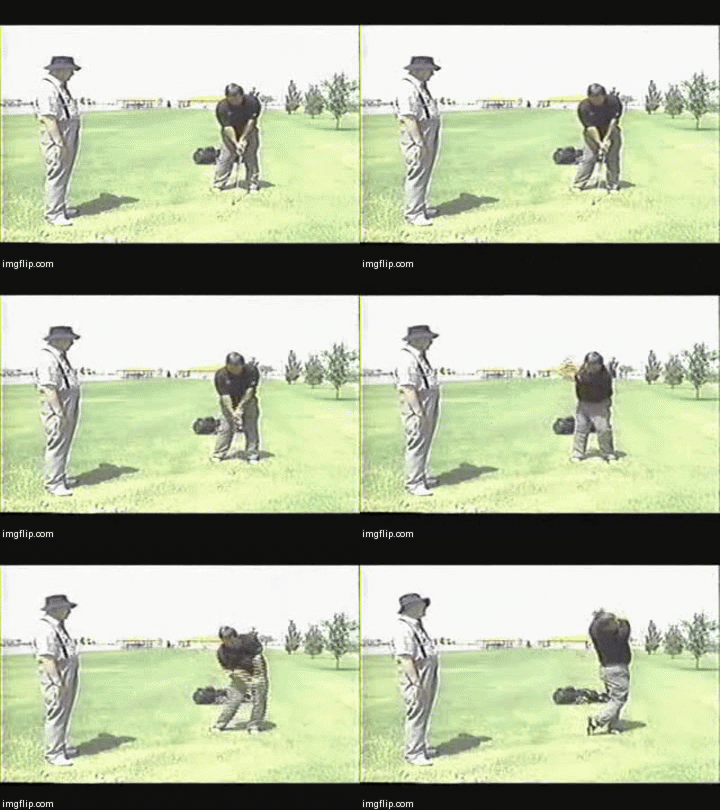
Clarification right here – Dunaway’s and Austin’s golf swings were slightly different but from the same “family,” I’d call it, just as the Late Hogan pivot action is of the same “family” as Dunaway’s pivot action, hence the very low leading heel lift with the full hip turn.
So I’m not saying that Dunaway swung in a completely different way than from what Austin taught, just that you can see at a glance that they had different looking swings with regards to stance width, heel lift and trailing foot action.
And let’s face it – Mike Dunaway’s swing blows Austin away, head to head.
There’s a reason he had a longest drive of 386 yards and had a 6 for 6 round averaging 375 yards, in the 1997 Remax World Long Drive at 42 years of age and suffering from diabetes, competing against men in their 20’s (the winner, Jason Zuback, would have been 27 years old then):
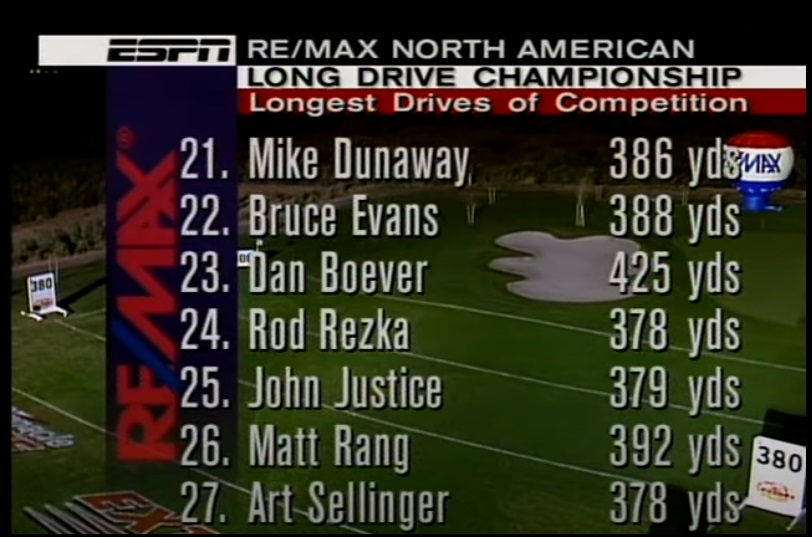
That, my friends, is superhuman swinging. With the same equipment and 10-15 years younger, he’d have blown that field away by some margin, I will guarantee you – he was driving it 350 yards with persimmon drivers and balata balls in his prime, remember.
Dunaway was so long and so accurate in long driving precisely because he only misses one checkmark on my below list of what makes a golf swing optimal, and that means he could only have been better by adding that one checkmark.
What I want to know is how all of these gurus and “experts” on the golf swing probably couldn’t even tell you what the optimal golf swing model entails with regards to setup, pivot and down swing transition, they can only point to this player or that player as having something they like to see in a golf swing.
By optimal – I would mean that you couldn’t improve the motion by changing the model. If you could change even one thing in a model, then it’s not optimal.
By optimal, I mean you take any random individual with some athletic ability and have them swing in varying ways – whichever the individual, you would end up with a swing model with which they performed the best on the average.
Since the greatest swingers had so many similarities in their swing models, we know that an optimal model based on how the human body works exists, just as it does for running or high jumping technique.
What I’ve done is try to build a swing model both in theory and and in practice, using myself as the model, which is terrible, and probably why it took me twenty years, but I’m the only model I have to work with, unfortunately – I have no Mike Dunaway showing up on my doorstep asking me to get him there as he did with Mike Austin.
The closer I got to what I thought was optimal, the less there was to fix, and the last two or three steps are the hardest, but I got there – today, I figured out what the pivot does with any type of leg and hip action with variances in the setup and how to get to that optimal mechanical action:
- The setup and grip,
- The posture and balance,
- The most efficient hip & leg action,
- The proper down swing transition mechanics to ensure
- The optimal impact position,
- All with as a stable head position as possible, that doesn’t shift around
If you get all of that, then you have it – change one thing and it’s still likely a great golf swing, just coming shy of optimality.
It’s not a long drive swing action, either, because that’s just the opposite end of Moe Norman – he was very accurate and straight but woefully lacking in power, whereas the long drive action is powerful but woefully inconsistent and inaccurate.
The optimal golf swing would give you the most power you could generate through leverage and the most consistency and accuracy in a full swing action.
We’re not talking about “perfect,” because we aren’t machines, but optimal, which is the best humanly possible action.
If you asked me yesterday, I’d be pretty sure I know that model.
If you asked me today, I’d tell you that I know what it is.
It’s not this:
MCS – Standard Classic Golf Swing

… and it’s not this below, although it would have been close with the proper grip and swinging right-dominant or neutrally instead of left-dominant:
MCS – The Late Hogan or Shift & Post Pivot Swing

What it is, I haven’t yet captured on video, but I wouldn’t have it at all if I hadn’t been unable to swing for a year and I hadn’t turned my focus back to breaking down swing models.
So, I have to get back into swing shape and, at 56, use myself as the model to show what the optimal golf swing looks like and how it works.
More to come!
 WAX Golf