
 “Pivot Action” or “Golf Swing Model…” take your pick.
I am posting this historical narrative of my swing research journey from 2005 to today, so that late-comers to the blog can refer to this and yesterday’s posting to get up to speed on what my work has been about.
As for the title – it would be very ironic if I have, because I began this journey with the intention of figuring out the “perfect” golf swing if it didn’t already exist – and I thought it already did!
When I vowed to figure out the golf swing back on US Open Saturday back in 2005, I was in the Moe Norman camp for someone having the “perfect” golf swing. So, I spent two years studying and trying to replicate his swing action.
By 2007, I was simply trying to build that perfect golf swing through athletic intuition while also studying the swings of PGA Tour golfers that I would record in tournament events and would study, along with watching episodes of Bobby Jones’ television show (which I watched and recorded from The Golf Channel, when it was still actually worth watching).
I don’t know how many of you were playing and watching golf back then, but I remember reading about a New Zealander named Mindy Blake, who according to some had developed the “perfect” golf swing.

I wasn’t convinced after finding more material on the Kiwi’s swing model, and it seemed more of a “half-swing” model the way Moe Norman’s was when everyone was raving about it.
… so I looked quite a bit into his stuff, but eventually decided his wasn’t it.
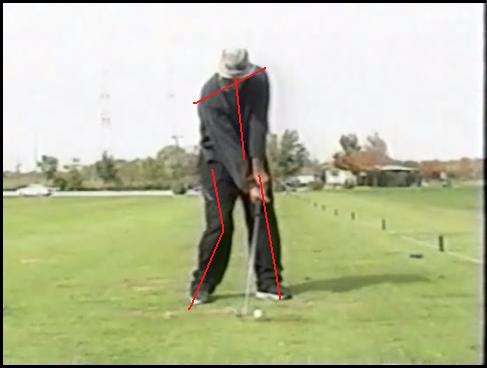
By this time, I had developed that familiar-to-you-all setup aspect with the “kicked-in” trailing leg on one of my trial swing models:
DJ – Autumn 2007
… and man, was I ever so close at the time. I had a “Vertical A” setup so my head wasn’t over the trailing side, and I was swinging with planted feet, but this setup and pivot action was the forefather of what I am currently doing.
If I could get my VHS cassette converted into digital, I have actual swings using a pivot action from this setup that is basically the new pivot I’ve created- perhaps I had created it that year, because I was able to swing flat-footed in the Modern Golf Swing fashion but without twisting the lower back!
You’ll notice I’m gripping the club with a baseball-grip style, but I was trying everything under the sun from the conventional to the ridiculous, thanks to Moe Norman.
I had heard glancing references to Mike Austin around that time, likely due to the now-deleted Guinness Book Of World Records reference to his claimed 515 yard drive, but the only golf swing of his that I could find online (YouTube was only about a year old at the time) was this one:
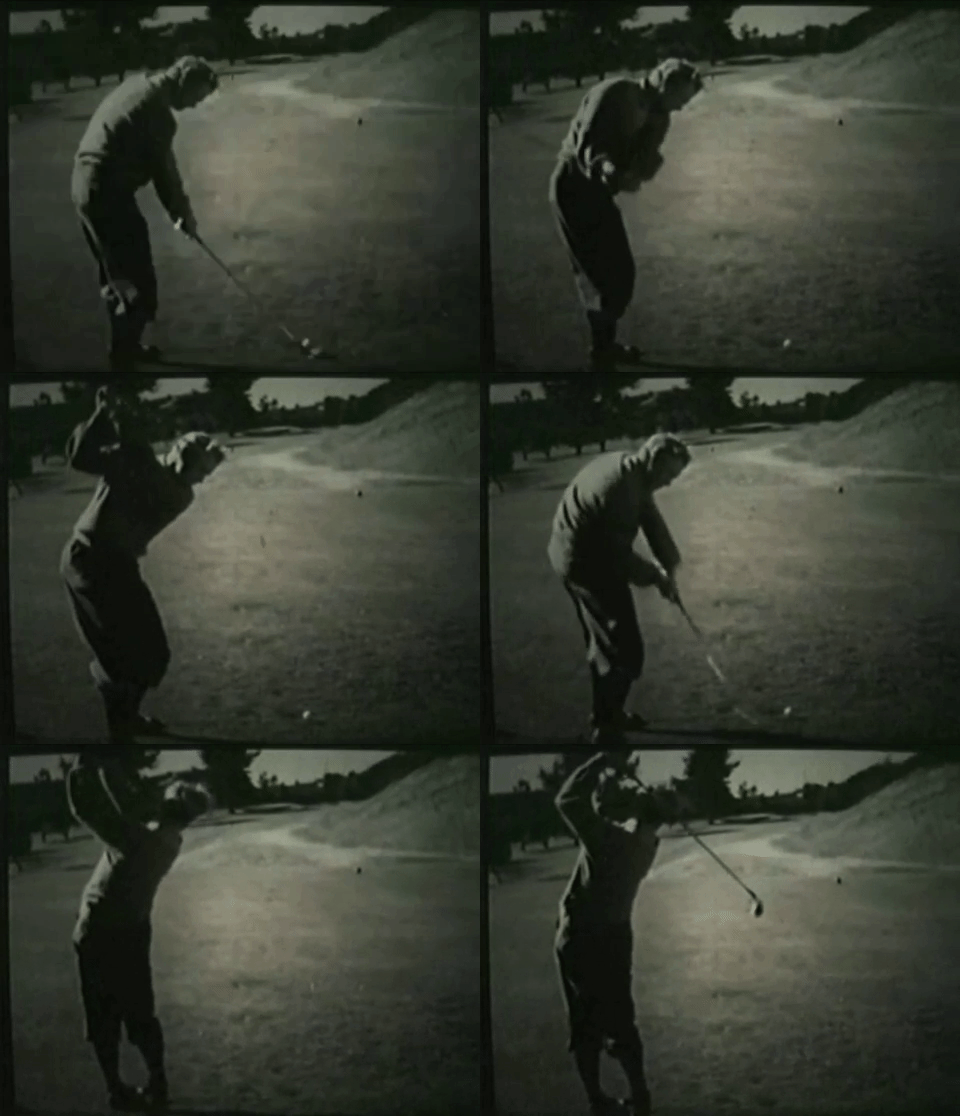
… and it didn’t impress me at the time.
It also looked to me that he was hitting a big pull or pull-fade from his alignment and ball flight – I even remember thinking, “Hmmm, that doesn’t look ‘perfect’ to me,” so I didn’t pay Austin any more attention until around the end of the season of 2009.
Heck, I even recorded and studied the swing of Jack “The Hammer” Hamm, of the Hammer Driver fame (which is non-conforming and thus illegal to use in official golf competition), another long drive fellow whose claims and purported records are fantastic (and largely unproven or hugely hyped), because you can’t say you’ve looked at everything if you haven’t.
Jack “The Hammer” Hamm

I spent 2008 hitting balls and looking at video, and looking at Tour golf swings.
I took 2009 off from the hitting balls with a camera part and just played golf that year, several times per week at the nearby course.
I had a great time hitting huge drives and irons that absolutely floored the retired fellows I mostly played with (I was working nights which gave me ample time to play afternoon rounds after I woke up), and this picture shows the first time I hit a drive of 350 yards – missed the green right but flag-high:

I returned to swing analysis when the season was ending in early November.
That was around the time I was finding more stuff about Mike Austin on YouTube, as a couple of years had passed, and I was intrigued enough to essentially join the online Mike Austin school of golf from then until 2013, at which time I abandoned the effort to replicate his swing action.
The shifting head was the deal breaker for me, and I began to think that a “perfect” mechanical action should be pretty straight-forward and not require ten hours and a doctorate in physiology to explain and understand – but during this time, I had also discovered Mike Dunaway, who actually had concrete and proven long-driving accomplishments.

When I left the Austin school of swing, I also left Dunaway, and my focus after some time (the spring of 2014) happened to land on Ben Hogan, and the rest is history.
I figured out his early pivot action and implemented it into my swing model, and in 2015, I established the “Leaning A” setup to bring the model to where it has been the last decade – a stable head during the pivot and downswing, a Classic Golf Swing hip and leg pivoting action and the slide-release to get into the leading foot.
It might have ended there, but I kept up my swing research because my own personal swing flaws that I either ignored (the too-strong grip) or didn’t notice or even know about (swinging left-dominant because I am cross-dominant, meaning I use my right side for some things like throwing and kicking and my left side for others like eating or shooting a gun or bow) had me thinking that I was missing something in the model due to inconsistencies in my ball striking.
Great thing that I did, too – because I returned to looking at Mike Dunaway’s swing out of boredom during the pandemic lockdowns and finally got around to fixing my grip and left-arm dominance around 2022-23.
Last Year To Today – The Late Hogan Pivot

Fast-forward to today, where I suffered from Frozen Shoulder starting in March of last year, and again out of boredom because I couldn’t hit balls or play, looking at Ben Hogan again and seeing something in his late pivot that I had actually copied back in 2017:

That resulted in the video project “The Basics Of The MCS Golf Swing” demonstrating and explaining how to make that Late Hogan pivot action, and it was after I finished the video project that it struck me – this pivot action was very similar to Mike Dunaway’s in the hip and leg motion!
I determined that Late Hogan and Dunaway had pivots you would put in the same class rather than the standard Classic Golf Swing models – or rather, Dunaway’s was already there and I added the Late Hogan action to it.
That brings us to the swing model I’m currently developing – if it isn’t Jack Nicklaus’ model because I doesn’t pivot the way he did even though the setup is similar, and if it isn’t Ben Hogan’s swing model, because it obviously isn’t, and if it isn’t Mike Dunaway’s swing model because the setup is different and the pivot action is not exactly the same – no shifting to the right on the back pivot – then whose model is it?
The answer would have to be that it’s mine. It shares elements of other swings, it has been influenced by other swingers, mainly the three I’ve just mentioned, but no other swing model has:
- The “Leaning A” setup, with the proper grip and ball positioning,
- A stable head position on the back pivot & down swing to impact,
- Little to no leading heel lift on the back pivot but no twisting of the lower back and
- The most powerful impact position possible
To me, the Late Hogan pivot and the Dunaway pivot are transitions from the Classic Golf Swing pivot to the swing model I’m currently developing, and the reason I’m doing so is because I have need of it.
No other swing model out there gives me what I need in a golf swing, and that is one that includes all four components listed above.
Will it be the mythical “perfect golf swing” of my dreams and two decades’ worth of research?
Who knows?
I would settle for “optimal.”
More to come.

