
 I want to make a point right off the bat that I’m not trying to manipulate the club here the way you see the Modern Golf Swing instructors telling their students to “hold off” the release through impact.
This is why pro golfers with plenty of athleticism don’t have any power – when you “hold off” the release, you have already slowed the natural momentum and speed of the club at the bottom, and so you have lost natural speed and therefor power.
Like this – note, I’ve slowed the post-impact down more to show how the arms and club aren’t releasing, not to try to trick anyone into thinking the club has slowed down to that extent:

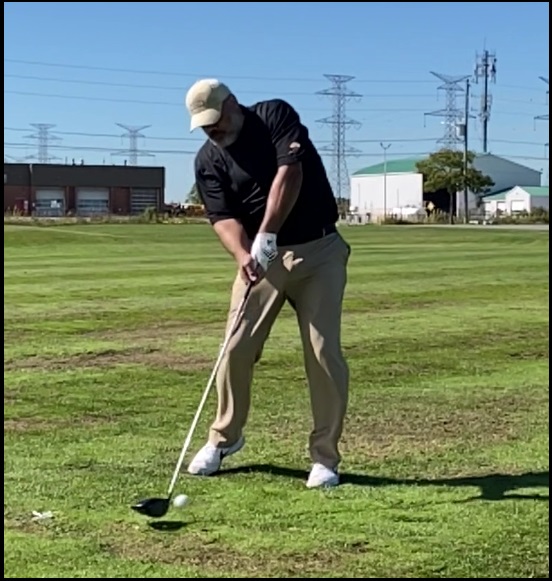
I’m swinging down and through the swing bottom with no attempt to manipulate anything, and a snapshot during a swing is only that fraction of time – there’s no attempt to do anything to make this moment happen other than swinging.
When you do it correctly with the no-turn down swing, you are simply returning to your address position of being square to the target line with the shoulders, because the hips again will be open to the target line:
You can see by the club head’s position relative to the tee that it has already begun to swing inside on the arc post-impact.
My shoulders are still nearly perfectly square to the target line because I’m not turning to the target through impact, merely returning to the address position and letting the momentum of the club and arms swing me around post-impact:

If you think that my hips are still square, they may look so but they aren’t:
… as seen from a diagonal shot of a drive from the same day.
There’s no hold-off, just a swing down and through, letting the address setup, the back pivot and the down swing do all the work.


DJ,
I hope all is well! This reminds me of our conversation a few years back about how important the “Figure 7” is in the golf swing. If you can retain the “Figure 7” without much effort, you are well on your way….
Twirl the club from your C7 in front of you, while maintaining the “Figure 7”, this will keep the club from getting deep and stuck behind you (aka – turning shoulders and hips flat to the plane). Your lower body will react automatically and create both posts (rear then front) so you can sling the club in the downswing. If done correctly, you will keep your tush line back and should start to bump forward to shallow the club without thought before the backswing is completed. This will create good control at impact.
Goose
Hey Goose! Hope you’re well 🙂
The “Figure 7” is very important – the first of the 3 Levers and created by the shoulders and the leading arm. Keep that position (the leading arm in relation to the shoulders) from the top intact to the swing bottom, and you’ll maximize leverage with minimal effort!