
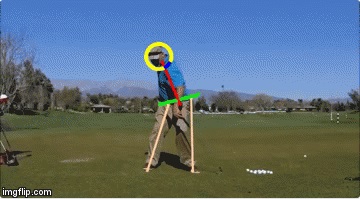
 There are of course a million different ways in which someone can swing a golf club, but the focus on this blog has been on building a mechanically-correct and proper golf swing.
Even here however, as you can see with my exploration on different pivot actions over the years, there are variations you will find in swinging in a mechanically-correct manner.
What is crucial, when building a golf swing, is to maintain the fundamentals of swinging in a mechanically-correct manner.
For me, the ones that come to mind are:
- The pivot having full and free hip motion, as the hips and legs are the engines of a mechanically-correct golf swing,
- A setup that provides for as stable a head position during the back pivot, transition and down swing to the bottom, with proper grip and ball placement in the stance and
- Starting from a balanced position and finishing in a balanced position on the leading foot without compensations such as twisting or flying of that leading foot.
If you can do these things, whatever your swing looks like, you’re swinging in a proper and mechanically-correct manner, in my humble assessment.
Proper golf swings will look similar, but may vary wildly based upon certain things like stance width, balance in the setup and the manner in which the pivot is performed.
If, for example, you are set up in a “Leaning A” position, then you are in position to deliver the above three bullet points.
However, a difference in balance will lead to different-looking swing actions:
- some may feel that they have their weight pressing into the leading foot, others may feel perfectly balanced, and others may feel as though more weight is on the trailing foot,
- some may feel balanced more into the toes over the ball, others balanced on the entire foot, still others more into the heels.
So, I have looked at three different pivot actions that I feel are correct:
- The traditional Classic Golf Swing pivot (young Ben Hogan, Sam Snead, Jack Nicklaus, Tom Weiskopf, etc.) with a high leading heel lift,
- The “Late Hogan” pivot with the low leading heel lift, which is actually a class of the “Shift & Post” pivot action and
- The pure “Shift & Post” pivot action of the Mike Dunaway swing model.
The Traditional Classic Swing

All are correct, with mechanical consideration, and one may be better or optimal for one person, with another being optimal for another, as we are all different people with different physiques, athletic skill levels and personalities.
I couldn’t tell you which would be best for an individual unless I saw them swing and use one or more models, but one will be best or optimal for them, I’m sure.
“Late Hogan” Shift & Post

I personally have swung with both of the first two actions listed above but have been trying to years to nail the third one, the Dunaway swing but one which adheres to the three bullet points – that means being set up in the “Leaning A” position instead of a centered stance with the shifting to the right as Dunaway did.
The Dunaway Shift & Post

You may ask, “how on earth can you say the Late Hogan and Dunaway had the same pivot action when they look so different swinging?”
I would answer, “they didn’t have the same swings, they had the same pivot action that you can see in the hip and leg action – the differences in their looks comes from the differences in their setups and actual swing mechanics.”
I’ve been continuing my shoulder rehab and can now make full back swings with very little discomfort when I’ve got the shoulder warmed up with range of motion exercises and resistance band sets – the pain isn’t from injury, but from weakened muscles after a year of little shoulder mobility and scar tissue that has to be worked out, which is painful.
There may still be some residual inflammation, as Frozen Shoulder takes 12-18 months on average to recover fully, and I’m about 13 months out from the first day I experienced shoulder pain trying to practice swing at home.
The fact that I can move my left arm freely when it’s warmed up and a little tired from the rehabbing however tells me it’s likely the two afore-mentioned factors at work.
That said, now that I can make a few full back pivots per day, I have been “shifting,” pardon the pun, from the “Late Hogan” Shift & Post to the “Leaning A – Dunaway” Shift & Post swing.
I am predicting that, of course, the setup will look different from Dunaway’s (“Leaning A” all the way), and the back pivot slightly because there’s no drift to the right on the pivot, but that the down swing and finish will look very Dunaway.
That’s my prediction, at least – we’ll see as soon as I am back in shape shape and can get some actual swings on video.
More to come.


Hi,
I was curious to inquire how exactly would I know or be able to find out which technique is optimal for me? Does body type factor into it where if your arms or legs are different dimensions that could change things? Also, I was interested to ask how the shift and post can be a better technique in some cases if it involves lateral hip movement in the backswing versus the classic golf swing which does not move laterally in the backswing? It seems like the shift and post might run into some consistency issues because it contains more lateral hip movement. Please excuse my ignorance on any of this and I’m sorry about all of the inquiries. Thanks either way and I love your stuff.
Hi Michael
I would say that all three pivot type are an evolution. The first and easiest pivot method to learn is the traditional Classic Golf Swing pivot with the high-lifting heel, and that’s why it’s the oldest one. Virtually everyone who took up golf could learn that pivot.
Second, the “Late Hogan” pivot is a transition pivot with the Shift & Post action – a little more advanced and thus more difficult to get than the traditional Classic, and the third and most advanced is the pure Shift & Post of Mike Dunaway’s action – how many people have you seen swinging this way besides Dunaway?
I think most people who want to play decent golf, if they aren’t trying to swing in the Modern Golf Swing way, would be to go with the Classic Golf Swing pivot and then move on to the Late Hogan pivot action if they wish.
If I were to teach a child the golf swing, I’d go up the ladder. Start with the traditional Classic, let them get proficient with it, then transition to the Late Hogan. The Dunaway model is something I believe only a real golf swing aficionado would want to learn and perform.
The Dunaway swing pivot isn’t more difficult to physically perform, as it is still a mechanically-correct motion – just more difficult to grasp and execute. I have just begun practice swinging again and I love the adjusted model using the MCS setup. I’ll never swing exactly like Dunaway because of the inconsistency you introduce with a shifting head – if you can swing without the lateral shift (that includes Hogan’s shifting off and back into the ball), why on earth have the shift?
Just my two cents on the three pivots.
Okay nice, thanks for responding and for your insight. I appreciate it greatly. If I’m understanding your take correctly, you’re saying that the optimal technique would be to implement the shift and post while maintaining the neutral setup and swinging in the box that you discussed last year? Is this correct? Thanks again.
That would be correct and you’re welcome, Michael – for the first two pivot actions.
The Dunaway swing model, I’m still breaking down and looking at, so I hesitate to say anything about it right now other than in general terms.