
 Between doing more rehab on the shoulder and the pivot action upon which I’ve been working, I may be trying a swing session on Friday.
I’ve been extra-careful in making sure the shoulder muscles are strong enough to withstand the forces generated by full swinging, and since I’m able to swing the Momentus Heavy Iron now with full swings, I believe it’s time to test out the Post-Modern Golf Swing model.
As I’ve said before, I consider the Late Hogan pivot action to be the transitional pivot action from the traditional Classic Golf Swing and the Post-Modern Golf Swing models.
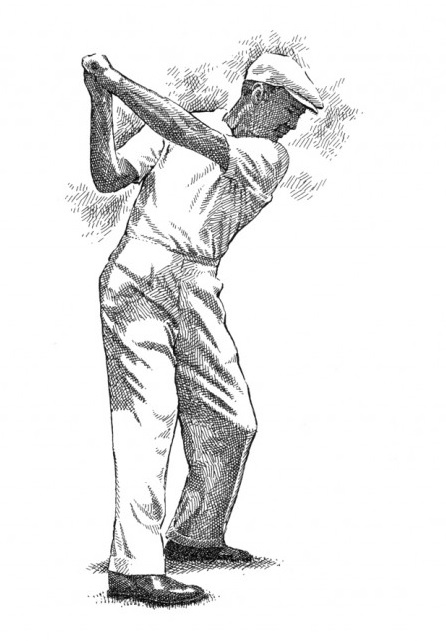
That was reinforced today as I was making my swings – now that I’ve figured out the precise action to get the full “post” position into the trailing or right leg, when I get to the top of the back pivot, I feel like how that Ben Hogan illustration from his “Five Lessons” book looks:
Not in the above-the-waist position, because I will never have that flat an arm angle, but in the hip, leg and foot area.
The funny thing is, Hogan’s top position never looked like that in real life – perhaps it was what he felt was ideal, but in his actual swing, he always had the separation leading heel, so he looked more like his “before” picture than the “after” illustration:
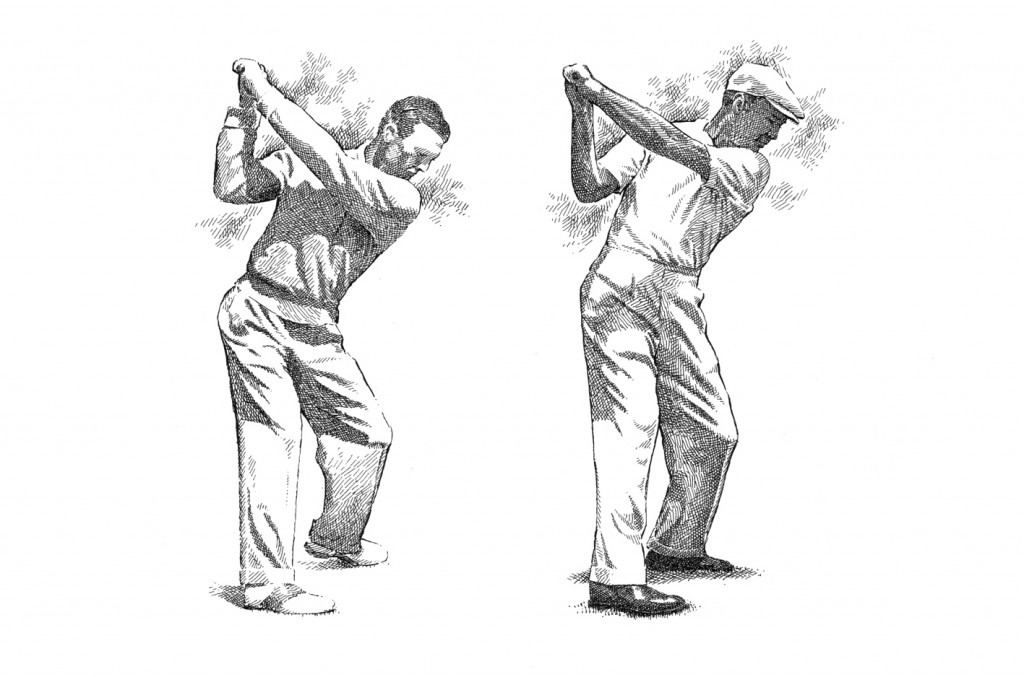
That “before” picture is actually the Late Hogan pivot, and I don’t have to prove it by doing anything more than showing his top position from a similar angle:
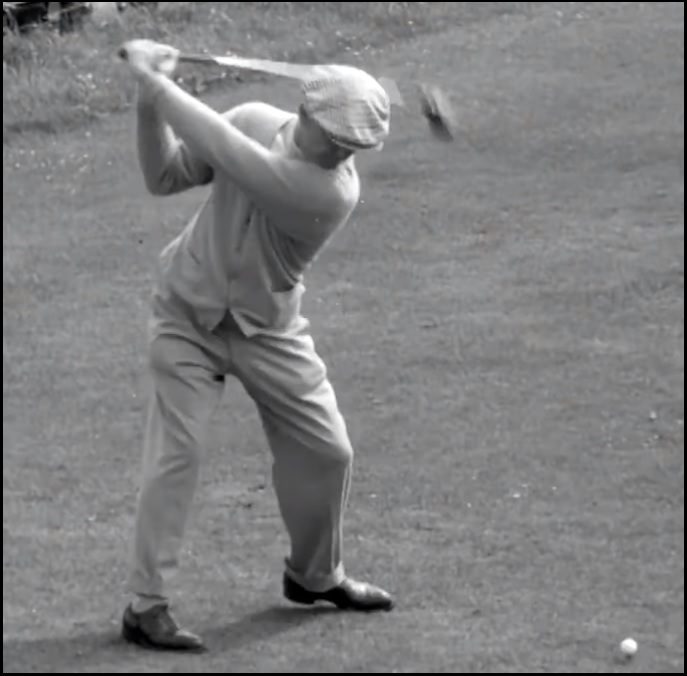
We all know that the “before” of Hogan’s pivot action had a higher heel lift:
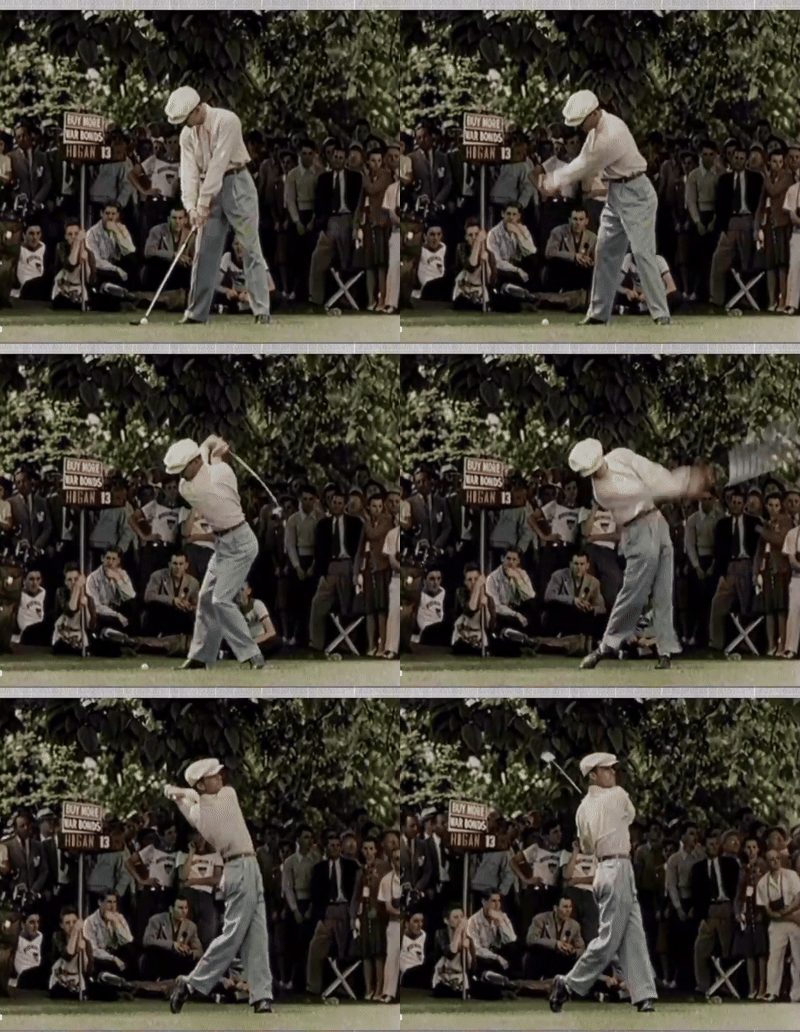
… and he reduced that heel lift with the transition to what I call the “Late Hogan” pivot (post-accident and in the 1950s).
Dunaway’s Shift & Post
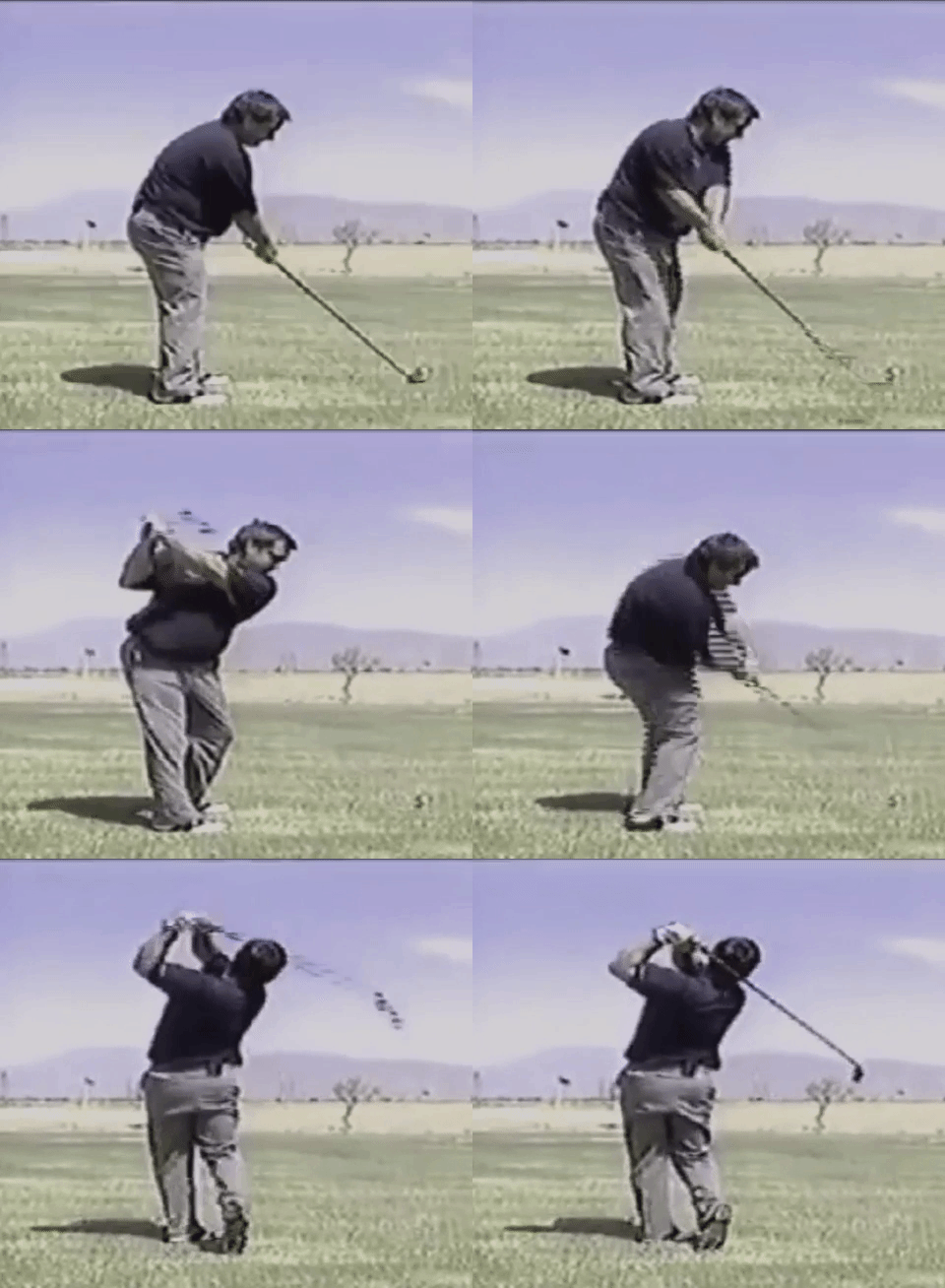
So, if you take out the head shift by watching Mike Dunaway swing down the line, I wonder how close to his pivot action my model will look, because Dunaway was truly the only person I’ve ever seen swing with the pure “shift and post” pivot action while still having his leading heel flat on the ground.
It’s not even that one has to try to keep that leading heel down – it simply works in a way that one can get full hip and shoulder turn without having to lift the heel or hyper-twist the lower back.
So, I have to tell you all, this model would have to be the perfect swing model, or the optimal one, mechanically, according to how the human body is constructed and moves.
It’s not that my own swing would be perfect with this model, as there’s no such thing to perfection when talking about people, but in breaking this swing action down, I can’t see how else you would improve the action by changing anything.
I will know pretty soon how I look swinging with this model, and I can’t wait – just to be swinging again!!
More to come.


Those swings of Hogan and Dunaway are works of art. Can’t wait to see the latest rendition of the Watts masterpiece when the shoulder is ready.
Couldn’t have said it better myself, Chief 🙂
This material is very powerful stuff if one is able to actualize it and get it working for them. This is obviously not an easy thing to do as you have been doing this teaching for many years and Ben Hogan much longer and yet few experience how this execution of swing mechanics will unleash a potential that practitioners will experience results that they did not know existed in them or even thought possible for them.
You took the words out of my mouth, Chief – this is precisely why I have the three models in progression from easiest to most difficult in technical terms.
1. The Classic Golf Swing – the easiest model to learn and master, which should be the beginning model for anyone new to the game or coming over from having been taught the Modern Golf Swing nonsense.
2. The Late Hogan or Shift & Post model – I wouldn’t want to try to go from the traditional Classic to trying to learn Dunaway’s pivot and swing. This is the transition model and is why I made this pivot the focus of the latest video.
3. The Post-Modern model – the third and last model, which I have only just now figured out, after 15 years of looking at it and having all of the Austin and Dunaway videos for most of that time.
And as you say, IF one can grasp and master either of the second or third models with regards to the pivot (and I hope to have succeeded in presenting the second one in “Basics”), one will unlock potential that could only be dreamt about. 👍🏼😊