
 If my Late Hogan or Transition Pivot and Post-Modern Swing people will bear with me for a few weeks, I am going to be focusing my posting primarily on the topic of the upcoming video on the first of the three pivot models in MCS – that is the Classic Golf Swing model.
I went back to look at my posting history from before the Frozen Shoulder injury, going past the point where I was branching off from the Classic Golf Swing model in search of the Dunaway-esqe Shift & Post action, and I found a nice post from December ’23.
It illustrates what I had figured out with regards to refining the Classic Golf Swing before I shifted gears to another model, and the principles are as relevant now as then.
For example, as I was going over the model after warming up with the shoulder rehab exercises, I was struck by how “quiet” the swing action can be with the proper setup and pivot action.
As I said, I’ve developed an easy exercise to train the body to pivot with the optimal mechanical action and you can actually work from the exercise up to the full swing using the same exercise principles, and I re-discovered the “Leading Foot Stomp” action which triggers the down swing leverage action from the top.
I had gone away from this action as I worked on models with low or no lifting leading heel whatsoever (The Late Hogan and Post-Modern pivot actions), because they don’t use this concept – you can’t really “stomp” anything with a very low or flat heel, can you?
Well, the Classic Golf Swing model provides a higher lifting leading heel (not a bad thing by any means), and I had this to say back in December ’23:
As you can see, there’s a big leg action here, some would say quite a bit of leg action for an iron swing, but you see the club is at parallel which means a regular length back swing but tremendous stored energy in that position with the leading leg where it is.
From there, a simple “step into it” move with the weight shift, a move I used to call the “Left (or Leading) Foot Stomp,” and you can gear the power up and down with control of how aggressive that step into the down swing you make it.
Right now, I am happy to say that, based on my work on the other two models, I was able to very quickly find an optimal pivot action that maximizes the leverage provided by the leading leg from the top of the back pivot.
It uses the dropping of the leading heel back to the ground as the transition begins, to trigger a very aggressive levering action (and by aggressive, I don’t mean unstable or violent, just very fast) that gets you down into impact with great speed generation.
The best thing is, you can use this concept even in the pivot exercise I’ve devised, and you will be able to vary your distances with clubs – easy, medium, full effort swings that look basically the same, perhaps with the difference of the speed that the hands and arms drop.
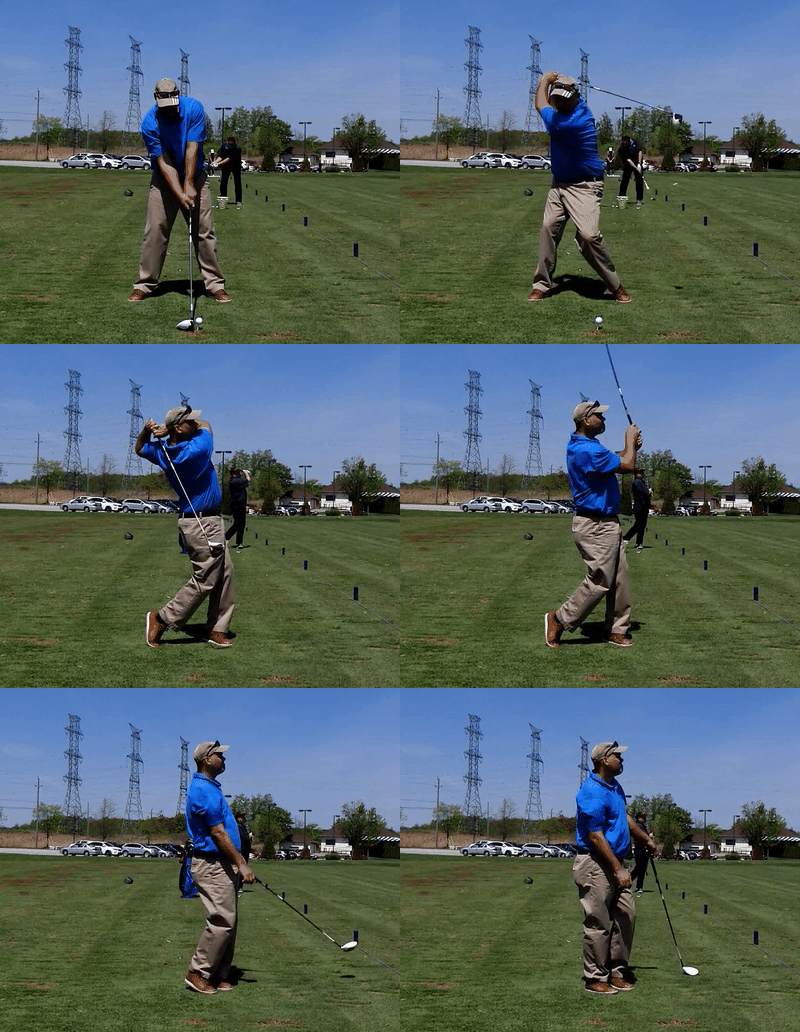
Because it uses the legs, you won’t feel as though you’re straining to make a full swing, because the work is performed by the kinetic chain formed by the leading leg and hip through the leading arm and the hands.
When you use that leveraging action and add to it the extending of the trailing arm, we’re talking about effortless power production such as I did back in 2015 when I essentially hit the right setup and leg action in building my model:

If you look at my knees during the swing sequence, you see that it’s a simple “rocking chair” sort of action from the back pivot to down swing into impact and the follow-through.
If you are transitioning from the Modern Golf Swing or want to improve your Classic Golf Swing and you want this simple, powerful action, the swing exercise will show you how to do it, and I am betting most will pick it up the first day they try it.
When you look at the “ringing the bell” action that Mike Dunaway taught but didn’t do himself (his hips didn’t shift from center to the right and then back to the left with his head remaining centered in place, like a ringing bell), this is more of a “rocking the chair” leg action that creates the hip rotation on the back pivot, with the hips then shifting to the target on the transition using the “Leading Foot Stomp” action – all while the head remains in place in its setup location.

I can promise you one thing – the more you rely on your legs and the less on lower back twisting or arms and hands to generate speed, the more effortless power you’ll produce – you don’t feel much effort when shifting from one foot to the other, do you?
More to come.
 WAX Golf