
 There’s nothing wrong with helping people improve their golf swings.
It is a tad disingenuous however in my opinion to present old and established mechanics principles as new and a result of “the advent of new technologies in the sport,” which is an exact sentence from the article I just read.
Or worse – it means that these basic principles aren’t being taught to beginning golfers.
The article in question is from Golf.com’s Zephyr Melton who brings us 3 Good Things Every Good Golf Swing Has In Common According To Data, in which he says:
Sportsbox AI — a state-of-the art app which analyzes swing videos and spits out hundreds of datapoints about your body movements — is one such tool that can be used to do just this. And in a recent Instagram post, they shared three key movements for solid ball striking with your irons.
“This should be interesting,” said I, as I love anything in new technology that brings us fresh with regards to swing mechanics, but I was quickly disappointed.
The first “discovery” for irons (and wedges and metal-woods, I might add), is – are you ready for this?
1. Forward shaft lean – When you don’t get forward shaft lean, you’re just asking for poor contact. Most of the time, this shows up in chunks and thins, but even if you hit the ball on the face, you won’t get the same power as you would when hitting with forward shaft lean. Instead, you’ll add loft and “scoop” the ball off the ground, which robs you of power.
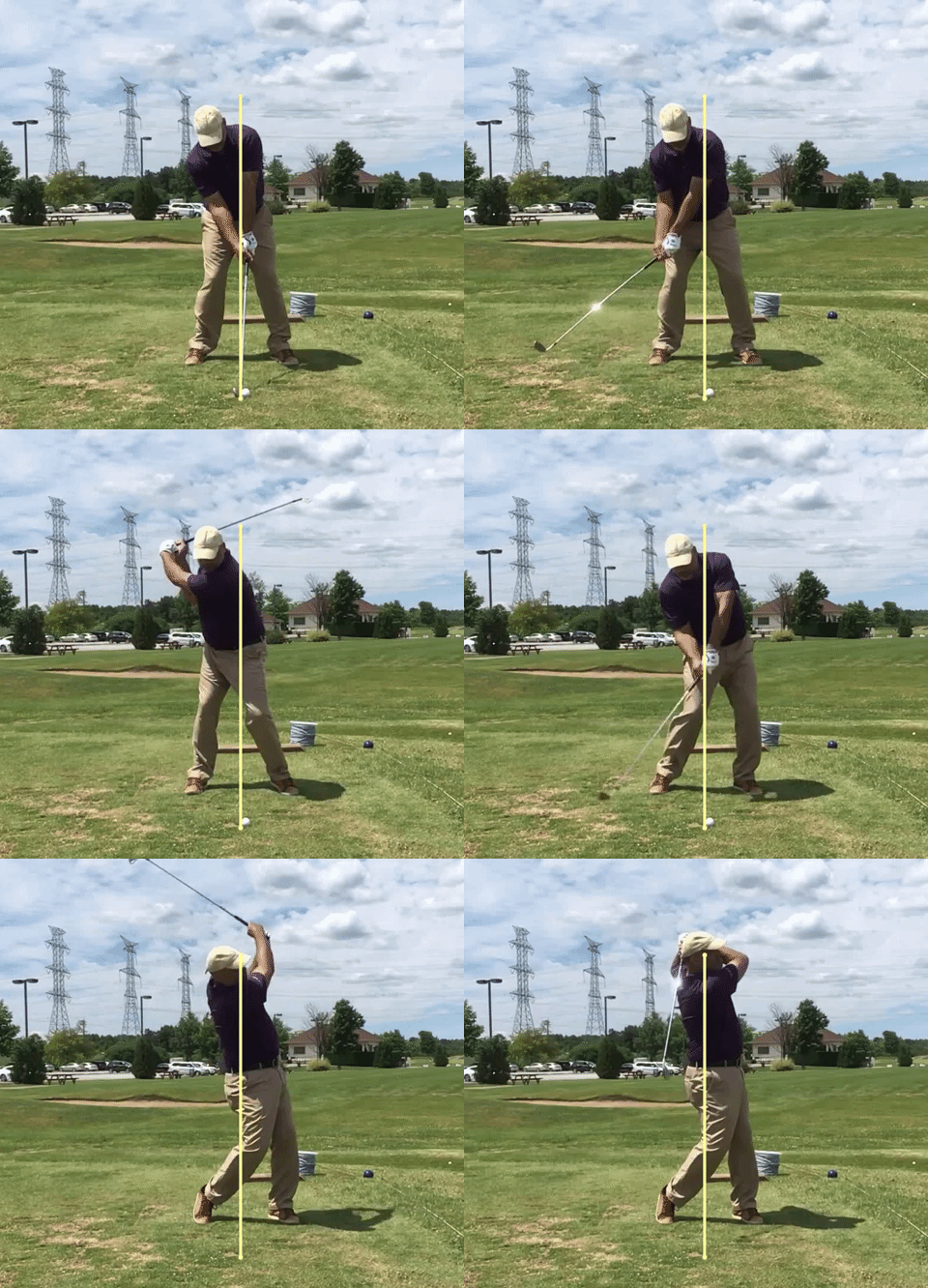
I’m sorry, and I hate to burst this bubble, but forward shaft lean has been part of golf instruction for hitting one’s clubs other than Driver and perhaps 3-wood since the days of Bobby Jones.
There is absolutely nothing new in this, as no one has ever in my knowledge advocated for trying to hit balls with irons with a backward shaft lean.
No one.
Ever.
The whole point of impacting the ball with a forward shaft lean is to compress the ball and impart back spin on it with the lofted face.
So, if you needed this new technology to tell you that, you’ve wasted any money you paid for golf instruction, as this is the foundational element of solid iron ball-striking.
Here is a Gif. I created years ago to illustrate that the setup and impact with the irons should be with a forward-leaning shaft, even with the longer irons as I’m swinging a 5 iron below:
Moving on:
2. Hips toward the target – You want to make sure your lead hip is closer to the target at impact than it was at address. This is a move that is seen in 100 percent of Tour players swings, according to Sportsbox AI data.
Another very basic element of any swing, whether irons or Driver – how many times have I railed against the “Flying Foot Syndrome” because it shows that the body’s weight is not into the leading foot, which is the way you automatically ensure proper hip action?
I even created this Gif. years ago (2018) to show where the hips are at address compared to impact, and it doesn’t matter that this is with the driver, because it applies to all full swings:
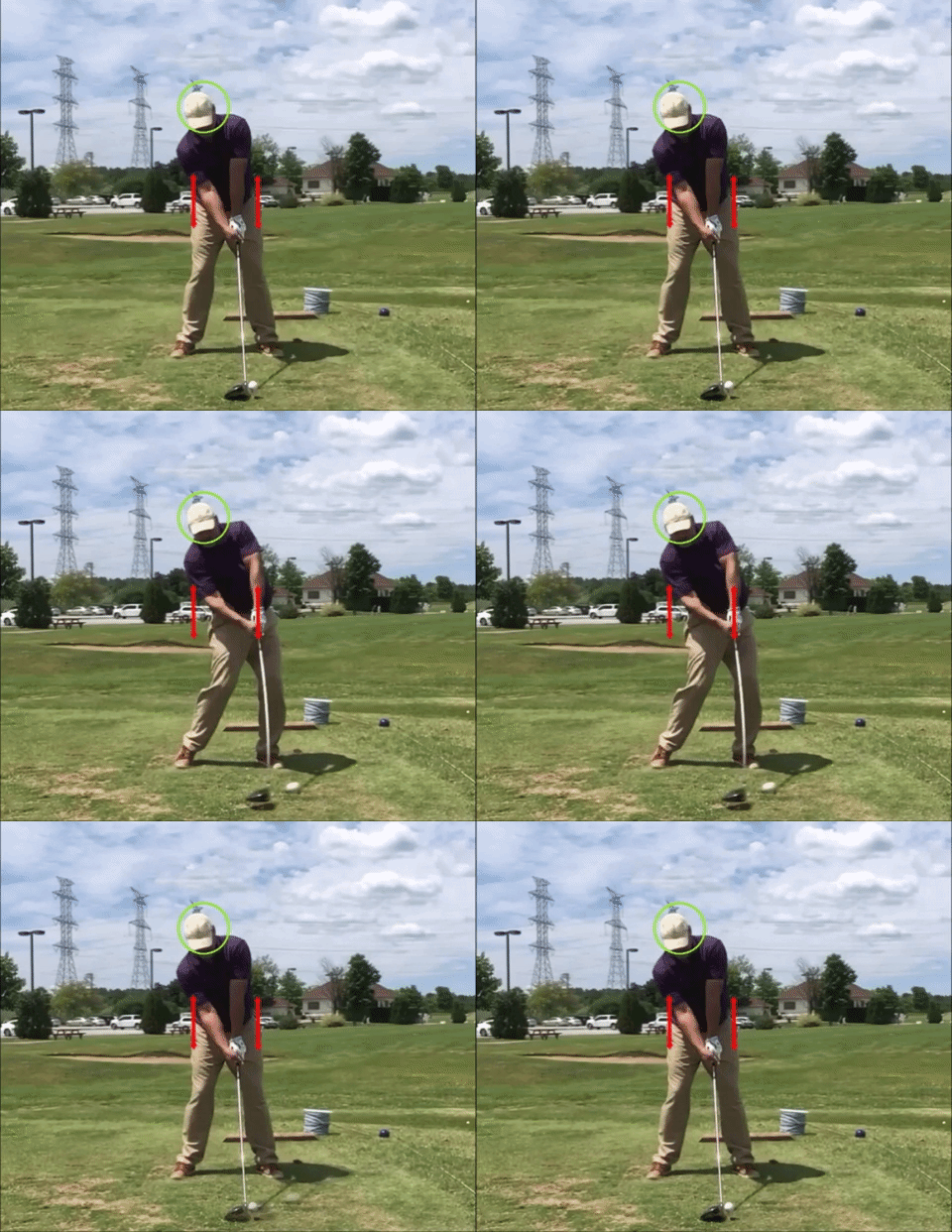
Clearly, the hips are closer to the target at impact than at address, so there is nothing new here, and certainly nothing that requires AI to divine. It is, simply, proper swing mechanics.
Not going very well, here – let’s take a look at the third offering and see if there is something new:
3. Pelvis turn greater than chest turn – The last must for solid iron strikes is to have your pelvis turned more than your chest at impact. This move is also seen in 100 percent of Tour players, according to Sportsbox AI data.
“OK… Let’s Stay Calm, Here…”
It continues:
If you can get you hips more open than your chest, though, you’ll be able to deliver the clubhead from a better place and hit more consistently solid shots.
I can guarantee you that there will never see a pro golfer whose swing doesn’t follow this principle, because once again, it is Beginner Golf Swing 101, or should be.
I have removed the posting from October 16th of 2024 because I am tidying up the blog and remove postings as I see fit (sometimes I re-post them), but a WAX Golf citizen Neil James Massa asked me in a comment on that posting:
… This might be a question you’ve answered many times before but at impact should the shoulders & the hips both be parallel to the target/toe line?
My response, with the accompanying picture, was:
To answer that question, it’s a yes and no.
Yes, the shoulders ideally are square to the target at address and impact, ensuring a proper out-square-in arc in the club path. And No, the hips are slightly opened at address and are more open to the target at impact. The hips are what provide the leverage and the legs turn the hips.
The Classic Golf Swing, as I have maintained for years, is the optimal way of swinging a golf club because its power and leverage are derived entirely from the free and full action of the hips and legs.
The hips turning toward the target – that action leverages everything.
I have preached forever that the simple action of returning the weight to the leading foot from the top of the back pivot automatically and without conscious effort leverages the arms and club down from the top to impact and through.
As I have lamented since early in my golf swing research, the Modern Golf Swing has lost so much of the fundamental knowledge of swing mechanics.
I’m seeing now that even these basic principles above have to be presented as “new” and as the product of “AI” because, how else does one excuse the inexcusable – the failure to teach these fundamentals in early golf instruction by every single instructor out there?
This is simple kinesiology, my friends.
But WAX Nation already knows that!
 WAX Golf