
 This is my latest line of inquiry.
It may seem counterintuitive, but that is actually true – a shorter back swing with a flatter top position CAN mean increased power translating into club head impact speed because of simple physics.
We tend to think that a longer back swing with the club going past parallel is the best way to increase club speed, but that isn’t always what happens.
I wondered for years how Mike Dunaway was able to create the awesome power and club speed that he did, with such a short-looking golf swing.

That gif. above is taken from the Peace River golf swing video at the end of which, he was hitting balls to a 375 yard green, many of which ran to or even landed on it, and he said he would have hit more greens except he was tired from shooting the video all day.
The thing is, when I look at this particular swing action of Dunaway’s compared to his others, I can actually visualize the Iron Byron in action:

So, how does such a normal-looking swing action produce such power? Aside from the swinger being a powerful man, that is – Dunaway was only 5’11” but played college football before an injury forced him out of the game, so he was plenty strong, but still…
How did he get some much out of that swing?
You only have to look to judo for the answer when talking about leverage:

Watch the man above performing the throw – he moves into the subject so that their hips are touching, and then he performs the throw.
Why wouldn’t he just do it standing a foot away from the subject?
Obviously, because he gets more leverage the closer he is to the subject, and when they are actually touching is where maximum leverage is generated.
That would also apply to the angle of the throw – the thrower is using a straight-line technique to throw the subject in the same direction as his turning motion – were he to try to throw the subject on a different angle from the turn, it wouldn’t be as powerful.
This is stuff we kind of learn intuitively when performing actions that require leverage, but when we take up golf, we rely on instructors to show us how to do it, and if the instruction isn’t up to snuff, then we are at a disadvantage.
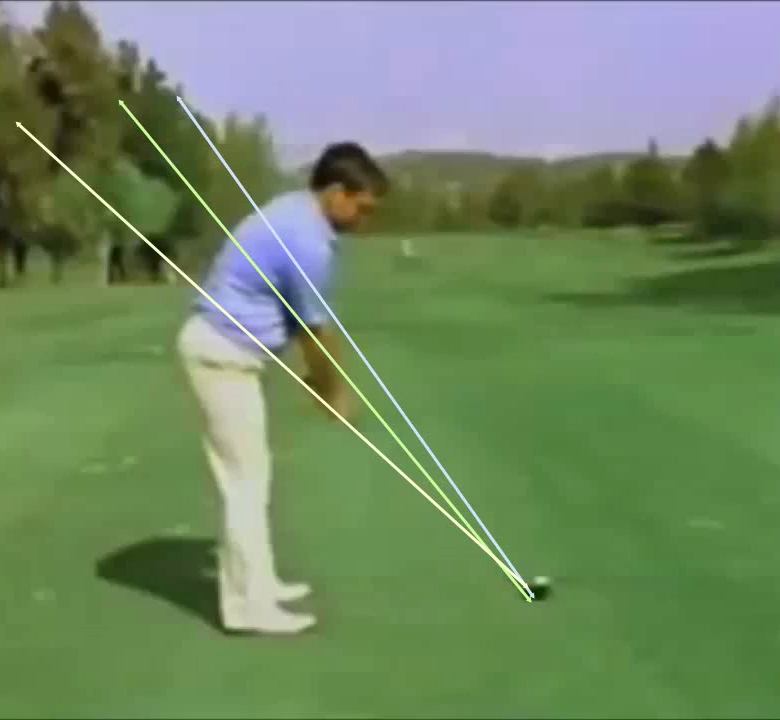
As soon as we understand or remember what we forgot about the principles of leverage, it immediately becomes clear that the most leverage you will generate in a golf swing will be when you can keep everything from the club head to the hands to the arms on a consistent plane coming down from the top.
That consistent plane is where the real rubber meets the road.
Doing things like jacking the hands up high, or collapsing the wrists to create a greater angle of shaft to arms at the top, all of the things like that may look like they would increase club head speed because the club head has a greater distance to travel from the transition to impact – a greater distance means more time to accelerate, no?

That top line is the plane of Dunaway’s leading arm at the top – doing anything like hiking his hands to take his arm above that line, and or collapsing his wrists to get the club head farther from the ball, wouldn’t have increased his impact speed.
It actually would likely have affected both his speed and consistency.
So, the things we think may increase speed or leverage make perfect sense at first, until you realize that none of these things are increasing the levers in use!
The arms don’t get longer, the club shaft doesn’t get longer – all one is doing is forcing the arms and club shaft out of that simple and most efficient plane in order get the club head a greater distance from the ball at the top.
The Iron Byron has only three ways of increasing club impact speed:
- using a longer club shaft with the same rotation speed of the arm assembly will increase the club speed as a longer shaft means the head travels a greater distance in the same time,
- increasing the rotation speed of the arm assembly, which increases the club head speed automatically or
- both of the above.
Nowhere up there does the option arise of twisting the arm assembly or manipulating the hinge to get the club head farther from the ball at the top, does it?
No, because that would throw the machine seriously out of balance, as when your tires need balancing and make your entire vehicle vibrate at or above a certain speed.
Creating a “longer” back swing top position doesn’t work because you aren’t increasing your shaft length or arm length – all you’re doing is moving out of the efficient plane that will maximize your leverage and therefore acceleration and club impact speed.
It may actually decrease your club head speed from what you get with the optimal plane.
The only way to increase your club head speed is to increase your shoulder turn (the very purpose of a proper pivot action), to have a faster down swing action with the hips and legs or to increase the length or your shaft, or all of the above.
 WAX Golf
Man, you are pounding it lately ! Great blog post. This piece was super important. Unless you can practice like Payne Stewart, or you have the amazing athleticism of John Daly, a shorter backswing is perfect. Another great player with a shorter backswing was George Knudson. Talk about accurate.
Cheers, AK – good point about Daly, and goes for long drivers as well.
There is a way to swing with a super-long back swing, but it requires great athleticism, for one, a lot of time to groove it and you will always sacrifice accuracy and consistency for greater distance.
Most people don’t know that Daly spent his youth on a range deck finding and grooving that extra-long back swing. Sure, he doesn’t practice much now, but that swing action was set in stone decades ago through diligent work.
He’s a notable exception and certainly not one to try to emulate.
And PS – Daly and Dunaway are both from Arkansas, and Daly himself said that no one was as long as Dunaway, himself included.