
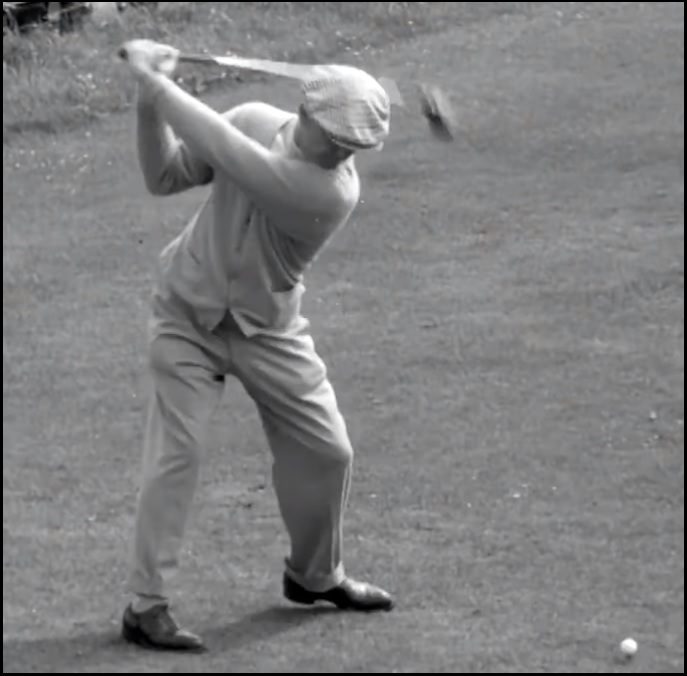
 Something I noticed instantly when I began to make practice back pivots, now that my shoulder is improving enough to do so, was the much flatter plane I have at the top compared to my previous, more typically Classic pivot style.
I began to look into it, wondering why I didn’t have much higher hands at the top the way I used to, a la Jack Nicklaus, but the flatter plane is actually a feature of the “Late Hogan” pivot action.
I’m really going to have to find another name for it, because as I’ve remarked, Sam Snead swung this way at a certain time in his career:

… and of course, I’ve just pointed out that Mike Dunaway, in all of his swing iterations, had this pivot action as well:
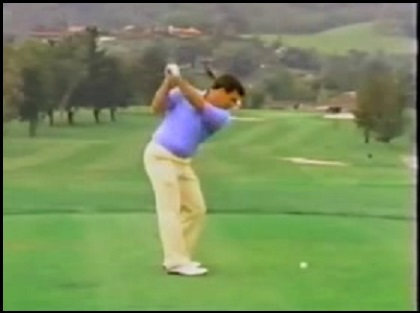
Now, Snead’s plane is a little steeper, and you can see greater separation in his trailing elbow and ribcage, but Dunaway was relatively flat, Hogan was certainly flat, and I’m finding that my top position is pretty flat as well compared to before, and without doing anything at all.
I thought at first that it was just because I’m still not 100% in the shoulder and was favoring it by keeping a flatter top position, but when I investigated it, it appears to be a function of this particular pivot action, with Sam Snead perhaps serving as the exception proving the rule.
One thing I have always remarked upon was how Mike Dunaway was able to drive the ball over 350 yards back in the 80s, for crying out loud, with such a flat top position.
He didn’t look at all like your typical long driver.
Even my first inadvertent pivots in this manner, back in 2017 – you can see clearly that I was swinging back on a flatter plane than usual before I jacked it up at the top, probably because I was used to that feel:
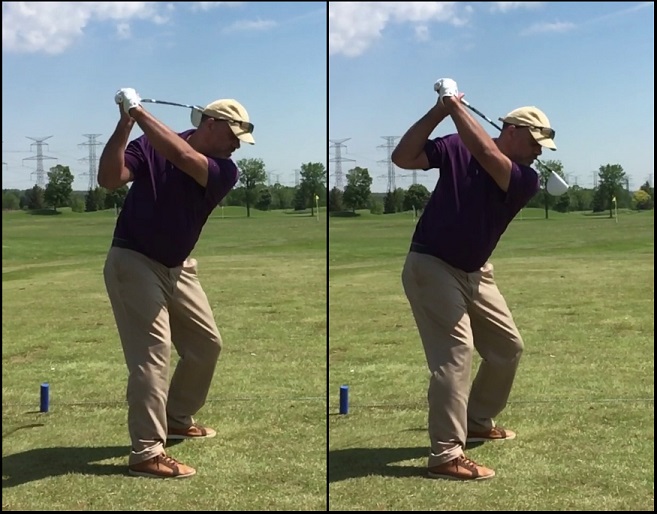
I will of course be looking further into this as my shoulder recovers fully, but it appears to me that this pivot action keeps one on a flatter plane than typical, unless one does something deliberate to steepen it as I did above.
That could have been the case with Snead as well, steepening the plane deliberately because he was used to high hands.
For me, the concern would be a loss of club speed or power, but as I have remarked already, Mike Dunaway was the longest driver on the planet in his day with a swing that looked like a regular playing swing and not a long driver swing.
The advantage to this, of course, is that it would be pretty difficult to come over the top with a flatter plane compared to swinging with a steep top position.
 WAX Golf
Gary Player has said that Hogan told him, “You can never swing too flat”. If you believe that the swing is primarily rotation based, this makes total sense. When you start to raise your hands, it happens independently of the rotation and, for most people, body rotation stops as soon as you start to lift your hands. If I was swinging the proverbial rock on a string, I would never raise my hands because it would kink the string at some point. The most powerful way to swing that string/rock is with the orbit being perpendicular to the spine much of the time. That means less drop of the arms on the downswing (comparatively) which greatly simplifies timing IMHO. Hogan talked about not breaking the plane of glass on your shoulders, and the more I can keep my hands on or slightly under that plane the better I hit the ball.
Good points, softly – Dunaway’s last video was called “Escape Force Motion” and he would spin a ball on string to demonstrate, so that goes well with the Hogan glass plane.
Great post. My natural swing style is a bit flatter with more connection of trail arm to rib cage.At times I felt guilty and wanted to swing more like Snead (or even Mike Austin) in regards to the elbow and steeper plane but my ball striking suffered.At the end of the day we all have natural tendencies and compensations. In my mind … as long as it’s mechanically sound and helps you score better do that.
Hello Curtis! Yes, it’s a bit counter-intuitive, isn’t it? You feel more powerful when the plane is steeper, but we’re not swinging perfectly vertical, rather on a tilted plane – so despite the “feel” of being more powerful, a steep plane strays from that straight line you should swing along.
I naturally have a flatter swing plane with more connection of trail elbow to rib cage. This causes me to have a bit of an abbreviated backswing. But I score well and hit the ball plenty but have felt guilty it didn’t look more like Snead or even Mike Austin.But every time I tried to change it ball striking and scores got worse.At the end of the day we all have different body styles, tendencies and compensations. I’ve learned that as long as your swing is mechanically sound stick to what works.
It’s all a trade-off when it comes to actually playing golf – the straightest, most consistent technique will likely have less power and distance than maximum, just as the longest, most powerful technique may come at a cost of accuracy and consistency. Long drivers can go missing 5 of 6 balls and then win on one moon shot.
My research and mission have always been to find the longest, most consistent and repeatable swing with the greatest accuracy in a mechanically-correct motion. There will likely always be a trade-off, even with the best technique.