
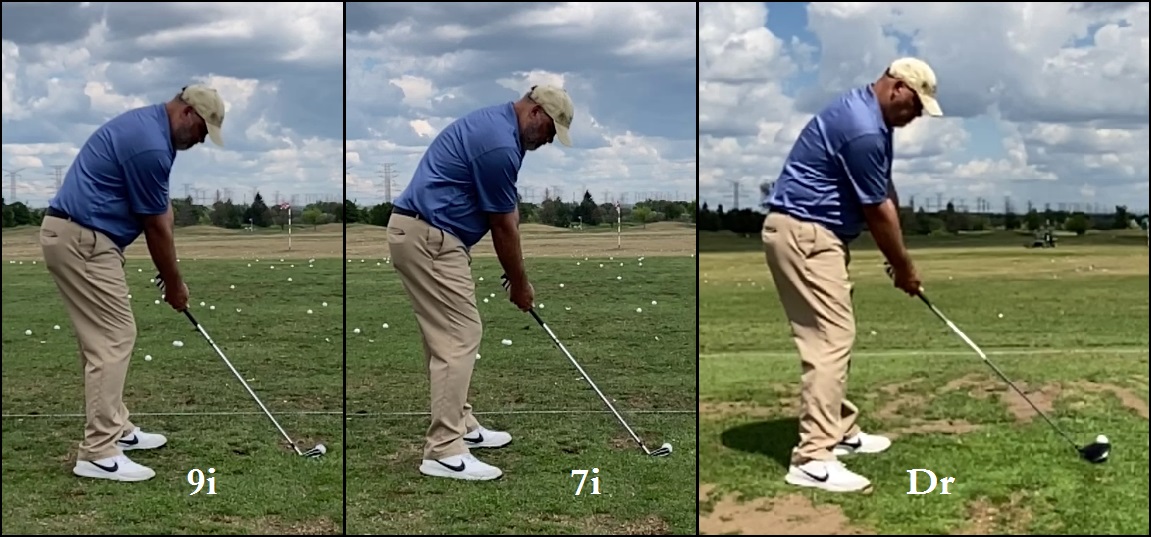
 Both Jack Nicklaus and Ben Hogan had a setup that was considered “the same for all clubs,” and that is the way you want to swing as well.
I’ve been saying forever now that you want to setup more like Nicklaus did (I don’t think he invented the setup, but as the G.O.A.T., we’ll just call it the “Nicklaus” setup), and that you want Hogan’s pivot action.
When you look at the way that Nicklaus set himself up (or at least what he considered the optimal way to set up) over the ball, it is easy to see how, other than the little differences in stance width and height with the varied ball positions, it is essentially the same swing:
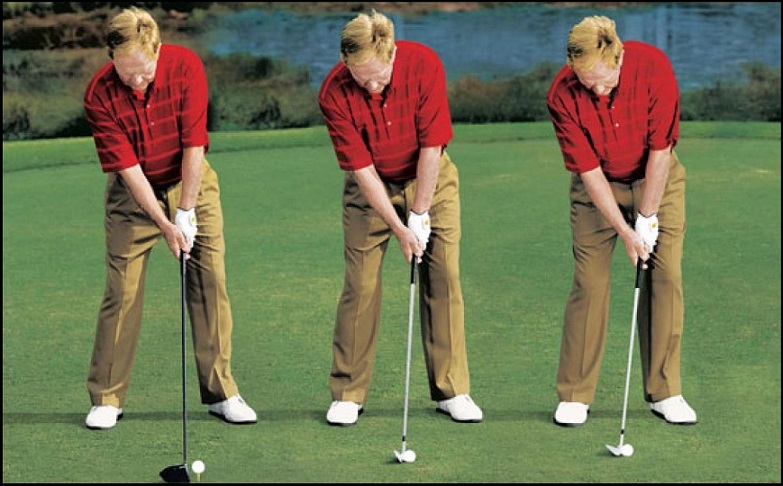
I would absolutely agree with this setup – in fact, I don’t just preach the Nicklaus setup, I also practice it:

You can see that all that is changing is the posture and the stance width to account for the club length and ball position, and from there:
… it’s the same pivot action and down swing motion.
Now, I don’t like Ben Hogan’s swing model for several reasons, a few being his ball position:

… as well as his anti-hook moves, but there is the one thing from Ben Hogan that you really want to copy, and that is his pivot action.
It was sublime:

And this is what it looks like here below with the Nicklaus setup and Hogan’s pivot action:

This is not a swing for just young golfers, either – Hogan was 45 years old in that above gif. and I was 47 years old in mine just above.
And because it uses Nicklaus’ setup, there is plenty of power, as seen below the same spring when I was 47:
The Nicklaus Setup & Hogan Pivot – 187 mph Ball Speed

You’ll notice that I’m using different drivers in the two gifs – I caved in the TaylorMade Rocketballz driver shortly after shooting the swing in the first gif. and the second gif. has me swinging a Ben Hogan CS3 driver circa 2005 a week or so later.
Notice as well that I was getting close to 190 mph ball speed with a 12 year old driver and a range ball, and I wasn’t swinging out of my shoes or with my feet flying around at impact.
Just a nice, Hogan-style pivot with with the hips and legs and pure leveraging down through the bottom using the weight transfer in the down swing phase.
I have been delayed in finishing the upcoming video due to something coming up regarding a “project,” shall we say, that arose last month and for which I am having to devote time away from the video.
That “project” is something I won’t discuss now, but will expand upon in the next week or two, but I am trying to finish the video ASAP.
More to come.
 WAX Golf
Don’t you threaten me a good time!
I’m doing it, Scott!
Noticed your arms are closer to a single plane setup than the modern “hang your arms straight”
I always felt that letting the arms hang out of plane was a recipe for disaster – to leave the plane and forcibly correct with esoteric, unrepeatable maneuvers (unless practiced ad nauseum) – also noticed that the lie angle of the club can be wrong and requires akwardly changing distance to ball to try to get the club’s correct lie angle since “straight” arms are myopically prioritized (could it be another pursuit of swing aesthetics like the top parallel that have no functional basis?)
Is my intuition here right?
I used to have my arms very extended but they have gradually adjusted to just shy of vertical. I think there is an element of people liking the aesthetics of vertical arms, but my best swinging has a bit of angle to them. There is some rotary force to the swing, so unless one drills very diligently on swinging with perfectly vertical arms, a bit of extension is never going to be the worst thing in the world.
Rotary force point makes a lot of sense, thank you – also yes totally noticed people love the aesthetics of straight parallel lines in a swing