
 I forgot to mention in yesterday’s post that John Daly used this left arm swing drill before playing every round when he was on Tour.
He wasn’t the type to warm up hitting dozens of balls with different clubs – he would get the feel of his swing for the day hitting a few wedges swinging left-arm only, and then head for the 1st tee.
I’ve got some down the line of the same drill I posted, shot the same day back in May 2015, and it shows the same fallacy of trying to pull the club through the swing bottom and toward the target, modern-style.
This is not the way to do it:
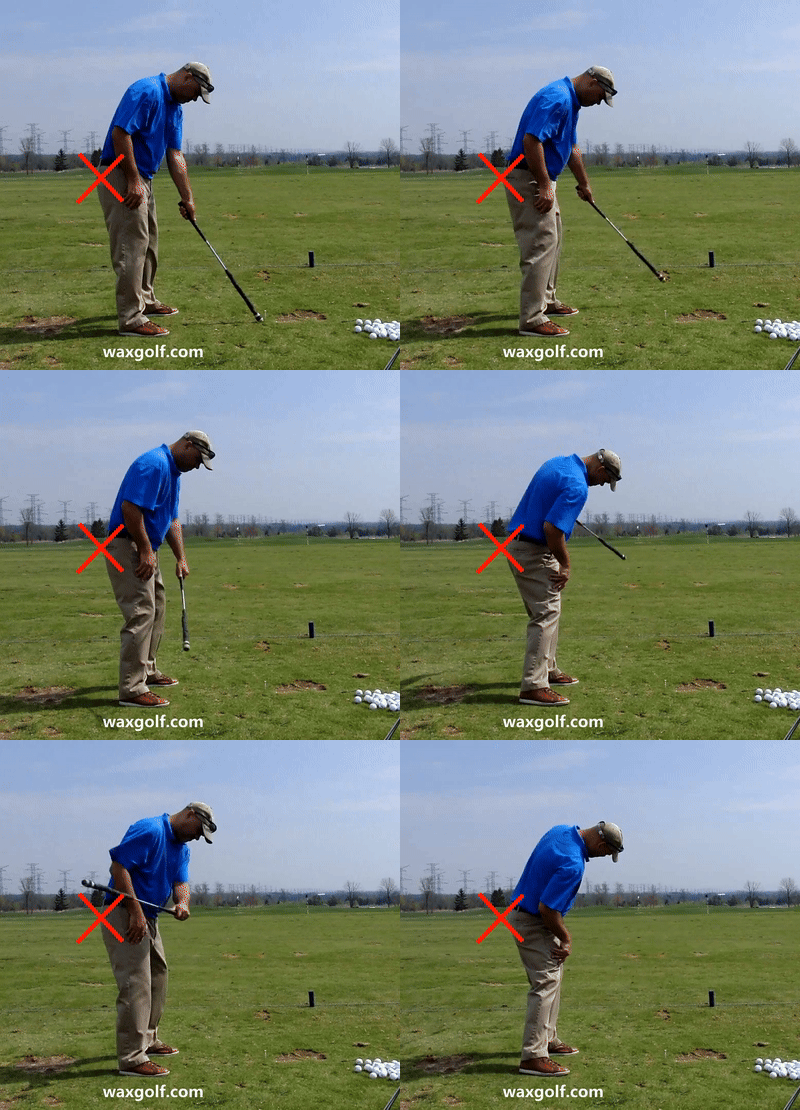
Again, the Modern Golf Swing players who perform the reverse-pivot with the planted leading heel have nowhere to go when they begin the down swing, so they go with the “Turn & Swipe.”
Contrast that to the simple leveraging power of the hips and legs combined with the use of gravity to swing the club through the swing bottom with a free release:
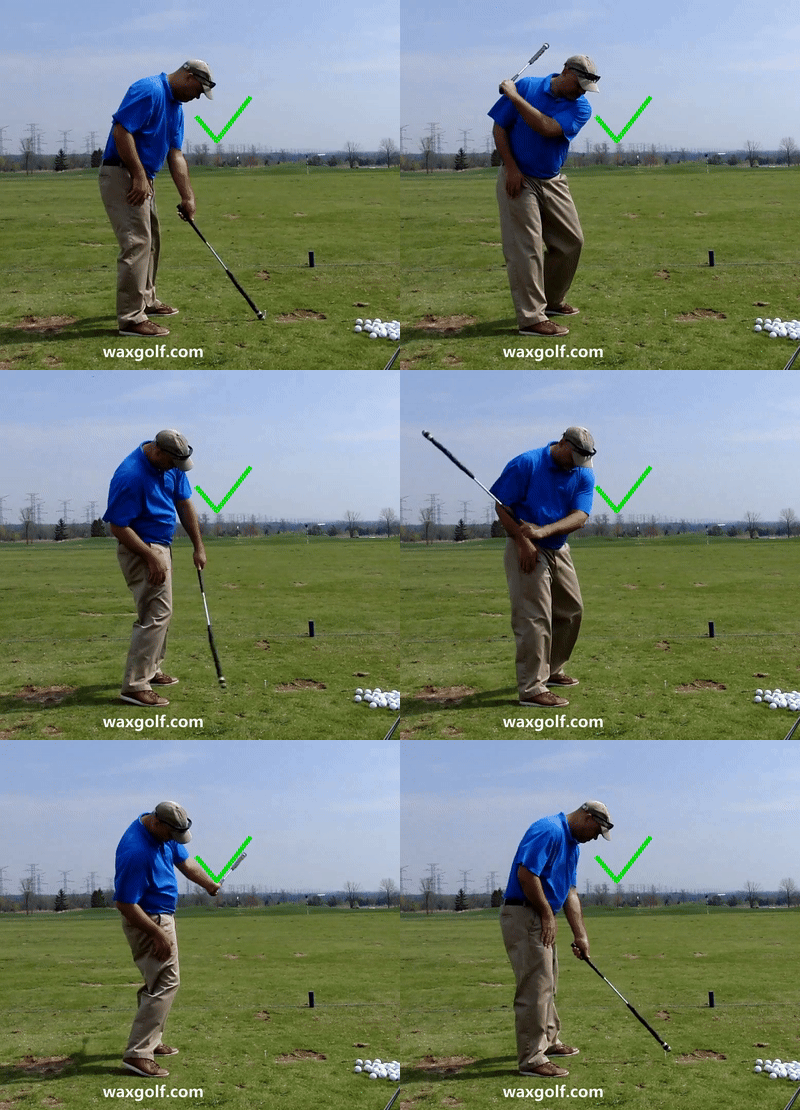
Once you get the feel of the proper swing, you realize that it’s not a lateral motion towards the target, but a vertical motion using gravity and leverage to swing down and release through:

There is no turn in the golf down swing – it’s a return to the squared shoulders to the target line coming to the swing bottom, only after which does the body turn due to the hip rotation and momentum of the arms and club.
It really doesn’t get any simpler than this, friends.
The Modern Golf Swing is a swing in parts, like a puzzle, whereas the Classic Golf Swing is a fluid motion broken down into two segments – the back pivot and the down swing.
The end.
 WAX Golf
This is awesome stuff, DJ!
I’ve got a couple of questions for you:
Cheers!
Hey Scott!
Before I say anything, let me give you one piece of advice regarding the Modern Golf Swing and its gurus – don’t watch them, don’t listen to them, just don’t.
They are working with something that has nothing to do with proper swinging and are best left alone to their madness. Pay them no attention whatsoever.
1. For example, to answer your first query, you address the ball with tilted shoulders because one hand is below the other on the club, and at impact, your trailing or right arm is still flexed, so you will have even more shoulder tilt because the right shoulder will naturally have to be lower than it was at address if the right arm is shorter (bent) than it was at address:
—–
Nick Faldo once on the Golf Channel ridiculously claimed the same thing as your previous coach, keeping the shoulders “level” through impact, yet when I took an impact pic of him, guess what you see?
—–
No one who discusses the Modern Golf Swing has any clue about proper mechanics nor about kinesiology, or they wouldn’t endorse it to begin with. They are pulling stuff out of their back ends, or worse, trying to solve problems & creating more problems (turn & swipe).
2. If the club shaft is moving in your hand at any point during the swing, then it’s a problem. In the summer of ’08, I had a huge callus on my left palm just off the wrist, in line with my pinkie, because the club shaft would move in my hand at impact – that’s not normal, so it’s a swing flaw. For years between ’09-’17, I never wore a glove and the only time the club would slip would be due to sweaty hands.
A moving grip in the hands is your clue that you’re doing something wrong with club path or face, and un-optimal contact with the ball or ground will cause this.
What stick are you using in those gifs?
That, sir, is a home-made swing stick, with a broken iron shaft and hockey tape wrapped around the end. 😉
You could sell it for $149 haha
I could, if I were a snake-oil salesman, but I would like to think that I have a little more integrity than that…
Thank you so much!
It’s crazy man but it seems like if you just do the opposite of what Modern teachers say you’ll end up alright lol.
I’m not conspiracy theorist but I’m beginning to think there’s some head “Modern Swing” honcho who’s in bed with club manufacturers and training aid companies to make players worse so they’ll be stuck in the never ending loop of buying their junk and they simply disseminate their “modern” ideas to ignorant teaching pros and Youtubers.
You don’t have to be a conspiracy theorist, Scott – The PGA of America does not exist to make people better golfers. It exists to make money running the golf business, of which teaching is a lucrative side-hustle.
There’s also this:
Christensen, John (2013-11-24). Perfect Swing, Imperfect Lies: The Legacy of Golf’s Longest Hitter (Kindle Locations 971-975). . Kindle Edition.
—–
As for the equipment manufacturers, they are delighted that the state of instruction has the student not knowing which end of the club to hold – more expensive equipment “to make you better” when it actually doesn’t.
Win-win for the teaching and equipment industry.
Ernest Jones apparently wrote a great book called “Swing the Clubhead.” Not sure if you ever read it.
I haven’t. And I’ve read about all the golf books I’m going to read, at this point.
But I’m sure it’s fairly simple and straightforward as he was.