
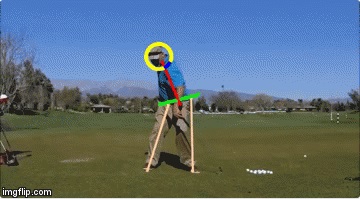
 You’ll all by now be familiar with the concept upon which I’ve been working with regards to swing modeling – that is, swinging in a manner that emulates the Iron Byron or any other swinging machine or robot.
What this would entail is in reaching the optimal in three processes (the setup, back pivot and down swing) with maximum stability in the leading foot and head positions throughout.
This of course is regarding the Classic Golf Swing model upon which I’ve been working using Jack Nicklaus’ early 1960s setup for the most part, with one notable adjustment, that being a narrower stance:
Jack’s Setup vs Jack’s Theoreticlly “Optimal” Setup

That adjusted setup is still where I am at present, having come back to his particular grip a couple of years after I first noticed and attempted to emulate it.
A couple of years in my swing work is a lifetime, so where I was unable to get that exact grip working in my attempts back then, I’m pretty much there now.
Looking at Jack’s swing with the wider stance:
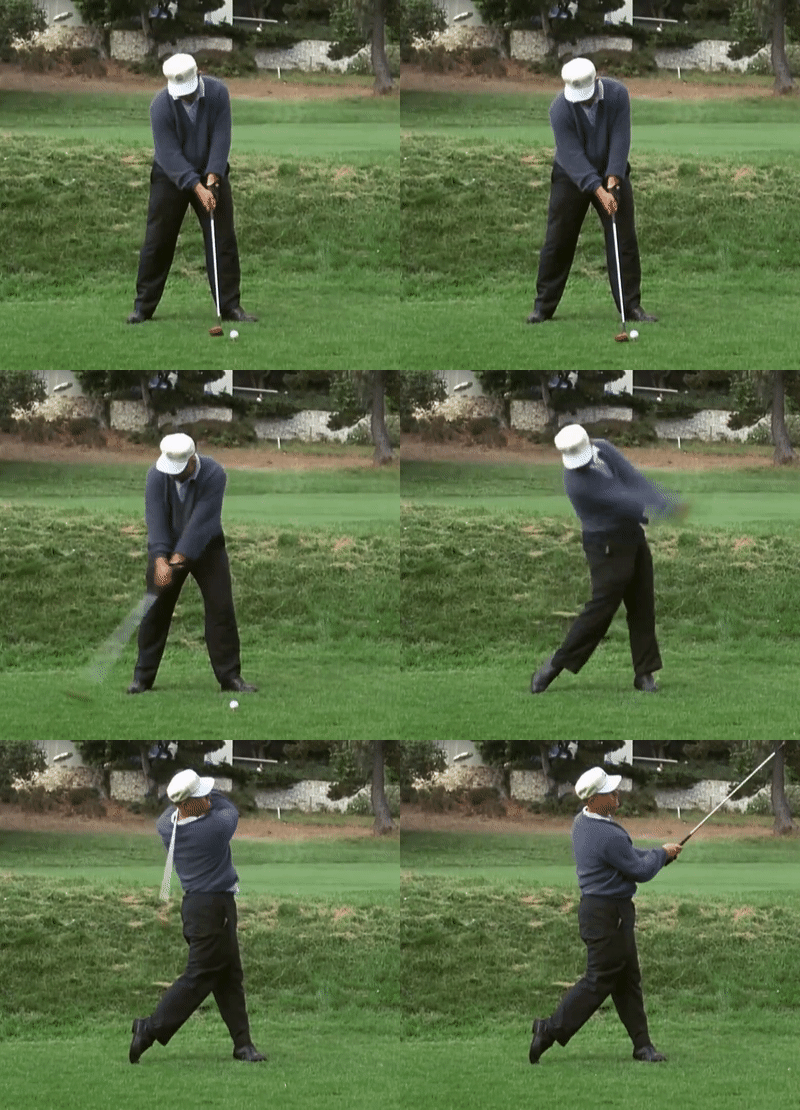
… I would dare to say that the only thing keeping this action from being near-perfect is the stance width, causing the slight leading foot instability through post-impact.
Again, you see the insistence on keeping the trailing foot anchored throughout the down swing to the finish.
This swing of Jack’s in 1963 is a monster of a swing action and other than the stance width, I can’t see anything else to quibble with.
I can vouch for his leverage with this particular model, as I’ve just torn the grip on my swing aid – it wants to come out of my hands so much at the swing bottom that the grip actually tore beneath my right hand this afternoon as I swung it.
I’d just increased the resistance on it so it won’t snap unless I’m nearly perfect in the setup, pivot and down swing.
I will likely be testing it out either at the range or the launch monitor facility after having made an unsatisfactory foray last week.
It’s not about driving the ball far or straight, but rather capturing that optimal action that makes it as long and as straight as possible with the hardest swing one can generate.
When you can nail the motion with a stable head and leading foot position, you are really creating a human swing machine where, if you get that grip and the ball position correct, is unbeatable as a golf swing motion.
The “Dunaway” model, upon which I’m working as well, of course excludes the stable head position throughout due to the nature of the setup.
That setup will have the head drift slightly to the right on the back pivot but remain stable from the top starting down to impact:
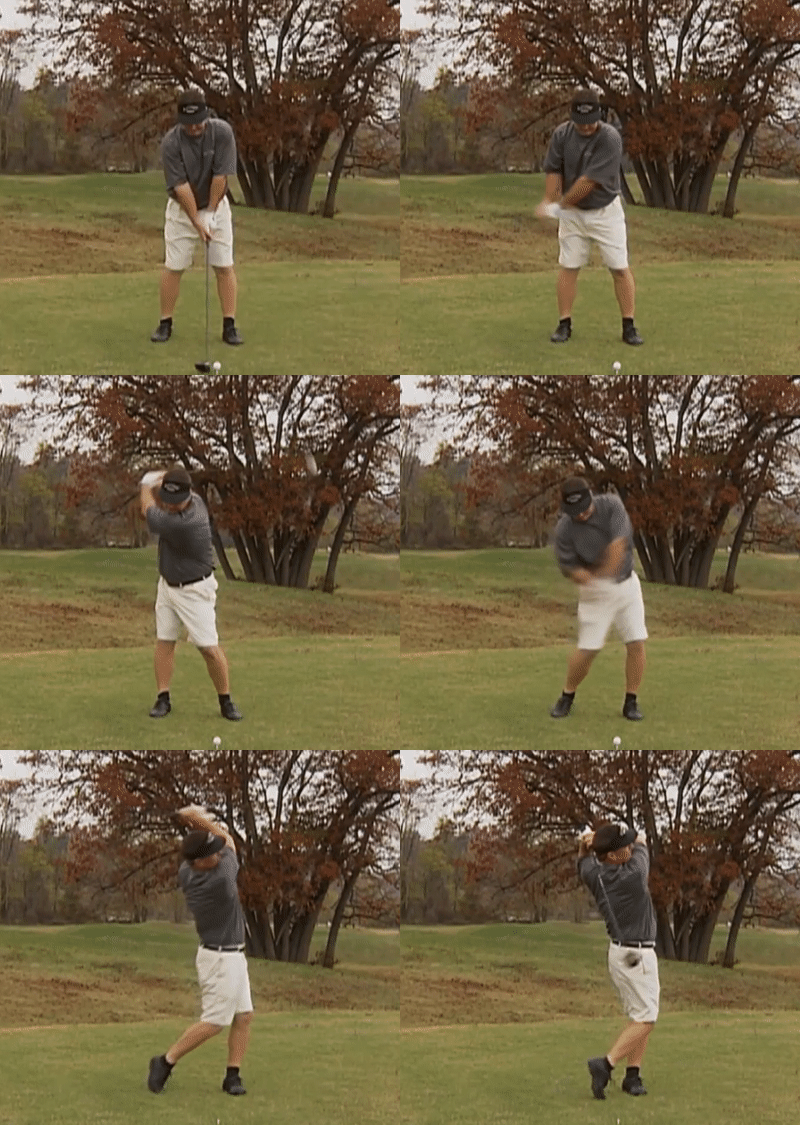
I’m pleased with the progress on this model as well and am eager to get one or both of these models out to people this season.
The work continues.
More to come!
 WAX Golf
Hey DJ, When I played and swung my best (boy do I miss that swing. Long story) My focus was on “returning to address” in my swing. Take it back with a stable head and then just return the club to address. This was the feel and I know that I was moving my hips but I went for the feel. If you look at Mike’s swing there is a slight pause of the hip as the arms and hands pass through the ball. Then he continues to come up with the step around. Jack has this to a lesser degree. At least for my eyes.
Hi Jim! I hope you & yours are well.
You said “If you look at Mike’s swing there is a slight pause of the hip as the arms and hands pass through the ball. Then he continues to come up with the step around. Jack has this to a lesser degree. At least for my eyes…”
It’s a long while back, but I discussed this a few years back (the below Gif is from 2015), I called it the “hip stall” through impact:
So, you’re right on the money there!