 I’ve taken Jack Nicklaus’ driver swing from the Masters in 1963 to illustrate the power of hip & leg action regarding the leveraging of the golf swing, something that has been lost with both the Modern Golf Swing models & the Flying Foot Syndrome.
It would likely surprise modern golf students to learn that what makes it so difficult to get a 90 degree shoulder turn at the top with a planted leading heel is also what makes the Classic Golf Swing so effortless in power production via leverage.
The shoulders and hips are connected (surprise!) through the hip girdle, spine & clavicle, which is why performing that horrific X-Factor move damages the lower back – the spine is meant to bend and flex, but not to twist past a few degrees, as I illustrated in the “E = MCS” video from 2017:
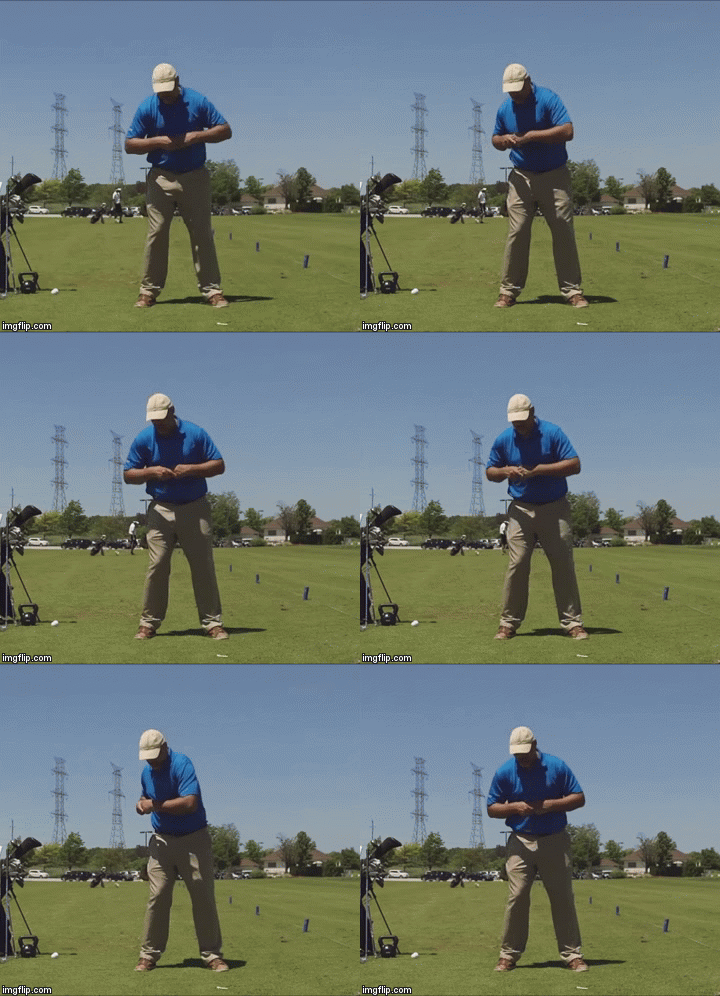
… so if you really try, you can’t twist the spine more than what I’m doing above, but it’s going to cause both incremental damage to the spine and discs as well as risk catastrophic damage on a particular swing.
We’ve all heard the tale, Fred Couples being the most famous example I can recall, of a golfer performing a swing and then crumpling to the ground in agony – that’s the spine and discs saying, “One too many times, fella…”
In this regard, you can turn what many consider a handicap (the spine not allowing more shoulder turn) into a power-plant using the body’s weight and connected hip/shoulder units.
You’ve all see this swing on the blog:

Now, I would ask you to take a moment and watch the gif. below where I highlight the positions of Jack’s left knee and shoulder at the top of the back swing, and how they are synced in the down swing to impact:

There are two things going on here in the down swing- Jack’s left knee (the “Swinging Gate” of yesteryears’ MCS videos) moves back toward the target to allow him to transfer nearly his full weight to the leading foot, and with no more effort than that, his left knee pulls his hips, which pull the left shoulder down and around into the high impact position.
The leg action turns the hips naturally, and when the leading knee moves from its position at the top, the hips move with it… naturally.
Now, I’d ask a simple question – what happens when the hips pull the shoulders from a 90 degree turned position to the high leading shoulder position at impact?
The answer, quite simply, is the the leading arm and trailing shoulder follow the leading shoulder, bringing with them the trailing arm, hands and club.
All with no more effort than the simple transfer of weight to the leading foot.
Add the factor of a laterally stable head during the swing and you create the perfect fulcrum of the C7 vertebra around which the shoulders turn.
It doesn’t get any simpler than that, but then the optimal golf swing motion is far simpler than any other type of model – it’s just that people tend to complicate things.
Look at Young Jack’s swing when he was a lad, and that swinging leading knee on the back swing to the top just screams “Leverage! Power! Effortlessly!”

So, when you hear all of this stuff about having to have “fast” hip rotation on the down swing, that rotation will come naturally with a freely moving hip and leg action, just by transferring weight and without having to jump out of one’s shoes!
And that, my friends, is what is lost when you stop using the hips and legs on the back swing to load the trebuchet, and now you’re stuck using all types of acrobatics to create the same leverage and power that comes without effort with the Classic Golf Swing.
I’d say the Classic power production is… optimal.
 WAX Golf
heh-heh heh-heh (he said) TREBUCHET !!! :)
(music to the ears, salve for the spine)
We have a longtime WAX Nation citizen here 😂
Been a while since I said, “Trebuchet,” hasn’t it DH? 😁