
 Back in 2016, I had a swing that largely resembled John Daly’s with regards to the back swing length and top position, and I’m curious about one thing.
That thing would, could I match the club and ball speed I was generating back then with the new, rebuilt swing upon which I’ve been working the last year?
I would be delighted if so, because I could really send the ball with that 2016 swing model.
It’s not a surprise though, if one knows anything about swing mechanics, because aside from my grip (extra strong) and the fact that I was swinging left-dominant, this swing was on point when it comes to impact conditions.
First, let’s look at the face-on, with a drive that flew for nearly 8 seconds, which is approaching long drive hang time:

From the above swing, some positions:

Another swing from the same day, captured in slo-mo, in which you can see the “Trebuchet Drop” motion of the head from the top of the back swing:

Note also in the swing above the lack of a snapping or hyper-extending leading knee – in fact, my left leg is actually flexed shock-absorber style through impact, because I release the trailing foot and therefore don’t experience any stress to that leading leg.
And the ever-important impact position. :
Looking down the line next.
This was about the best I ever swung a club with the angled stance, which I had built into the model Ben Hogan-style, with the difference that he did it to minimize the risk of hitting it left while I did it to keep my shoulders square to the target line at address and impact due to my offset shoulders:
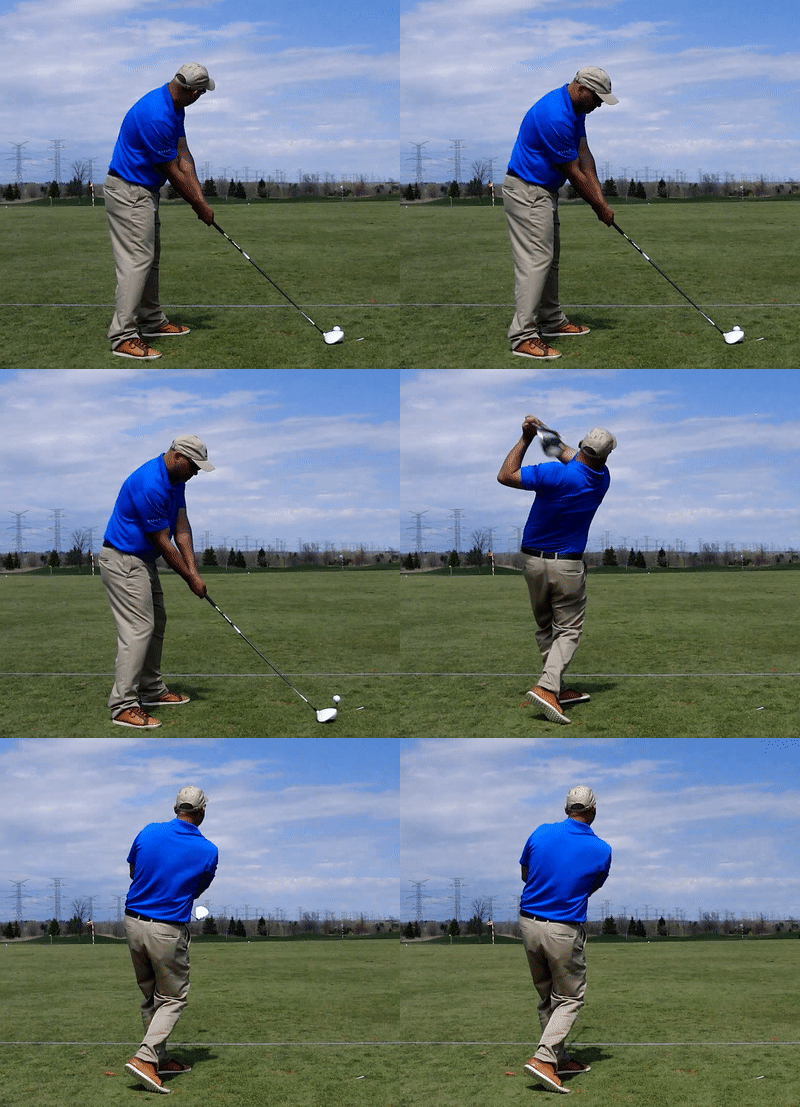
As of today, I will have eliminated the angled stance, the arms would be much more vertical at address and there wouldn’t be a big past-parallel position of the shaft at the top having switched from left to right-dominant, but I still love this swing action and the results it produced.
In slo-mo:

If you are wondering how someone could swing a club with such a long back swing and at over 120 mph club impact speed with such stability in the lower body, it’s simple.
When you are set up more or less the way you should be and the ball is in its proper position in front of you, it’s a matter of simply pivoting back to the top and then stepping into that leading foot just as one would do to throw a ball side-arm.
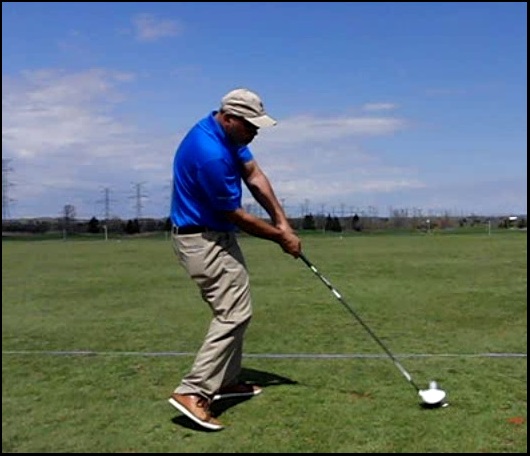
I’ve never seen anyone lose their balance throwing a ball side-arm from a standing position, so it should be the same with a swing, no matter how hard one swings.
Now, I’m setting a challenge for myself – as well as I may have been swinging with this model at the age of 46, I want to match and exceed the club and ball speeds of that age now at 53 with my rebuilt MCS Classic Golf Swing model.
I think I may be able to do it because, looking at the hip and leg action of that swings above, I have rediscovered that action and the only difference you’d notice would of course be the three things I’ve mentioned:
- a neutral rather than strong grip,
- a closer to parallel shaft position at the top and
- a squared rather than angled stance line
There would be one more thing, if I nail my model correctly – a raised trailing heel at impact such as above, but with no short-stop slide release and instead a step-around from the raised heel position to the finish, Mike Dunaway style:

Let’s see what happens in the coming weeks!
 WAX Golf