
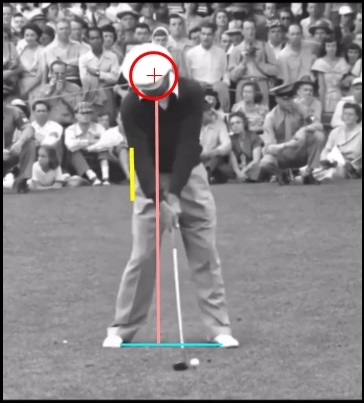
 I’ve said many times that Ben Hogan had the “Perfect Pivot” action when it comes to the actual pivot mechanics, but that one shouldn’t try to copy his actual swing.
Here is why – the way Hogan swung is a way he found able to repeat, but he also had to hit balls every day to maintain his precision.
People don’t think about how it took him 16 years to figure out exactly how to swing that way (turned pro at 18, first win at 34), after which he was virtually unbeatable.
It’s far easier to build a swing that you can maintain with practice but which doesn’t fall apart if you don’t.
I have taken a Hogan swing and broken it down to show you how problematic it would be to try to replicate it:
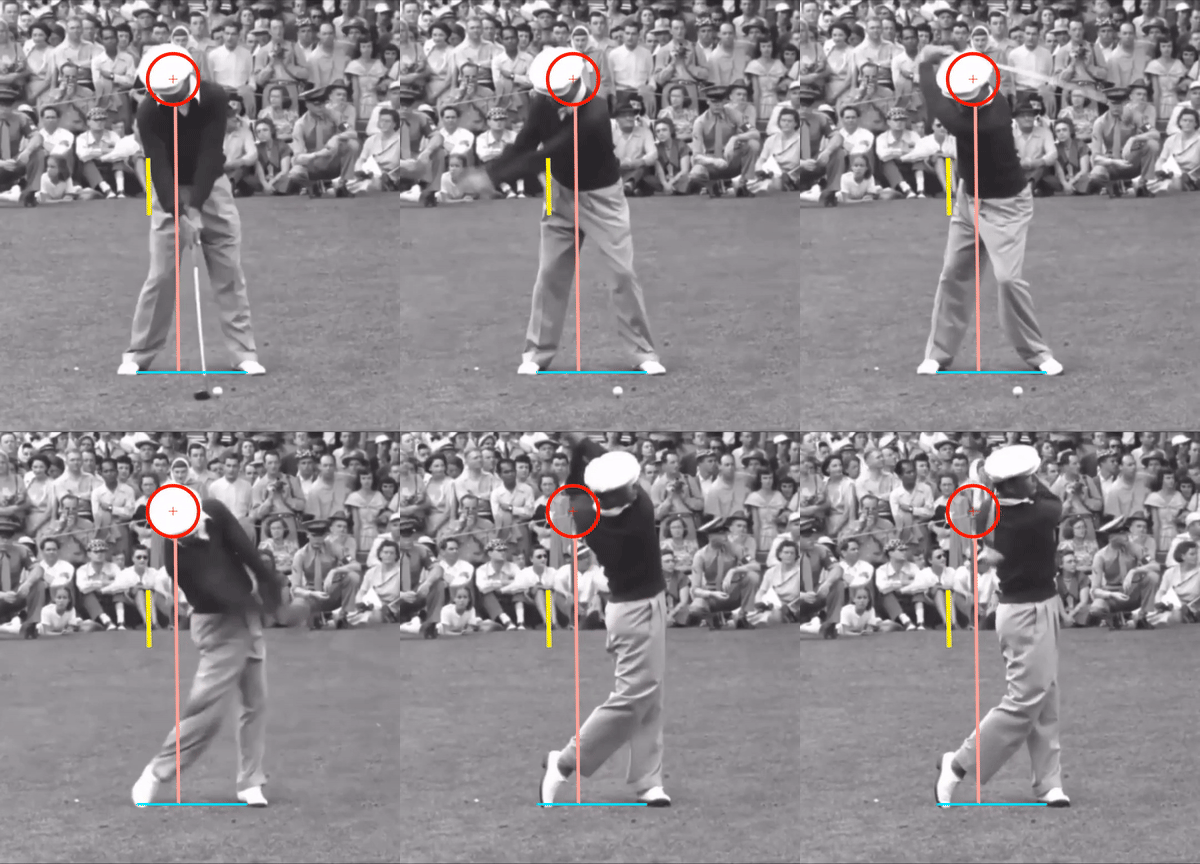
If you take a look at the below sequence, you will see that:
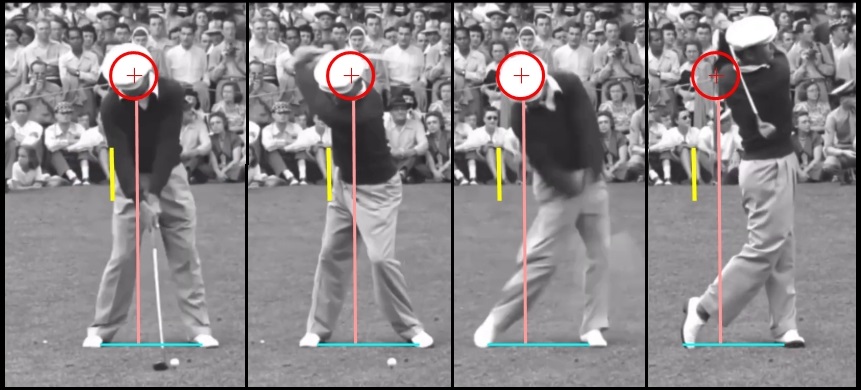
- He was set up with a right-biased address over the ball. His head was clearly far right in his stance, not centered and definitely not left-biased,
- His head actually shifted to his right off the ball on the back pivot, but he didn’t break his hip plane in doing so (that is the genius of his pivot action).
- He then shifted toward the target on the down swing, with not only his body but also his head, so that his head was completely within the red circle at impact and
- He then finished balanced on his left or leading foot by releasing his trailing foot so than he could stand balanced and not with the falling-forward finish you see today.
Not Balanced

The Problem
All of that head motion is why he had to practice constantly, because it required timing and coordination to shift exactly the right way each direction. Hogan was a feel swinger.
This Took Practice

Notice, it was neither a “Squat & Dump” (the “squat” position is a transitory position in a flowing motion) nor a “Turn & Swipe” motion in any way as you see them doing today to try to copy his swing. They’re so completely lost, it’s ridiculous.
By all means, copy that pivot action (I have!) but trust me, you don’t want to build a golf swing based upon feel, because there will be days that you just can’t make good contact due to being “off,” whereas building a swing based on proper positioning and mechanical action will mean better performance even when you’re “off.”
Modern Fallacies
Here, we get to all of the Modern Golf Swing fallacies again.
- Hogan was set up with a right-biased stance, not centered nor left.
2. Hogan pivoted over his right side and even shifted to the right with his head, whilst keeping the hip from crossing the vertical plane (no shift of the hips to the right). So when he talked about “bracing his right leg against shifting to the right,” he meant exactly that, and not restricting the hip turn or his left heel lift in any way.

So this:

… shows you that these people have no clue how Hogan actually swung, although I can’t figure out why, because you can see clearly what he was doing if you look.
And this:

… is so far from Ben Hogan’s swing mechanics as to be from another planet, not to mention it’s absolutely ridiculous in terms of mechanics.
It’s as though the only thing they can copy in Hogan’s swing is his finish, and even then, it’s a stilted, forced-pose finish and not the graceful termination of a swing as Hogan had.
The people purporting to know golf swing mechanics and who teach this rubbish and try to stamp it with “Hogan-Approved” are either completely incompetent or perpetrating a fraud.
It could be both – that they are not only incompetent and have no clue what they’re doing, they are also fraudulently presenting things knowing they’re wrong.
Sue me.
It won’t end well for anyone who tries.
 WAX Golf
Class analysis once again from the master. I’ve never tried to swing exactly like Hogan as I found rolling the wrists to be wasted effort,but I never noticed just how much movement he actually had in his swing until seeing the piece. That definitely requires fine tuning. He definitely “owned his swing”.
He was poetry in motion but some of the motion was unnecessary.
It still amazes me how people think they can recreate a recipe whilst leaving out some ingredients and adding other ingredients not in the recipe.
Not only that, how they can look at the lopsided mishmash of the final product and declare, “Nailed it!!”
I just cannot fathom whatever logic it is they’re using. Perhaps there just is no logic.
I’m beginning to think it’s just crowd following but for golf “Yh, I like that blah blah too. Watch it all the time.”. When it comes to full swings I think that Dunaway,Payne and Watson are the types to follow as they’re mechanically sound and don’t cause injury and are repeatable. However,when it comes to short game due to the limited motion you can follow whoever you please. Well,maybe not Trevino all the way depending on how much green fees your club can afford with the Texas sized divots he loves 🙂
Great breakdown!
I myself am definitely struggling with not moving my head forward along with my body in the downstroke.
Haven’t figured out how to keep my head steady but move my low body toward the target.
Let me get that video done, Scott – I am going through everything to make sure first-timers with an MCS swing video can follow along as well (or as nearly) as old hands.
I’m on it!
Hey DJ, hope you’re doing well — wanted to run something by you.
I was out hitting balls into my net tonight, just kind of in a groove and thinking about head movement and how it ties into the swing.
From my study, it seems like all the great swingers we admire — guys like Jack and Bobby Jones — do a really solid job of keeping their head “in the box.” But something I’ve always noticed (and honestly found a little confusing) is that even though they talk about keeping the head steady, their head almost always dips just a bit in the backswing.
Like take Jack — I’ve heard him describe it like he imagines a stake going down from the top of his head into the ground, and he just turns around that. (Rough paraphrasing, but you get the idea.) And yet, when I watch face-on footage, there’s definitely a little vertical movement throughout his swing.
So while I was hitting tonight, I started thinking about how the club makes pure contact with the ball. Obviously, we’re trying to meet the center of the face with ball at impact — that’s the whole game.
And to me, it seems like there are two ways to make that happen:
If we don’t dip a bit on the backswing but do increase tilt on the way down, we risk thinning it. Or, if we increase tilt without offsetting it with that small dip in the backswing, we risk hitting it fat.
Hopefully this makes sense — even if you don’t fully agree with my analysis, I’m here to learn and refine my understanding.
Appreciate everything you share, as always.
Cheers,
Hi Scott
I don’t really see a correlation between ball striking and how the head moves during the swing.
Head motion has so many different causes, from the setup to the actual manner of pivot. A swinger might be standing taller than he will be at impact, he could conversely be set up with a little more flex in the knees, both of which circumstances causing slight head dip or lift on the down swing.
We have not yet ever seen a “perfect” golf swing, so head stability is something you want in theory, but hand-eye coordination will also cause a slight change in head level during the swing.
With the pivot, the change in weight distribution on both the back pivot and downswing could cause slight head movement between address and impact. Also, the quality of the pivot will affect whether the head moved or not.
A ball lying on the fairway versus one teed up may cause slight head lift or dip – so many factors between the setup and pivot action.
Basically, if one can set up with one’s head perfectly at the same level it needs to be at impact, you will get no head movement- if it isn’t or even if it is but changes position on the back pivot, you will get minor changes in head position on the transition.
I haven’t myself found any link between head movement in a certain direction and ball-striking quality.
Theoretically again, the more stable the head whilst in motion, the better one’s ball striking will likely be.
Final note – since one hand is below the other on the shaft, it is impossible to have level shoulders at address or impact without doing something terribly wrong.
The trailing shoulder will always be lower. Since they change during the back pivot and down swing, they will be level at some point in both, but never at address nor impact. 👍🏼
So would it be fair to say you’re more concerned with the side-to-side movement of the head than the up-and-down motion?
All the classic golfers and yourself believe in keeping a steady head. For the record, I don’t disagree with this but I’m trying to understand why this so such a big fundamental and why head movement in the swing is detrimental.
In your article, you mentioned that Hogan’s head moves off the ball during the backswing but returns in the downswing. That kind of movement, to me, suggests there’s some added challenge in consistently striking the ball well. Unless you’re someone who spends everyday on the range (like Ben Hogan).
In Jack’s book, “Golf My Way,” he dedicates a whole chapter (“Golf’s One Unarguable Universal Fundamental”) to keeping a steady head. He argues for “keeping the head very steady, if not absolutely rock still, through-out the swing as the bedrock fundamental of golf.” He gives four reasons for this, and I quote:
Jack Nicklaus, Golf My Way, p. 46-47
Now, he does mention a few pages later that “the sheer momentum of the downswing often causes the good golfer’s head to move slightly backward, and sometimes a little downward, through impact and beyond. Such movements are tolerable, so long as they are slight enough to allow the neck or top of the spine to continue to serve as the fixed swing axis.”
Scott:
Here is the principle distilled to its essence:
The swing rotates around the C7 vertebra. If the head is moving, the C7 is moving. That is not something you want in a precision motion.
A little experiment- try throwing darts at a bull’s eye standing still.
Now, see how you do throwing darts sitting in an office chair that someone is pushing and pulling side to side.
Same concept 👍🏼