
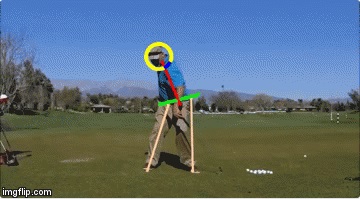
 I spent year upon head-clanging year “pulling” my golf swing with the leading arm, and am just now getting comfortable with a purely trailing arm swing action.
I mentioned in my last post that I have set my swing aid to a difficulty setting that simply will not snap unless I’m swinging with a pure trailing arm motion.
The reason for this is that I realized a little while back that, despite the transition from a left-dominant to right-dominant swing action, I was still employing too much “pull” in the down swing and was likely unconsciously setting up to do so.
I actually captured the desired action years ago while in California shooting the “MCS – Ultimate Leverage” video in early 2015 – nine years ago now and can you believe it’s going on 14 years since my first video project?
What happened was, I was holding a club in my left hand while shooting the intro to the video and was forced to pantomime a stable-headed Classic Golf Swing action with just the right arm:

In fact, I know that the above gif. will look suspiciously familiar to some WAX netizens, which would be due to my having employed the above action as a swing model gif. in the years since:

Now, I know fully well that one swings a golf club with two hands holding the club and therefore with both arms – the key is that the leading arm should only be aiding the trailing arm in leveraging the club down and through.
If you feel yourself pulling the club down from the top of the back swing, then you are swinging leading arm dominant. A trailing arm dominant swing should feel exactly as though you’re swinging the club with the trailing arm only, as demonstrated in the above gif.
And that means having the proper stance, ball position and grip to perform this action (Fundamentals Trifecta, anyone?), and this is all I’ve been doing the past couple of weeks.
When performed properly, you will get a trailing arm action that absolutely whips the club down and through the swing bottom with in this manner:

Now, the counter-intuitive part of all of this – the real source of power is not the isolated trailing arm action itself, but the hip and leg action.
Jack Nicklaus’ prodigious length came not from his trailing arm action, it was his hip and leg action.
Even in his youth, you can see a very strong hip and leg action on the pivot, and look at how his club just blazes down and through the swing bottom with his “leading foot stomp” action, a phrase I coined back around 2010 in my Mike Austin/Dunaway study days:
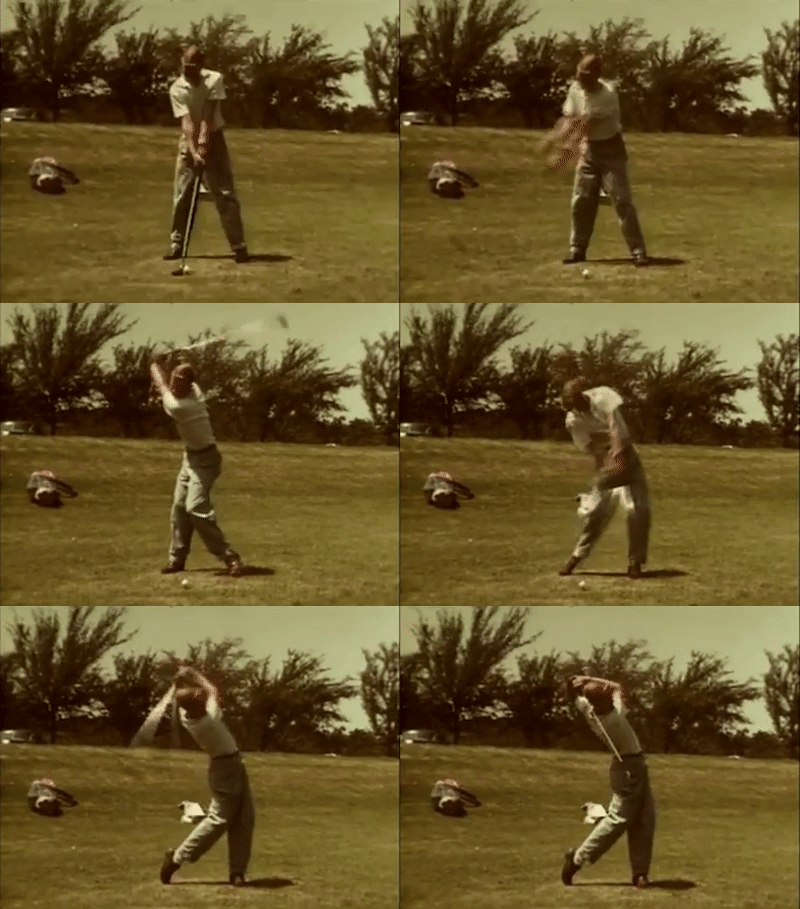
The only swing “flaw” in this entire action is the Reverse-C finish, which would have been fixed very simply with a step-around finish.
You’ll notice as well the absence of any lateral movement in young Jack’s swing – it is a pure “up” then “down” action.
A glorious action no longer seen in professional golf, sadly.
 WAX Golf
I love this post, buddy! I’m not very bright, so some of the things you discuss go right over my head. But this makes perfect sense. Many thanks, and looking forward to your next video series (and hopefully a best-seller instruction book)!
JJ
Hi JJ! Apologies, your comment got caught up in the spam filter for some reason & I just found it.
Thanks for the kind words, I’m also excited about the upcoming video/ book project! 😊
DJ, great article. I have never heard about your Ultimate Leverage video. I have your E=MCS videos and would be interested in purchasing the UL video if it is still available.
What I have seen with the Nicklaus gifs you have posted is his finish. In baseball, the home run hitters have a backward lean on follow through while the singles hitters are relatively straight up and down. I think the step through or the back foot slide like Greg Norman could take some strain off of the spine but to generate power like Nicklaus, we need to strive to keep the head stable and not drift forward even post impact.
You are absolutely spot-on with this observation, Bob! I in fact built the MCS swing model with the “Leaning A” setup, where you think of the body as the letter “A” in the setup, but the “A” is leaning away from the target:
That’s an obvious thing that no one had ever spoken of – I simply reasoned that if the optimal impact position is one in which the spine is leaning away from the target (something I noticed in the great swingers), then the setup had to be similar if one’s head is not going to move from address to impact.
The finish is where I commented in the posting that the only thing missing from young Jack’s swing was a trailing foot release to minimize lower back strain on the finish due to his head remaining behind. I actually didn’t even notice what you mentioned above in my own swing (the head remaining behind the leading foot instead of over it) until you brought it up:
Great eye, Bob! 😁