
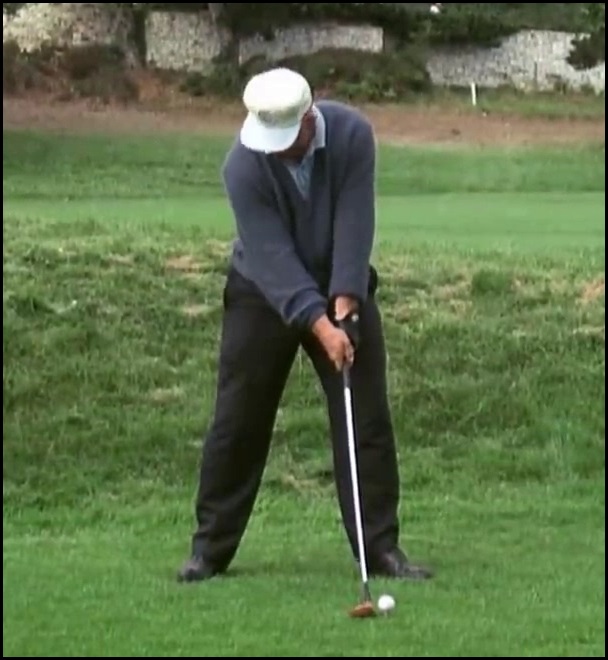
 Here’s something neat that I’ve recently worked out about the Nicklaus head turn before he began his back pivot – it wasn’t a shift, just a turn.
If you already knew that, here’s the catch – it wasn’t to “get his head out of the way of the shoulder turn” as people have stated in their analysis – it was simply that his final setup component was to put his head where it was supposed to be at impact.
If you look at the video and then the still captures of 3 different head shots on a driver swing of his from 1963, you’ll see how this is the case and that I’m not just making something up, considering I’ve been looking at his grip and head move for weeks now while working on my swing model.
First, let’s take a look at the swing itself from the setup procedure to the finish:
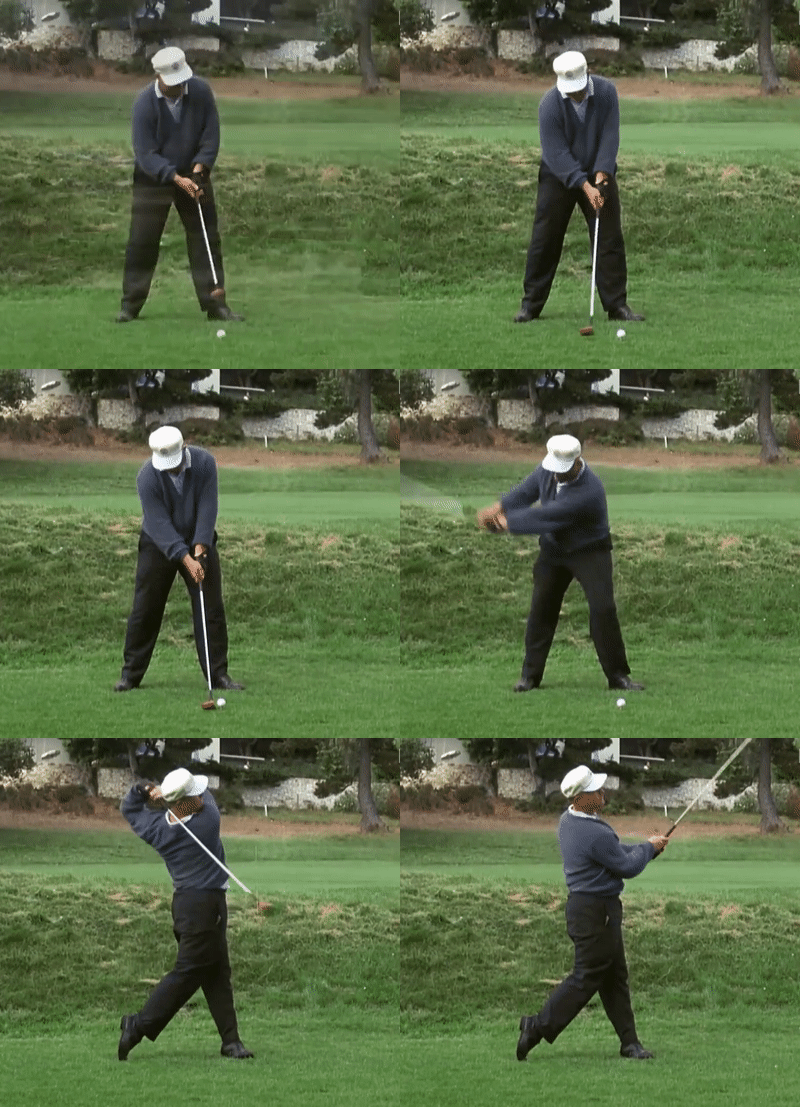
Very first thing that isn’t even related to the swing, did you notice the “Hogan Waggle” in the setup procedure? Pretty good stuff, there.
Back to my point – while there appears to a lot of motion in this swing, it’s just because of the swinging gate action of the left knee with the raising heel and a raising then dropping of the head from back pivot to down swing.
Other than that, he was very stable in his positions in the crucial parts of the swing:
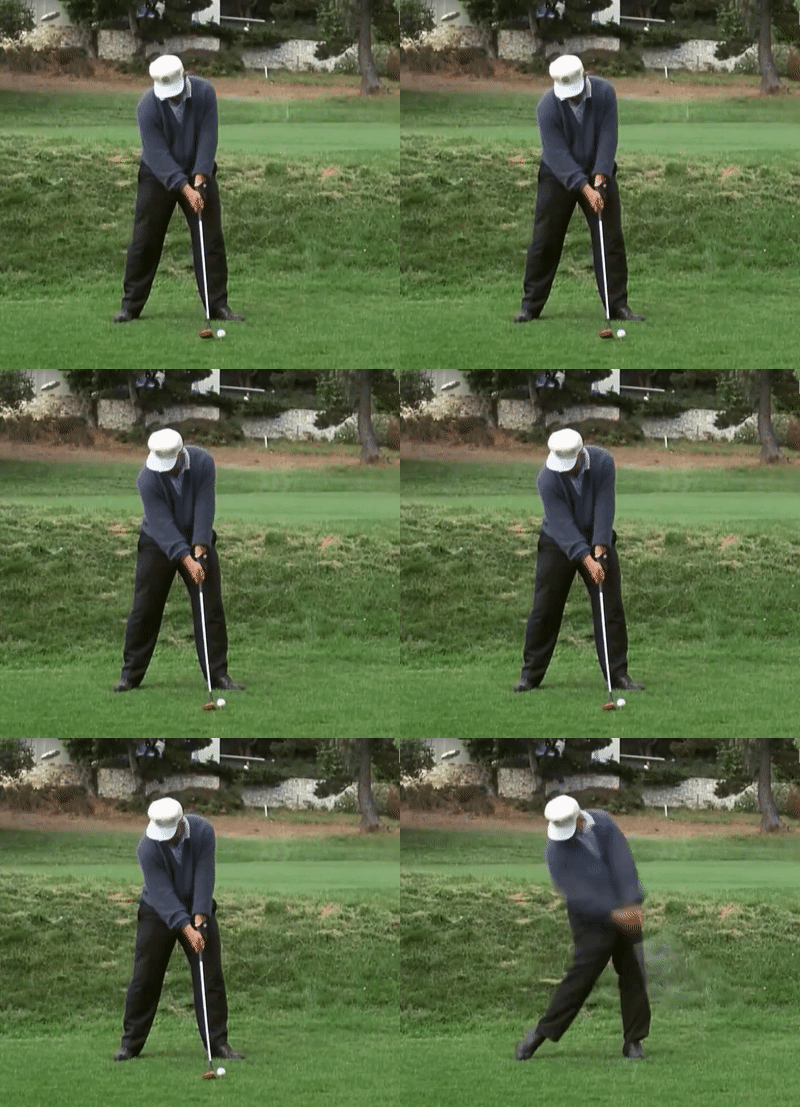
The head motion comes from the too-wide stance, which kept this particular setup and swing action from being just about perfect or optimal, but he never lost his lateral position due to swinging in the Classic Golf Swing style.
So, as you can see for yourself, he set up to the ball with his feet and club, then he put his head in the position it would be in for impact.
I am pretty sure that I am doing my best work at the moment, better than anything I have done since I developed the MCS Classic Golf Swing model that I completed over the winter of ’16-’17.
In fact, the last video on this model, I released in 2018, and in the ensuing years, I struggled with having hit a roadblock in getting my model theory to match real-life swinging from a personal standpoint.
That is, until I threw everything out last year and declared I was going to re-model my model using athletic intuition and the kinesiological knowledge I’ve acquired since 2005.
The journey continues, and I am getting ever closer to the finish line.
More to come!
 WAX Golf
Scientific experiment starts with a thesis, an idea. Using all variables, the thesis is proved or not! Changing elements of the experiment yields a product that verifies the thesis. Or not! The process of experimentation takes perseverance, patience, and discipline all driven by curiosity and a desire to find the solution. Hit a roadblock, begin anew until you’ve narrowed the variables into a workable model that meets the goal and fulfills the thesis. It is truly noteworthy that you’ve continued your experiment, DJ. And you’ve been nothing but generous in sharing your findings!
THANK YOU and count me in when your next video is available for purchase!
Thank you for the kind words, Peter – I have had no other choice than to continue because I made a vow years ago to find the optimal golf swing if it was out there, and to figure it out for myself it it wasn’t. The only noteworthy aspect of this journey however is my mule-stubbornness, because once I get onto something, you can’t get me off it.
I appreciate your continued presence and support – I don’t think many others have stuck around as long as you have, but I am very appreciative! 🙂 DJ
I continue to enjoy your posts DJ. Keep up the great work : – ) Your posts are Always thought provoking & always well-considered. A couple of questions i) Why in the set up for a right-handed golfer do you address the ball with the club held in the left hand ii) Does Jack’s ball position change significantly for other clubs (It’s just that I seem to recall in his video series “golf my way” he suggests the same ball position for every club!?) iii) Is Jack hitting a power fade with this et up or a draw?
Look forward to hearing from you, Neil
Hi Neil! Thanks for the kind words, sir 🙂
In answer to your queries, i) Since we hold the club with both hands, the leading arm and shoulder dictate where the swing bottom will occur, thusly the ball should be placed to avoid the ball being too far behind or in front of the swing bottom, ii) I don’t know why Jack would have said that, because his own demonstration shows clearly that the ball moves away from his leading heel, the more so the shorter the club:
There are times, even with the greats, where you are better served watching what they do over what they say, as everyone can fall victim to false “feels” in what they’re doing. It may be Jack felt that he was doing what he suggested, but a glance is all that is needed to see that the ball position changes as it should.
DJ
Neil, I forgot to answer iii) Jack didn’t change his grip, so he would have been playing his standard power fade or a draw with the same grip – to draw or fade, you open or close the face of the club slightly while standing square to your starting ball flight.
The ball then either draws or fades from that line to the desired destination. It is a much easier and more consistent way to shape the ball flight because you’re not changing your swing, just the angle of the club face.
It’s been a while since I wrote about this, so anyone let me know if you’d like a re-visit of this way of shaping balls! 🙂
Thanks for the additional information & clarification DJ
One of my golf instructors (Luther Blacklock) said to me that “90% of all swing problems start with the set up and that the other 10% ……… start with the set up!!” In your recent post we saw in the video clip a bit more of Jack’s set up (i.e. the waggle) which I found interesting. Any chance we could see/explore a bit of Jack’s pre shot routine?
I would agree with your instructor, Neil – I have been saying forever that if you nail the setup, the swing is nearly over already. The body is built to move a certain way, and if you don’t set up for that way, then you’re behind the 8 ball before you’ve even made a swing.
I’ll what I can find on Jack’s setup routine, but most of it is simply having the correct grip and getting over the ball in the proper address position… stay tuned. 🙂
I allow my head to turn on the way back. I also do it slightly at an angle, towards the inside a bit. I always believed a head turn was critical in getting the shoulders around, and freeing the neck. I never actually see the ball as I strike it. Just my thoughts on it.