
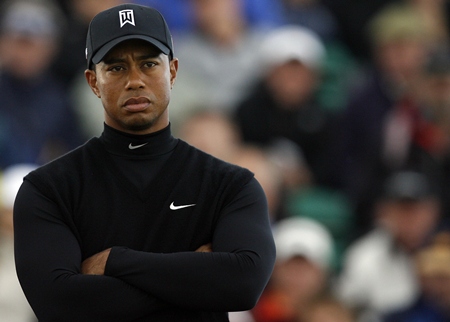
 When I did the podcast with Josh Karp on Tom Weiskopf and other things golf, the two of us lamented the lack of historical knowledge in today’s game.
Talking about anything in golf before the Age Of Tiger usually has the other person’s eyes glazing over, because it seems that people who watch golf now think golf only started with the Big Cat.
Again, I’m not hating on TW here – he was the reason I bought my first range membership and lesson package the Monday following his ’97 Masters win.
But even though I only began to play golf in ’95, if you want to call slapping the ball around a course “playing,” when I became obsessed with golf in ’97, I read every golf magazine I could lay my hands on, including old issues in libraries, doctor’s and dentist’s offices, golf clubhouses, etc.
I read extensively about the eras before the 90’s and I watched The Golf Channel religiously back between ’97-’00 and again when I started my swing research in ’05, so I knew about Ben Hogan, Byron Nelson, Lee Trevino, Gary Player, Greg Norman, Jack Nicklaus, Sam Snead, Bobby Jones and many others.
For me, playing and getting better at golf also included educating myself about the players that came before my time.
So, before I even get into today’s rant, comments like “Jack Nicklaus didn’t have any competition,” or “he played against farmers and weekend players” are especially egregious and betray the speaker’s woeful knowledge of golf history, considering Nicklaus accomplished everything he did competing against all-time greats who won 6, 7, 8, and 9 majors during their careers.
Jack Nicklaus came runner-up in majors more times against two players (8 – Tom Watson and Lee Trevino) than Tiger Woods has total runner-up finishes (7, some against the likes of Rich Beem, Michael Campbell and Y.E. Yang).
The Nicklaus era featured all-time greats – major champions like Lee Trevino (6), Arnold Palmer (7), Tom Watson (8) and Gary Player (9) – who besides Phil Mickelson (6) are considered “All-time Greats” who won majors during Tiger Woods’ heyday from ’97 to ’08, when he won 14 of his 15 majors?
Weekend players? Get out of here. It’s Tiger Woods who played against weekend players, if you want to throw stuff like that out there. Jack Nicklaus got beaten 19 times in his career (runner-up finishes) in majors – he was playing against real gamers. And he didn’t play in no-cut reduced field glorified exhibitions, which constitute a very large portion of Tiger Woods’ PGA Tour victories and “consecutive weekends played” record.
That still baffles and irritates me – how do you include no-cut tournaments in a record of “Consecutive cuts made?” Absolutely mind-boggling.
Now, today’s subject – I was curious to see what great insight Tiger Woods had for putting when I clicked on this Golf Digest article by Coleman Bentley, but it wasn’t the putting thing that grabbed my attention.
It was this line, and the bolding and underlining are mine:
His continued impact as a personality and executive, combined with his rampant success, make Woods feel current despite his age, but as a player, he is part of a bygone age—one where technique and nuance always bested bomb and gouge.
Um, What?!?

Technique and nuance besting “bomb and gouge?”
I must be losing my mind, because I could swear that the PGA of America’s groove rule for irons (making any iron shorter than the 4 iron with U-shaped grooves illegal, mandating V grooves for 5 iron to wedge) took effect January 1, 2010.
This rule change was enacted in an attempt to bring to a close the “bomb and gouge era,” during which Tiger Woods was the most dominant player on earth.
Here are some questions, which I’ll answer as well, to save time:
- What was considered to be the weakest part of Tiger Woods’ game? Hint – it was his driving off the tee. In 2007, considered one of the most dominant years of his career, he was 152nd off the tee with a 59.83% fairways hit, and yet still won 7 events, including the PGA Championship.
- What shots make up a very, very big part of Tiger Woods “greatest shots ever” library? Answer – take a look at how many of his greatest shots ever were from out of position i.e. having missed the fairway or green.
- What tactic did the old fellows at Augusta National employ to try to “Tiger-Proof” the course during the Masters? Don’t look now, but that was when the first rough was introduced, because they thought it might slow down a certain ’97 Masters winner who missed a lot of fairways and still got up and down for pars and birdies.
Seve Ballesteros and Tiger Woods come to mind to me, if you were to ask me about multiple major winners who sprayed the ball everywhere off the tee and still had the world-class scrambling ability to still get the ball in the hole in fewer strokes than most.
And Seve didn’t play in the Bomb and Gouge Era. His last major win was in ’88 when they were still playing with persimmon woods and blade irons.
Also, here is something that you will get if you Google “When was the Bomb and Gouge Era?”
The “bomb and gouge” era in golf, characterized by prioritizing distance off the tee even from the rough, gained significant traction around 2005-2006, solidified by players like Tiger Woods, Phil Mickelson, and the emergence of new long hitters, though the strategic concept existed earlier, with its formal naming in a June 2006 Golf Digest cover story highlighting players like Bubba Watson.
So, the term gained traction as early as 2005, but it would have to have started before then, because you don’t name a trend at the very start of it, more like around mid-way through.
Taking that as a rough guide, you might be safe in saying that the era ran from approximately 2000 to 2010.
If you’re wondering, here are Tiger Woods’ driving stats for 2005-2008, after which time he went 10 years before winning his 15th and last major:
2005 – 54.58% (191st)
2006 – 60.71% (139th)
2007 – 59.83% (152nd)
2008 – 57.86% (no ranking available)
Tiger Woods broke 60% average driving once during those four years.
The Bomb & Gouge Era was the Tiger Woods Era.
Stats don’t lie. The highlight reels don’t lie.
And they don’t forget, as people are prone to do, if they knew anything to begin with.
And this isn’t so much about Tiger Woods as it is that no one seems to have any knowledge of golf history going back more than 10 years.
 WAX Golf
“…he is part of a bygone age—one where technique and nuance always bested bomb and gouge…”
Could refer to the lead doc on Tiger’s orthopedic surgery team…Gotta give those guys a ton of credit for sorting Tiger and his back, knees, etc. more than a dozen times…
And if ever there were a pro in need of a traditional MCS swing makeover, it’s Jordan Speith..let’s find him and send him some video!!
Too funny, Peter! 😂
Funny you mention Spieth – in the podcast, I referenced him as a player who, you may recall from the 2010’s, I said would be parking expensive cars instead of buying them, if his short game deserted him.
Not an attack on Jordan by any means – my point was that he, as the son of athletes, had one of the worst golf swing, technically, that could be found out there.
He is an athletic young man and I am pretty sure that with an MCS swing model, he’d be challenging Scottie Scheffler for dominance.
And he wouldn’t have to be making one ridiculous par save after another to do so.
Do you believe that lie angles should be as upright as your body and swing will allow and also achieve the steepest swing possible? Also, what is your opinion on the optimal weight for clubs to be? Do you think that clubs should be as heavy or as light as possible as your body and swing will allow? Thanks.
That is all personal, Michael – some people may find that they are suited to normal, flatter or steeper lies with clubs, and would be determined by getting fitted by a professional- just don’t take swing advice from them, by no means.
The clubs should be comfortable to hold with the posture set out bu the swing model.
Same with weighting of clubs. I like a heavier feel because I don’t use muscles to swing them, rather leverage using muscles. So, a heavier club doesn’t bother me – I swing them Momentus Heavy Driver exactly the way I would a regular driver.
Hope that helps 👍🏼
Thanks. It could be a silly question but I also wanted to ask if you think that any of these principles below have any merit in the golf swing? “Bone alignment, angles of joint movement, and the ability to tense some muscle groups while keeping others relaxed.” Is it better to have tensed/flexed muscles at impact, relaxed ones, or both? These are principles primarily from Kung fu but I was interested in inquiring if you think they’d be applicable in the golf swing. Thanks again.
I would never advise one to think about impact, Michael. For me, and in the Classic era, the swing is a continuous motion from the top of the back swing to the finish. You don’t “hit” the golf ball, it simply gets in the way as you swing through to the finish. There is no “hit” in the Iron Byron, either – it winds up, then swings the club through to the finish. The ball… simply gets in the way.