
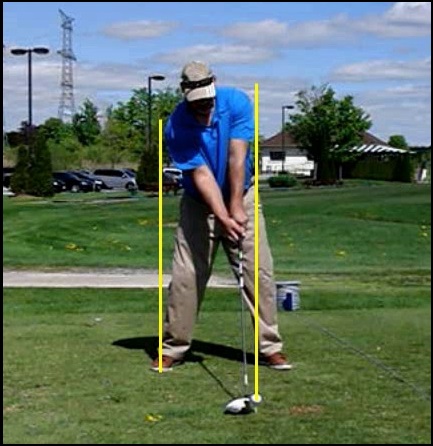
 Those of you who were around last winter will remember that I had been conducting research on the right-dominant swing model and that I had concluded around that time that I had already figured out the optimal golf swing model.
It is an ironic situation in which one may find oneself when realizing that one had actually accomplished one’s mission but lacked the knowledge or expertise at the time to actually recognize the accomplishment.
It took me ten years after I had basically nailed the optimal setup for the MCS Golf Swing model to sit down, look at the video evidence and have it leap from the screen at me.
“Hmm,” I said to myself, looking at my swings from May of 2015, “I do believe this is it.”
Even then, that was nearly half a year ago, and it took that additional time to break down why “this is it.”
It has to do with swinging “in the box,” which I’ve written about earlier in the summer.
Until I articulated this concept, I couldn’t explain why my 2015 swings using this setup were virtually optimal even as I knew that they were.
Once I came up with the “in the box” concept, I could see at a glance that these swings were “it.”
You’ve seen these swings quite a bit this past summer, so let’s recap with one in real time speed:

Let’s take a look at one in slow-motion:

And part of another swing, also in slow-motion, where I will show you the “in the box” swing action, first in the key positions:
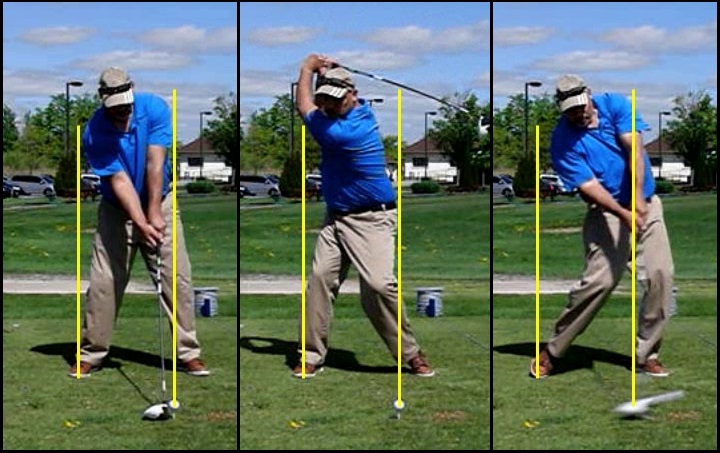
- Setup
- At The Top
- Impact
I’ve drawn vertical lines that contain my shoulders, and this is the key – when I swing from the address position to impact, my shoulders never cross either line, meaning there is absolutely no lateral movement in my body.
The back pivot is simply powered by the hips & legs, with the upper body action consisting only of the flexing of the right arm to the top.
Notice how my body is nearly completely inside the lines at the top of the pivot (only the feet remain outside, as they don’t shift or slide).
From there, the down swing is like pulling a bell rope with the requisite weight shift – not the “harpoon that seal” action of the Modern Golf Swing.
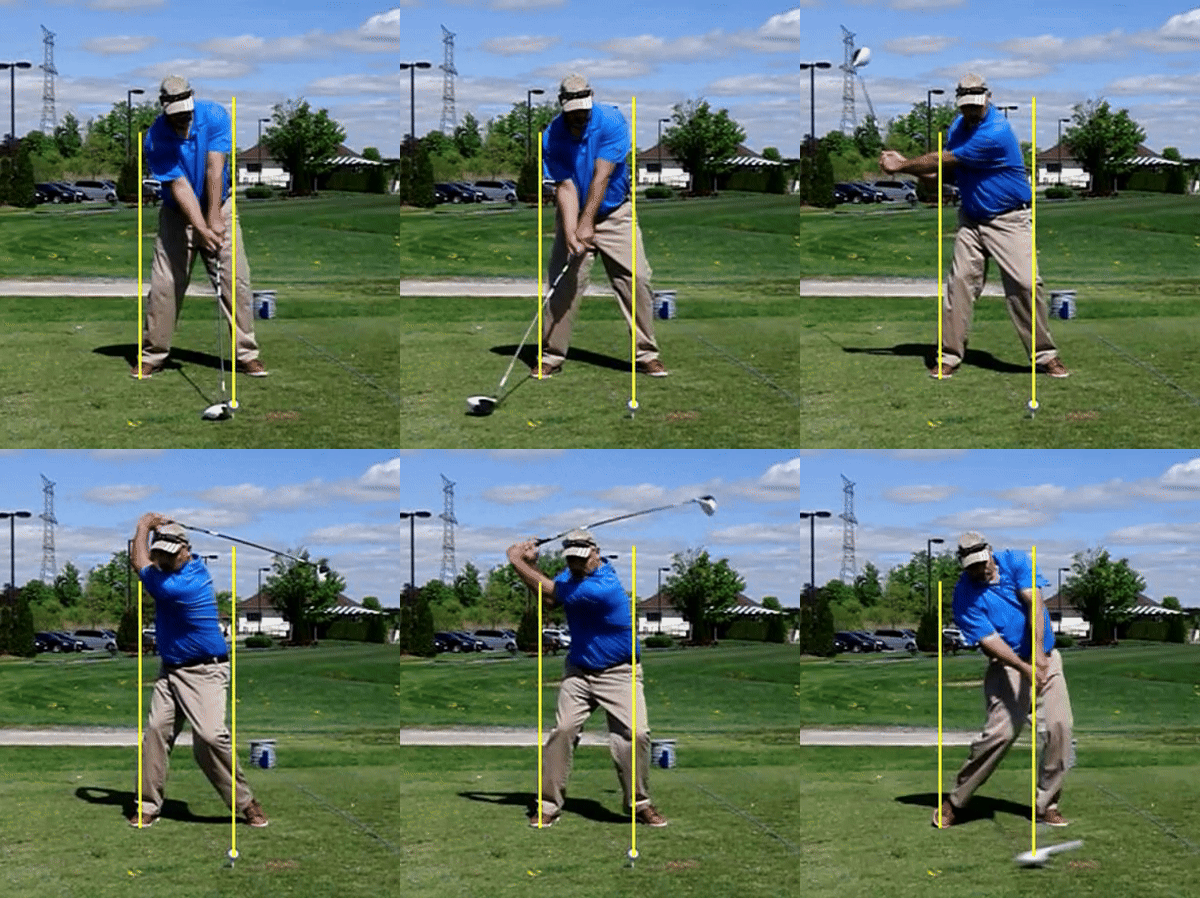
There is complete stability in the lower body parts, where the only action in the feet is in the pivoting action – the left heel rises to facilitate the full hip turn, and then drops, and the right heel rises as the weight transfers fully to the left into impact.
This wasn’t even a perfect swing – I would have had the ball a tad more to the target:

… like here above, so that instead of the vertical club shaft at impact, you have a slight backward lean to it, but that ball was still hammered, long and straight.
In a golf swing, you want:
- No compensations of manipulations,
- No big changes in position, laterally or vertically,
- Maximum leverage and power,
- Accuracy, consistency, repeatability and
- Minimal risk of injury (mechanically-sound, not just mechanically-correct).
Now, if you can show me another golf swing model that exhibits the same stability hallmarks (no lateral motion or big changes of head level up or down) and with no compensations or acrobatics to achieve this, with a fully leveraged down swing and explosive power, all with minimal risk of injury (I would swing for hours back then, hitting all clubs, and other than fatigue, never had any physical issues from swinging), then I would love to see it.
 WAX Golf
In a golf swing, you want:
No lies were told there.
The box is the best and most natural method. I’ve tried the lateral recently after seeing a certain crank from Atlanta in Jersey Islands…I mean Georgia…but switched back to rotary and never swung better. Every shot is pure and doesn’t require any manipulation. It’s also easier to shape shots in different directions that way.
The cardinal rule in stability and accuracy is what? We all know it.
Keep the head stable.
The more stable the head during the swing, without compensations, the better the model.
If the ball is in the correct position and your grip enables a square impact, and you swing with no lateral or vertical motion- how exactly do you miss?
Most beautiful box swinger of all time. Other than DJ Watts of course 😉 lol
I’ll give it to Dunaway. I’m just a lowly swing researcher 😊
Hello DJ!
That back foot slide you do and recommend — are you actively pushing on the inside of your back foot toward the target in your downswing to create the slide or is it more of a conscious movement?
Hey Scott
The only thing conscious about the action is the conscious determination to not anchor that trailing foot. People try to turn like a barrel in place with the trailing foot anchored, which leads to the Flying Foot or the rolling leading ankle, the hyperextended leading leg, or some or all at once.
When you shift the weight into the leading foot, the hip turn will force that trailing foot to slide in because you can’t stand finished on one leg with the other foot rooted in place.
Here’s something you can try – make a swing motion from a standard address position and focus on finishing with all of your weight on the leading foot. Unless you have a super-narrow stance, that trailing foot will have to release. If not, watch what your body does to compensate.
You can look like this:
Or like this:
… keep in mind, that’s not just a silly and awkward finish position – your down swing and impact will change to accommodate finishing in that ridiculous pose. Change one thing, change everything.