
 An up the line view of one of my driver swings from when I was shooting the “E = MCS” video back in 2017 shows how you can use the Ben Hogan “Perfect Pivot” to get great consistency in your golf swing.
I’ve said before that the golf swing isn’t really a rotary or “turning” motion, rather a pivot action and a down swing, where the hips and legs drive the swing and the turning of the hips are what rotate you to the finish.
What you are going to see below are the things that make Ben Hogan’s pivot action the “perfect pivot.”
Regardless of all of the other things that made Hogan great, it was his pivot action that was the base of all success.
I don’t even try to swing like Hogan, all I ever wanted from him was his pivot action.
Witness:

When I’m at the top of the back pivot, you can see that I haven’t really “turned,” other than the action of my legs and hips have created that hip and shoulder turn whilst I’m essentially still facing the ball in front of me.
Now, look at that hip and shoulder turn, with a very low leading heel raise, all accomplished with a right-biased setup and tilting spine (the “Leaning A” setup) – that is Hogan’s pivot action, and it can’t be beat.
You see also that there is no turn into impact – I’ve merely returned to a square-shoulder position at impact, and it is the driving and rotation of the hips with the legs that have pulled me back to that position:

… and the only differences in position you can see from up the line are the flexed right arm in the action of extending, and more of the trailing leg is visible with a more extended leading leg – basically I have the hips more opened at impact than I did at address.
And if you want to know how great Hogan’s pivot works with the proper, MCS setup:
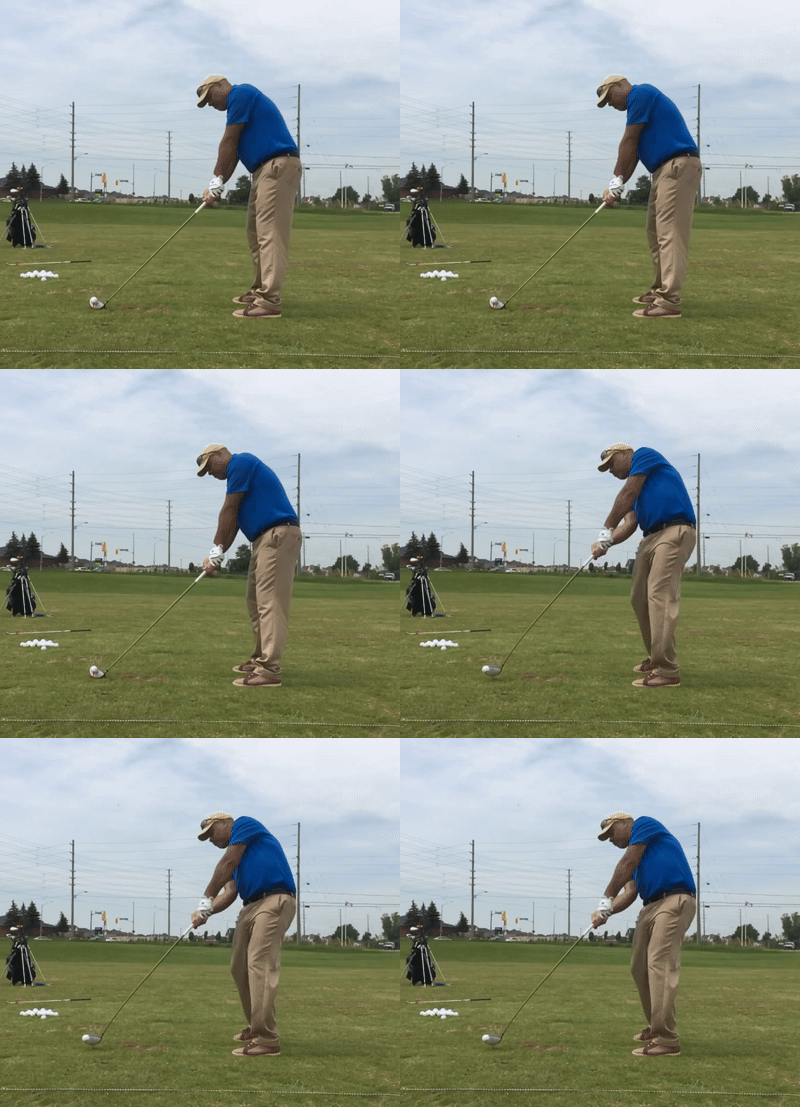
… can you get any better positional stability in the entire body position than this above?
When you get this stability looking up the line and then combine that with how I look at address and impact face-on (a different swing, of course):

… I would ask you – if you are square to the proper target line and your club face is square to the target line at address, how do you miss by much if at all, with a proper pivot and down swing?
It all begins and ends with the setup, which is the only way you can perform the “perfect pivot” with no compensations or manipulations.
If anyone were to be taught this setup and pivot action at a young age, when they start out playing golf, would you have any doubt that, given a modicum of athletic ability and drive to practice and play, they would clean it up on any golf circuit?
I don’t.
 WAX Golf
Hey DJ,
When performing your backswing, are you mainly focused on pivoting into your right hip and letting your shoulders and arms follow naturally—rather than trying to force a one-piece takeaway where the club, hands, shoulders, and torso all move together?
Up until a couple of weeks ago, I was hyper-focused on keeping everything moving in one piece. Lately though, trying to MCS my swing, I’ve shifted to more of a pivot-only mindset, and the results have been way better.
It might just be a feel thing, but I’ve been concentrating on pivoting right from the start. Then, once I’m at the top, I’m trying to “throw” the shaft into the ground using my legs and core—not consciously using my arms. The quality and consistency of my strikes have been phenomenal. It feels like a simple two-step swing: (1) pivot, (2) throw from the top with the legs and core.
Cheers, buddy.
Hey Scott – my feels may not be the same as what yours would or should me, as I’m cross-dominant (left-handed on fine motor movement like eating, writing, shooting) and right-handed on gross motor skills (kicking, throwing, swinging, punching), so I kind of do the same with the swing.
I focus on sweeping that leading (left) arm back beneath and behind me on the back pivot, and the right side impulse takes over on the down swing as I transition. I have drilled the leg and hip pivot action so much that I don’t have to think about the action. As with all other sports, you want thoughtless motion through drilling.
The pivot action is the key, and it drives everything, so my advice is to make it automatic. Carve out a few minutes per day (even while watching TV) to focus on that. The folded arms or shaft-across-the-chest method is best, as it takes the hands and arms out of it. Just focus on getting the stance established, remove the hands and arms and practice the back pivot, keeping the head stable.
Perfect!
Couple questions regarding the “leaning A” setup.
It’s the most basic of fundamentals that has been lost to the stack and tilt nonsense. It’s the only proper way to stand over the ball, and all you have to do is make sure your head is to the right of the center of your stance.
I used to teach exactly, “stand erect and slide your right hand down your leg to the knee. There’s your ‘Leaning A’ stance.”
Thank you good sir!
So once you’re done w/ full-swing any chance you’re going to analyze short game / putting 🙂
I did have a couple of short game videos produced over the years, probably still have the raw footage somewhere if I can’t find the full finished videos – computer changes and hard drive gets lost or destroyed… you know how it goes 🙂
Hey DJ,
Hope everything’s going great with you!
I’ve been working on the Leaning A setup and messing around with ball position, and I had a question.
Does the Leaning A setup move the bottom of the swing arc further back?
If I set up square to the ball and then adjust into a Leaning A stance (without moving the ball), would the low point move back which could cause fat shots if no adjustments are made to ball position and/or moving weight forward in the downswing? My guess is no, but I’m curious what you think 🙂
As an example, with my 7-iron I usually place the ball just forward of center. Before MCS my shoulders were pretty square, but lately with the Leaning A, when I’m looking down at the ball it now looks like ball is miles in front of me and it will require a great shifting of weight toward the target in the downswing to avoid hitting behind the ball (which I’ve been doing a lot lately).
Would love to get your take!
Cheers,
Hey Scott, doing OK!
Here is what you’re doing that isn’t optimal, and how you can easily solve the issue – you’re setting up to the ball with your traditional address and then changing the spine angle, which will of course (as you say) put the ball in an un-optimal position.
Instead, try setting up without a ball, with whichever club you want to swing, with the “Leaning A” position – then you will know exactly where the ball should be. Give it a shot 🙂
See that’s why you’re good – simple and effective advice that one wouldn’t normally jump to on their own.
After I sent you the message, I reviewed a handful of swings I took just prior. My objective was to see if anything stood out as to why I was hitting behind the ball.
The biggest thing that stood out was my pivot. While I was making an earnest effort to replicate hogan, I noticed that my upper body was moving slightly down and diagonally toward my trailing big toe. This of course would affect my swing arc, requiring unconscious compensations. I also noticed that I was shifting my lower body outside the box in my downswing prior to impact and was dumping the club behind the ball.
I went back outside and practiced your pivot move from your gif, focusing on turning around the C7 and not dipping and moving my upper diagonally. I also focused on staying behind the ball from my backswing to impact (as opposed to shifting my low body forward).
And Voila! I was back to hitting them pure again.
I must admit that I’m not 100% sure why staying behind the ball works since intuitively I feel that doing so would move the low point further ahead. My hypothesis is that when I my shift my body in the downswing, getting outside the box, it creates a tendency to dump the club behind the ball.
Thanks buddy.
Excellent. And very welcome sir 👍🏼