
 I have many time thought of re-editing the old “E = MCS” swing video because nearly all of it is still relevant, but the reasons I haven’t, and why I removed it from sale on the site are because I have made new discoveries since shooting that video back in 2017.
There are so few changes however, that I won’t even try to think of a new name for the upcoming video – it will simply be “The New E =MCS Golf Swing Video.”
The major change, and probably the only reason I would need for the old video never seeing the light of day again, is because I became increasingly dissatisfied with the way I was swinging in that video.
There was the left dominance as well as the too-strong grip:
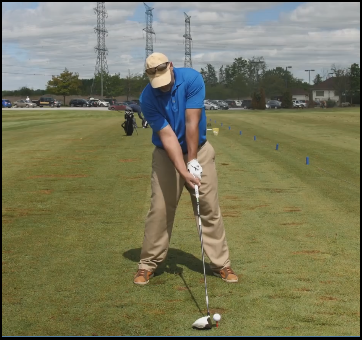
… both of which I overlooked at the time because I am cross-dominant – but once I figured out cross-dominance and how it will affect one’s swing, I couldn’t look at my old swings again.
The setup will still be based upon what I feel would have been Jack Nicklaus’s optimal setup if you had narrowed his stance slightly around 1963:

I have also done a lot of work on the pivot over the years, whilst working on other models like the one based upon Mike Dunaway’s model, so the nature of the pivot has changed slightly.
DJ’s Pivot – 2017

It is still based upon Ben Hogan’s “Perfect Pivot” action but, because of my assertion that the golf swing is vertical and not rotary, I will perform, demonstrate and explain the pivot action differently when compared to the original video.

Because of all of the above, I felt it better to simply shoot a new video with new swings.
I had hoped to have already finished this project and had it available, but the weather and a nagging left shoulder rotator cuff issue have kept me from having it ready.
The shoulder is a mystery – I may have hurt it whilst doing some intensive speed work with my SwingRite, but the day I woke up with a sore shoulder was at least a week, perhaps two weeks after I had stopped the work, and I hadn’t even swung a club in a few days when I did try making some swings back around the middle of March.
90% of the video of course doesn’t involved actual swinging, but I do want to have new swings shot for this video, so I’m working on the rest of it whilst hoping the shoulder comes around.
These are the perils of getting older, I suppose – things just hurt and twinge for no reason, but after a lifetime of sports participation, it is a price I would pay all over again to have had the athletic experiences I’ve had.
So, the work continues!
 WAX Golf
Looking forward to the final product.
Do you have any opinions on an optimal wrist type? i.e cupped,bowed etc
I have no opinion on that.
Now, if you ask me what the wrist position should be when swinging exactly in a particular way, there may be an answer.
But if someone’s grip is different from another’s, if their arm angles are different at the top, or any other factors of difference- you could never say that wrist angle has to be A,B or C, because of the variants.
My model, if and when I determine it to be exactly the way one swings optimally, will likely have a certain standard wrist angle.
But change one thing about the model and again, variants will change the wrist angle at the top.
Question just came to me after seeing this https://www.golfdigest.com/story/watson-wrist
Ah, well then we have a misunderstanding, here silly – I thought you were talking about the wrist at the top, which is when “cupped” vs “bowed” is mentioned. Not address vs impact.
In a proper setup with a mechanically-sound swing model, your leading wrist should be cupped at address and flatter (not necessarily bowed) at impact due to the nature of the difference between setup and impact:
—–
Rory McIlroy’s driver position has a very straight wrist and arm to shaft angle, which doesn’t make him longer or shorter but plays havoc with his accuracy and consistency.
—–
Mike Dunaway talked about flattening the wrist from a cupped position to trigger the back swing, but remember that he began with a cupped wrist and then flattened it with a forward press, so that is not the same as Rory setting up that way without performing a pre-pivot forward press. One was cupped, the other is flat.