
 Of course, the old WAX Nation crew from the days of the Smash Golf blog and the DJ Watts Golf blog (I used to get bored of my sites and create new ones, but WAX Golf has been around since 2013) will remember this.
There are actually two pivot actions that I know of which are mechanically-correct – which one is optimal, I haven’t yet figured out, and each could be equally effective depending on the person using it.
Pivot #1
I have since 2014 focused on the rotational pivot action that Ben Hogan used (some of you will remember “The Ben Hogan Project” video from that year), and I even dubbed it the “Perfect Pivot” because of how easy and effective it is:

In the rotational pivot, the hips turn in place on the back swing and then shift toward the target on the down swing.
If you see that red line in the above gif., I’ve postulated that Ben Hogan was misunderstood (and gave birth to Modern Golf Swing theory) when he stated that he wanted to “resist” with his right leg and hip on the back pivot.
What he meant, of course, was that he wanted to restrict or resist that right hip from moving laterally, because he certainly didn’t restrict his hip turn at all, as proven by watching his leading knee move inside the vertical line of his ball.
And if you watch his swing from the rear vantage point, it is patently obvious that Hogan swung with the Classic Golf Swing style of allowing the leading heel to leave the ground to avoid restricting the hip turn:
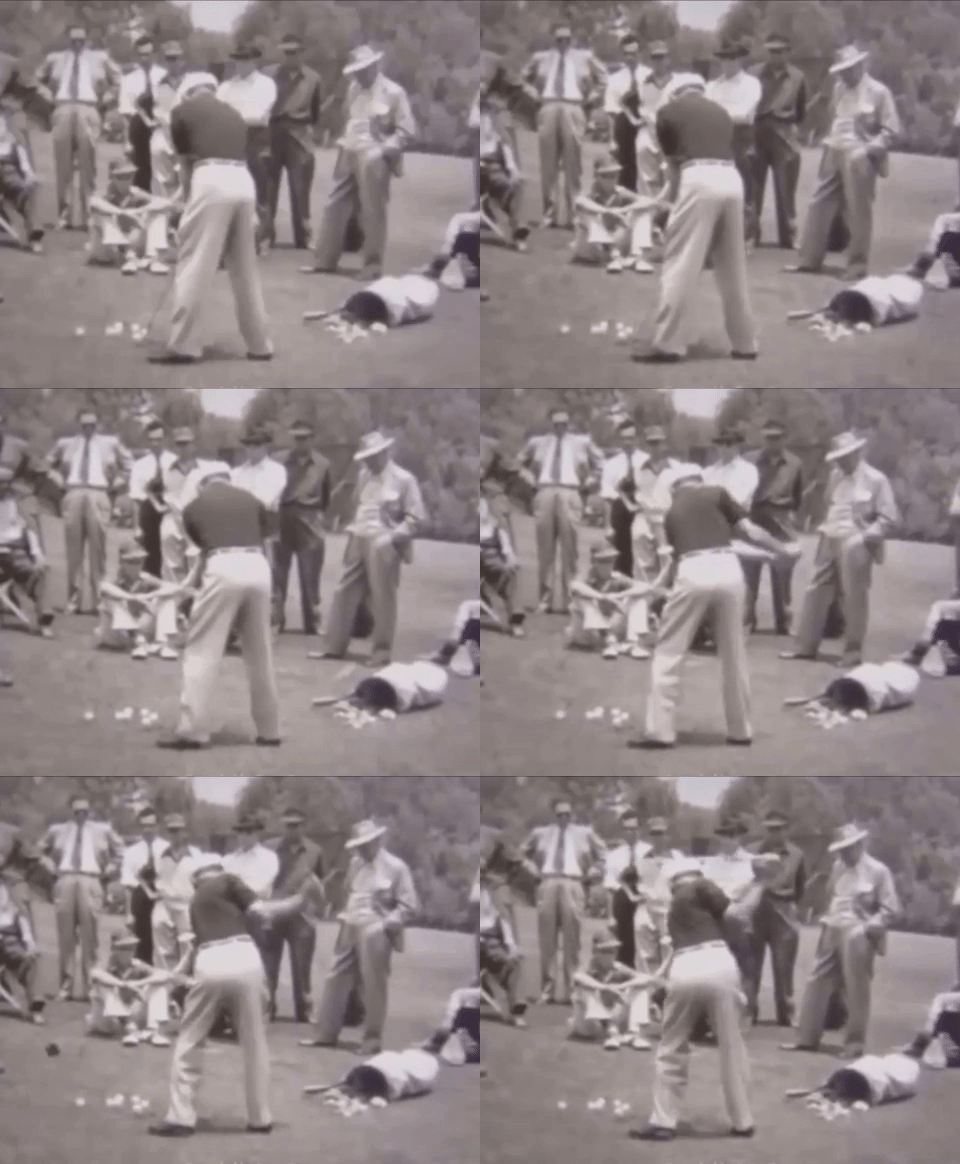
That is no restricted hip turn, but they most definitely didn’t shift to his right on the back pivot.
I shattered the myth of Ben Hogan swinging with planted feet in that “Ben Hogan Project” video.
Pivot #2
The second mechanically-correct pivot was one used by Mike Dunaway (the “Father of Modern Long Drive”) and his mentor Mike Austin, which has come to be known as the “Shift & Post” pivot because the hips work differently from the rotating-in-place pivot.
I didn’t like the Shift & Post and left that school of swing around 2013 because I was not able to make myself set up over the ball in a manner that would allow me to perform that pivot.
I had played various sports and thrown enough stones and balls in my life to know that it is much more difficult to perform a precise athletic movement while the head is shifting instead of staying stationary, something that isn’t a problem with the Classic Golf Swing rotary pivot:

You can see why it was called the “Shift & Post,” as the hips shift laterally to place the weight over the straightened trailing leg or “post,” after which the hips shift back towards the target as in the rotary pivot down swing – the problem for me was the shifting of the head during the back pivot.
I did mention a couple of years ago during the height of the pandemic that I was working on a pivot that had the same “shift & post” action but that got lost in the weeds when I realized I was swinging left-dominant and had been as long as I’d been swinging a golf club.
When I began the work to transition to swinging neutrally or even right-dominant, that pivot inquiry fell by the wayside, but I’ve been working for about a week or more on it again.
The trick is in the setup, of course – if you build your address position over the ball so that the head is already where it should be at impact (very easy with the rotary Classic Swing action), then it won’t move much or at all during the entire swing from the beginning to impact:

Right now, I’d say that I’m pretty close to declaring that a “Shift & Post” pivot can be performed with the MCS setup, which would emulate the “ringing the bell” action coined by Mike Austin to describe the hips moving back and forth while the C7 remains stable, just the way a bell swings whilst ringing.
He and Dunaway tried to demonstrate it as well:

… except that Dunaway’s demonstration of this was miles distant from the way he actually swung. His head definitely shifted on the back pivot, from a little to quite a bit depending on which iteration of his swing you watch from over the years.
My initial work on this indicates I may be correct, but I won’t have definitive proof until I’ve been to the lab to test it out.
Until then…
More to come!
 WAX Golf
Apologies if this is off topic: https://www.youtube.com/watch?v=fegKKbJV56g What are your thoughts on this video? I personally agree with it, and think that pros need to back to persimmon and blades.
Apologies, your comment was caught by the spam filter and I just saw it.
Had a glance at it, silly9 – perhaps stainless steel heads and blades, I wouldn’t want countless trees destroyed for the sake of the game. But definitely limitations on head size and trampoline to more closely emulate persimmon than a titanium shoe box.
If you need one of those or cavity-back irons to play the game, by all means, go ahead – but they have no place in the “pro” game where the best players compete for obscene amounts of money.
Best examples of a rotating and lateral pivot. Sadly in terms of the rotating plane,the term “barrel” has lead to a level of twisting that ben hogan himself never taught or followed.
Exactly – I have described myself the action of the hips in the rotary swing as “turning a barrel,” but people then start to twist themselves into pretzels when the proper pivot doesn’t actually make one “rotate.” The hips swivel back and forth when one walks, but we aren’t turning our torsos to the right and left as we do so.
Do you think the equipment has to change (or return to how it was) for people to follow a more MCS swing? Modern equipment forgiveness doesn’t encourage reflection or a fluid swing due to how forgiving it is.When you swing with a steel shafted blade or persimmon you know you have to swing in a good rhythm and balance.No violence.”Purity of technique” -Moe Norman
Don’t get me started on that one, silly9 – I hate that the pros essentially play golf the way a child uses training wheels on a bicycle. With other sports, you have children’s and amateurs’ equipment that are not permitted in the pro circuits. Lower nets and smaller balls in basketball, aluminum bats for children and college players of baseball… and so on.
The best golfers in the world should be using equipment that isn’t forgiving – if you are going to switch from persimmon, then stainless steel heads of a size not much larger than persimmon should be in order. Balls should have a minimum spin factor so that mis-hits don’t travel as far as when struck on the sweet spot.
Golf pros are using equipment that is so forgiving, and they still can’t hit more fairways than the Classic era players did. It’s ridiculous.
And get rid of these ridiculous cavity-back irons, back to blades for the pros. Then we’d see that many of these pros wouldn’t last a season on Tour without some serious swing re-tooling. Not to mention, most pros out there would end up in traction trying to use the equipment from 30-40 years ago.
I am all for a roll-back. The sooner the better.
You summed it up complete right 🙂 It really is ridiculous that pros use the same equipment as average amateurs in the double digit handicaps.(Senior pros not included as they’ve earned it ) I really struggle to see the modern pros as impressive apart from the short game,when I’ve seen guys at my club (average age is 65,not a lot of people in their mid 20’s like me) hit it not only hit it 280-300 without much of a swing,but in the fairway consistently as well.And most players at a club don’t get paid to hit golf balls for a living.That shouldn’t be happening.
I don’t want to single out any specific players, but there is a player who was winning majors in the early teens who I declared would be parking expensive cars rather than buying them if he didn’t have the short game he had. Short off the tee, could barely hit a fairway or green in regulation, yet winning majors.
Pros are ridiculous with the short game, but the long game has become a wasteland of 275-290 carry drives that roll another 50-75, if they hit the fairway… bah.
A few big drivers but they can’t hit the side of a barn from the inside. You try to watch golf on TV and all you see is players around the green for the most part. I prefer the old days when you had to be a ball-striker to do well.
Ben Hogan won majors and was a decent short gamer but the putting was his worst facet, especially after his car wreck. I’m just a old-timer at heart – I’m not impressed with guys missing the fairway, missing the green, chunking it on and draining a thirty-footer for par.
I know, every stroke counts, but if you can’t hit a fairway consistently with the equipment on hand, you have no place in pro golf. Or shouldn’t.
My tuppence 🙂
Scheffler would still be great.A genuine ball striker. https://x.com/PGATOUR/status/1900917968831181075