
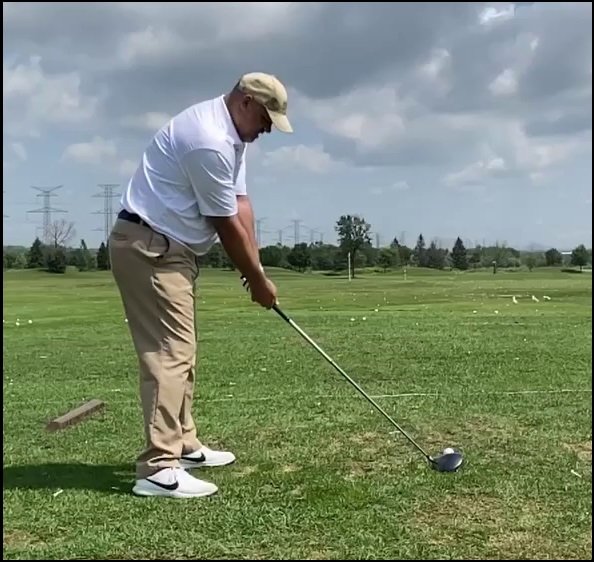
 I have made an important breakthrough in my theory work, I believe, that finally solves the issue of the setup.
I think it’s been about a week since a little nugget of an idea landed in my brain and began to change the way I look at the setup for a golf swing.
For my regular readers, the first part of this post involves an old subject about my struggles developing my own swing to match my theoretic model due to a physical deformity, but for the benefit of any new readers or fresh visitors, I’ll start from the beginning.
Old hands, feel free to skip the intro!
Intro
The thing is, I may have landed upon this many years back if I had had a normal or more normal body make-up – I will never know that, because all I can go by is how quickly I picked up technical things in other sports, but it isn’t assured that I would have.
You see, I have always cursed the fact (since I discovered the problem, that is, I’ve had it all my life) that I have scoliosis – not even that I have it, but that my particular deformity sets my spine more than a few degrees left of center if standing with my feet on a perpendicular line to the direction I’m facing.
Most people, standing squarely with their feet, will have their hips and shoulders also square and in line with their feet.
I, on the other hand, will have my shoulders opened left, and I’ve even now noticed it at times when simply walking when I pay attention to it.
I believe the first time was when I didn’t want to get my shoes wet after a rainstorm and was walking through a water-filled car park and I began walking on the raised curb as if it were a tight-rope, while also avoiding the soaked grass.
At one point I noticed that I was perfectly balanced while walking a straight line but that my shoulders were not square to that line, rather open a few degrees. As if I were walking whilst chatting with someone to my left.
So, this is something I only realized during the winter of 2013-14, and some of you may remember when I first blogged about it. That I’ve had scoliosis all my life, which didn’t interfere with my previous sports endeavors at all, to my knowledge, but that this twist in the spinal column was what had played havoc with my swing.
I could hit a ball dead straight 180 yards with a 7 iron, or with a little pull-fade, and yet my divot would be going 45 degrees left! The wonders of hand-eye coordination and practice, ladies and gentlemen…
Obviously, one cannot dream of playing golf at a high level swinging like this.
End of Intro – The Major Error
I though I had solved the problem years ago by adopting the “angled stance line” as I called it, and old MCS hands will know what that’s all about, because many people found that even if they didn’t have my condition that the Hogan-style angled stance line worked for them:

To be honest, looking at the above gif now, years after I made and shared it all the way back in 2014, I wouldn’t be surprised at all if Hogan had a similar spinal twist, because of how squared his shoulders were at address even with a substantial “drop-back” with his right foot.
In fact, the only difference between his swing above and the way I was swinging years back with the angled stance was that I had a very steep swing plane – but I began playing golf at the age of 25, and by the time I had learned enough about the golf swing to know that high hands at the top was not an optimal thing, it was so deeply ingrained that I still have issues with it because the “high hands” position feels so natural.
But look who also had very high hands earlier in his career, definitely before his near-fatal car wreck that made him change his swing due to reduced lower body mobility:
Young Ben Hogan

Notice how even Hogan had the short-stop slide release through impact, just saying…
Compare his stance and swing action to mine 9 years ago, and I’m not saying to compare the results or skill level, just the physical motion similarities:
DJ May 2015
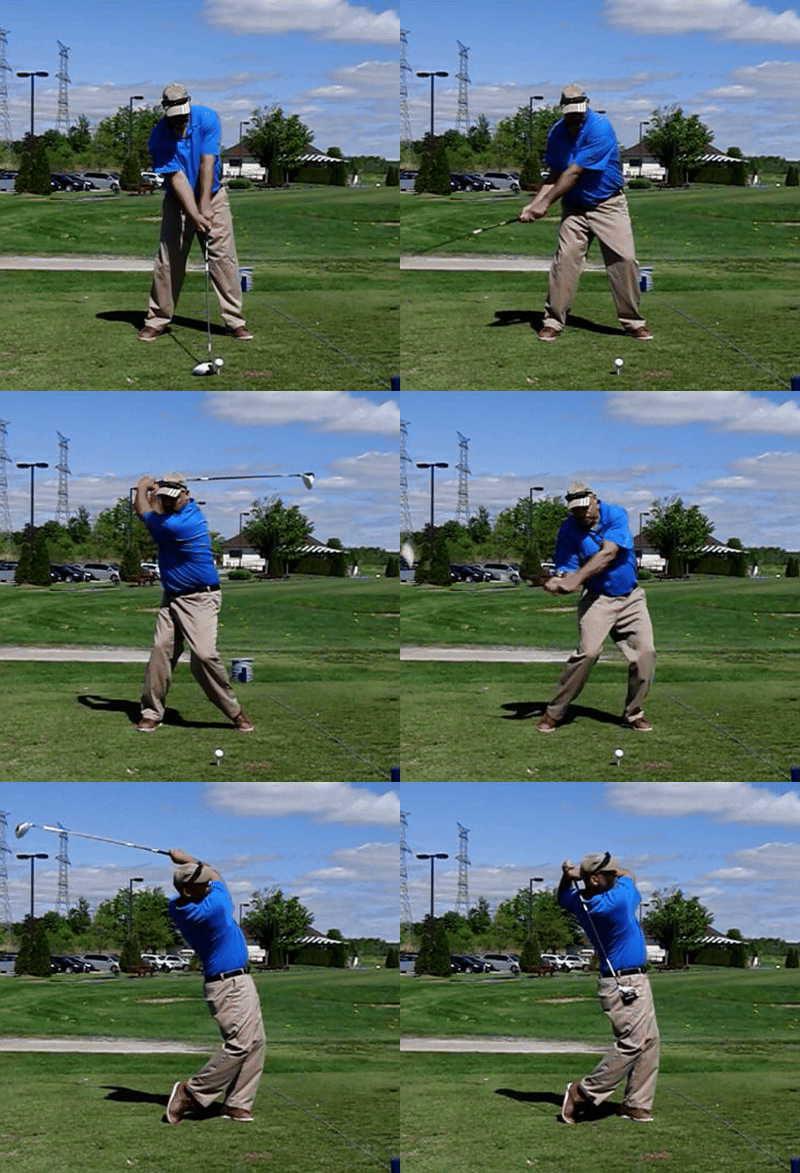
I can see two differences, in the wider Hogan stance and his much weaker right hand grip, but looking at my swing back in 2015 and comparing it younger Hogan’s, I can’t help wondering if he had a similar condition or perhaps a longer right arm than left, both of which problems having a similar solution with the angled stance.
Continuing my thought – in 2017, I thought I had discovered a way to set up over the ball with my feet square to the line, and I dropped the angled stance from the standard MCS model.
You can see what happened next, if you look at a swing session I had in 2018 and see what jumps out at you:

Yeah, that’s brutal – five degrees outside-in club path, club face 3 degrees closed and yet only 2.9 yards offline from perfectly on target on a 335 yard drive!!
If you look at the side spin numbers directly below the ball speed (middle row, 3rd from the left), you’ll see a substantial 221 rpm right – my classic pull-fade action with which I could knock down flagsticks at times, or yank it dead left or banana slice it right, all depending on what my club face was doing…
This is why being an athlete (I am no longer, but certainly was in my youth) can interfere with identifying issues in one’s golf swing, because sometime the athletic component can mask those issues without a deep dive into the stats.
I looked at those numbers and shuddered. “What the heck is going on?”
But I figured that it wasn’t the spinal thing (oh, it was, rest assured), just a habit of having too-high hands leading to an over the top move.
So I worked on lowering my hands, and I mean I worked on it, and look what I got a few weeks later on a swing session:

There in the left-green circle, you see a nearly perfectly neutral but ever so slightly inside-out club path, which you could bottle and sell for a fortune, but now missing the line by 12 yards on a 330 yard drive – which is still a very decent drive if you’re playing away from danger right or simply setting up right-ish if your miss is a left one, back to the fairway center.
This here, my friends, was the worst thing that could have happened, because it made me think that I could stand square to the ball and still get things done, but that was all accomplished through manipulation, and you all know how I hate that word when it comes to the golf swing, because manipulation goes with “compensation.”
I even went back over this subject two winters back, you’ll recall, when I set out to see how angled a stance I would have to adopt to hit the ball with a neutral club path at impact, I also abandoned my results when again, I was able to manipulate my swing to achieve a neutral club path with a squared stance line.
“It was a vestibular issue,” I said, and again, cold reality hit when I would swing without thoughts of manipulation or compensation.
So, when I finally got into a setup the past two sessions that allowed me to simply hit drive after drive down the line without thinking about anything to do with manipulation or compensation, I was over the moon.
I knew I’d finally solved my issues by following my own intuition for once and for all, and then the nugget landed regarding setup.
You see, there is only one optimal setup and that is the one that will allow the swinger to swing with mechanical-correctness and also to have a club path that is outside-in reaching the swing bottom.
That means I was swinging with a setup much closer to my optimal one back in 2015 compared to 2017 to now, regardless of results.
This whole process has been akin to a steeple-chaser falling into the water on the last hurdle with the finish line in sight, and the sides of the pit are too steep to pull oneself out.
Stuck in the same place for an eternity until a helping hand pulls you out in time to still finish the race.
That helping hand was my following my own process and trusting it instead of trying to shoe-horn myself into a setup that simply wasn’t going to work for me.
Luckily, most of the people who play golf don’t have my issues, so they will not struggle through the setup process.
Were the last 7 years a waste?
I don’t think so, if I finally get to the finish line.
Theory work is not for the swift of foot, nor the faint of heart. When you decide on a goal, you either see it through or fall short.
As Yoda said, “You do or you do not. There is no ‘try.'”
And now, I think I’m at 98% through to the finish. I will have another session or two, to make absolutely sure of things.
It’s almost as if you will know when you’ve reached the goal however, not “I think I have it, “ – I have no doubt, I just want to make sure I’m fully 100% before beginning the video process.
With apologies to anyone waiting on my next project, I’m not rushing this. I refuse to.
More to come!
 WAX Golf