
 This is just an essay on my pet peeve as I am working on my golf swing setup and kicking myself for not figuring out some things before now.
Simply put, when you are talking about “compensation” in a golf swing, it means something very basic.
You have either built a setup over the ball or have done something (in the back pivot or down swing) that will make it difficult or impossible to make square contact with the ball sitting on the tee or the ground.
On a secondary level, you may also have built a swing that makes it very hard to avoid injury swinging from the top to the finish due to improper setup or mechanics.
In this case, you then have to make a compensatory move, either to strike the ball squarely, or to avoid injury and in many cases, both.
So, a compensation move may work very well – until it doesn’t, and there is absolutely nothing better than being able to swing without having to make any compensations at all.
Why is compensation my mortal enemy?
It’s because I came to and have always treated golf as a sport and not a game. And in sport, if you are not making mechanically-sound motions, you are bound to incur injury, not to mention your performances will suffer significantly.

I possess a sort of competitive zeal which I have brought to all sports in which I competed, and many summer and winter days were whiled away practicing my throwing against the back wall of the house, dribbling a basketball in the basement or shooting a tennis ball with a hockey stick at the basement sofa – if there is a proper word here, I was obsessed with practice and honing whatever skills were required to play that game.
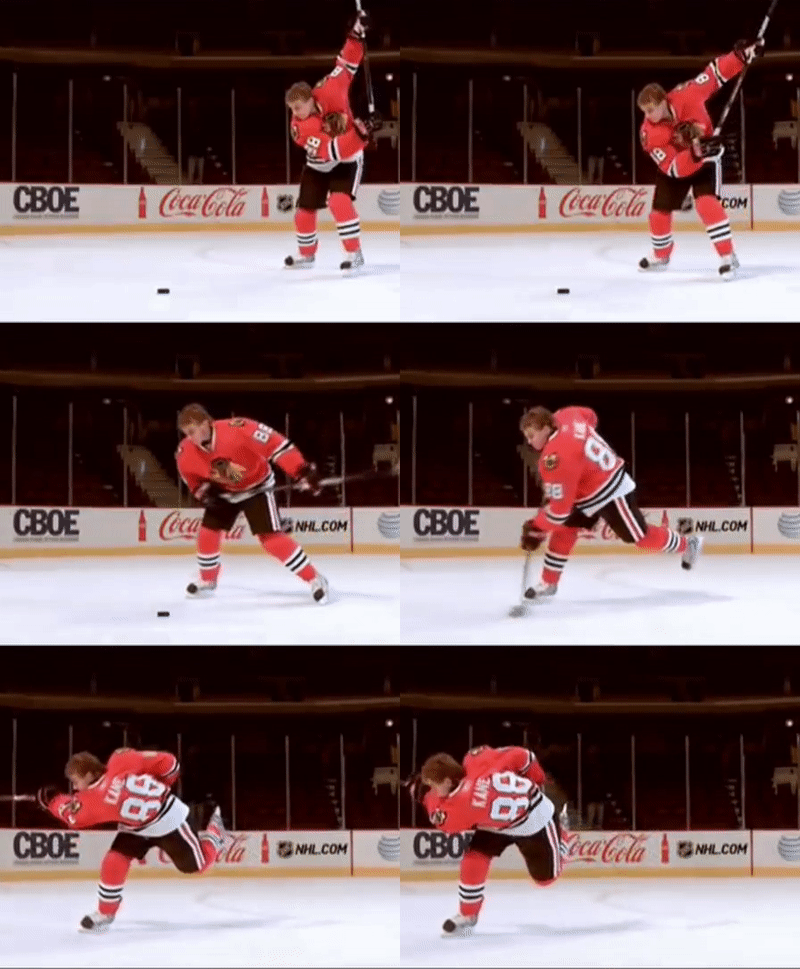
It was always about technique, and some of you may have heard the phrase, “Hard work beats talent when talent doesn’t work hard.”
Let me say that I have medals in my collection that I had no business winning competing against far better athletes than myself, but I had worked hard enough to get that much of an edge to beat those athletes who didn’t put in the work.
I can’t even take much pleasure in having earned them (I’ll look at them and say, “shouldn’t have won this one, or that one either…”) and I keep them to remind me of the difference between winning out of sheer talent and earning the laurel by dint of dedication to practice.

This mindset has kept me going through my golf swing research, long after I could have stopped and said, “Well, this is a pretty good swing…”
Because of my view on proper mechanics, compensation and maximizing performance, I have obsessed over the golf swing because no one was ever able to teach me the technique of the optimal swing the way I had basketball, track & field, baseball or hockey coaches teach me proper mechanics.
And guess what?
Until just a few weeks ago, I was still in the wrong mindset of exactly how to build a setup over the ball in order to swing with zero compensatory moves.
Instead of building a setup and saying, “Now, how to swing to produce the best speed and accuracy without any compensations,” I have been saying “How do I set up over this ball so that, swinging with no compensations, I can make square contact with the ball and send it on the desired line?”
In other words, how do I set up over this ball in order to swing naturally and freely and as hard as I wish to swing, and still bring the club head square to the ball with a neutral club path?
Trust me, the difference between those two questions is vast.
The answer to which question will also allow me to tell others how to build a setup in order to swing without compensations – everyone is built differently, with differing levels of athleticism and with or without physical impairment.
I have scoliosis, which profoundly affects the way I have to set up to the ball to get the desired impact conditions.
To finish, there is no one way to set up over a ball, but there is only one way in which to swing optimally, and that is without compensation.
 WAX Golf