
 I’m not a doctor, while I do have a bit of knowledge regarding kinesiology attained through swing research and a lifetime of athletic pursuits, but this article really set my Spider Senses tingling when I read about Jordan Spieth’s wayward ECU tendon.
Basically, the sheath that holds his left ECU tendon in place is torn and it pops out from time to time, leading to his having to WD from events or miss them altogether when this occurs.
From the Golf.com website, courtesy of Nick Piastowski:
“It’s a thing that’s recurring,” Spieth told Hodowanic. “I was lucky because most times it comes out, and I can’t turn it (left), and so I would have been screwed. It’s the ECU tendon. It came out and came right back in its groove.
“On 14 yesterday, I thought I was done for the week,” Spieth added. “Then (the tendon) came back in, and I was like, ‘All right, I’m good.’”
The incident was the latest mention of the wrist over the past year. Last May, he withdrew from the Byron Nelson because of it, though he played in the PGA Championship a week later. Then, in late November, at the Hero World Challenge, Spieth revealed that he re-injured the wrist in a bizarre incident.
Blah blah… OK, you can read the entire article at Golf.com, so I’ll move on.
A Google definition on the function of the ECU tendon:
The extensor carpi ulnaris (ECU) muscle plays a key role not only in the active movements of wrist extension and ulnar deviation but also in providing stability to the ulnar side of the wrist. Its position relative to the other structures in the wrist changes with forearm pronation and supination.
First, let’s look at a swing of his from not too long ago, for reference.
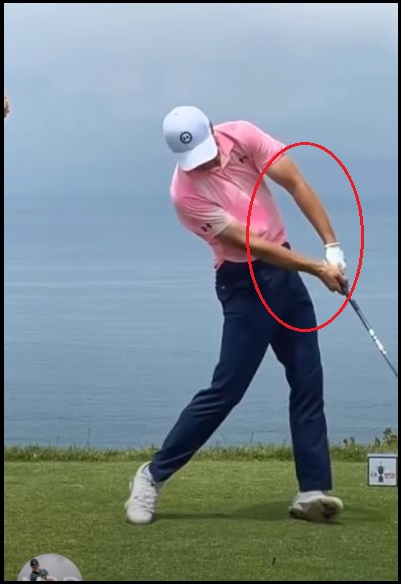
Funny (not really) that the bum tendon is in his left wrist, when I look at this position of his post-impact:
Now, let me explain very quickly how harmful it is to the leading wrist when you try to “hold off” the natural release of the golf club through the swing bottom and into post-impact – very simply, it’s very harmful, because you’re dealing with the principals of the conservation of angular momentum.
This is what makes something twirl on a string when you swing it, and the club head swings in a circle around your hands as you swing it, due to the conservation of angular momentum.
Used properly, you can create effortless power in the swing bottom by allowing that club head to travel naturally in its curved path and allowing the release, as illustrated by Tony Finau in comparison to Spieth:

Whereas Finau has allowed the full release of the club with his wrists, Spieth is desperately trying to prevent it, and the place where you would do that would be with the leading wrist.
We don’t even have to talk about how JS’s hands are above the ball when the club hasn’t even released yet:

… which forces him to spin on his left heel to get the club head to the ball before he buries that same club head into the tee ground behind the ball, adding more rotary torque force to the wrist he’s using to hold off the release… it’s a mess, and one of the worst swings of a world class golfer I’ll ever have to hold my nose to review.
Speaking of the two golfers, one of them blasts it a country mile and the other is relatively short-hitting… you only have to look at the post-impact to know which is which.
There is another golfer who injured his left wrist about whom I wrote a couple of years back, one Bryson DeChambeau – I asked at the time whether the broken hamate bone in his left hand was caused by this:
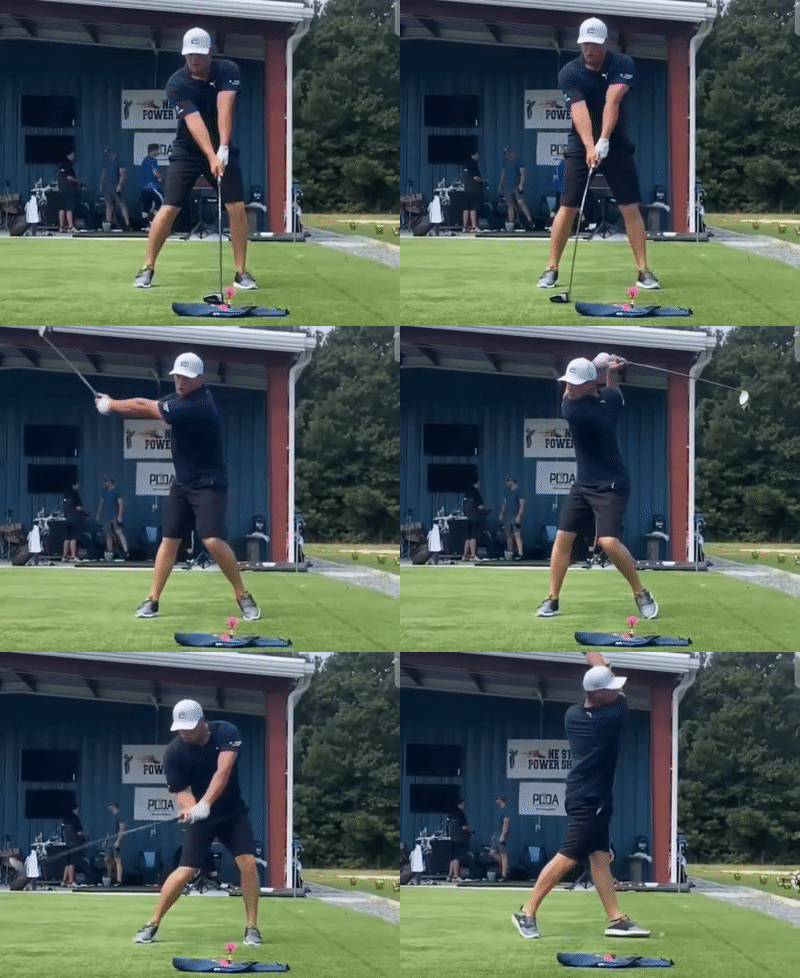
Note the unnaturally straightened (bowed even) left wrist in the setup, and then this post-impact position again:

… and the fact that he was actively trying to prevent a natural release through the swing bottom, which he demonstrated on video: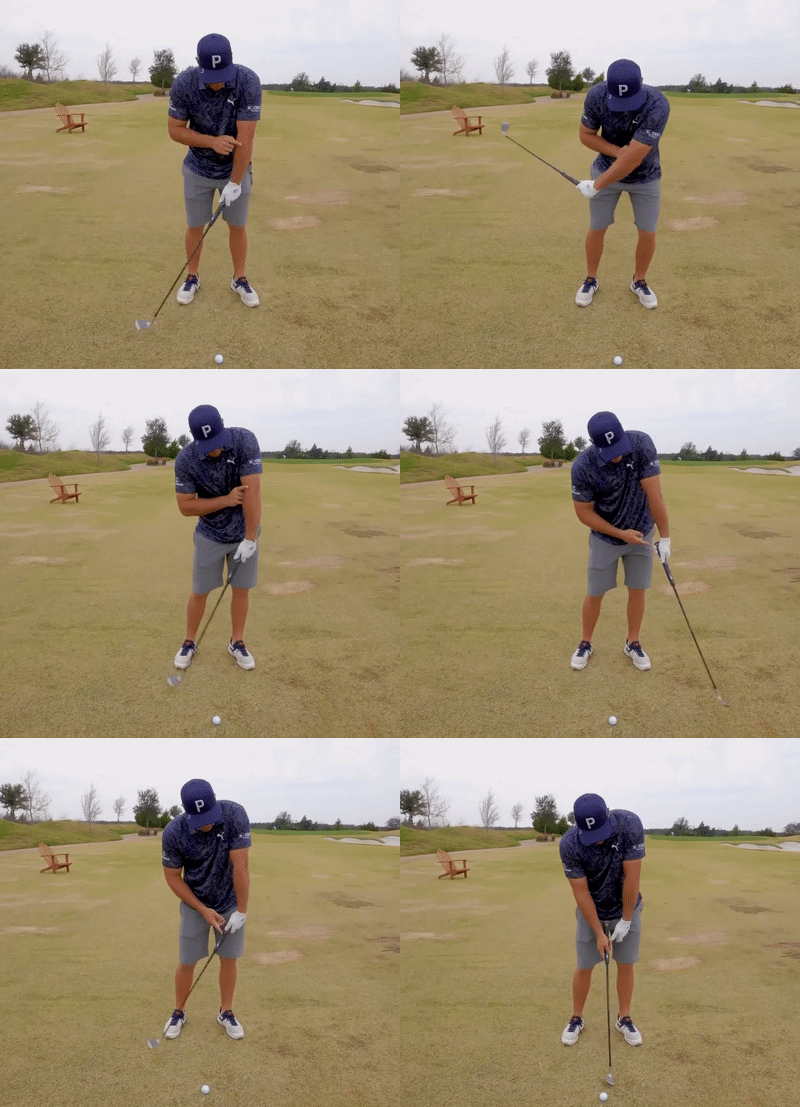
I will repeat what I said at the top, that I certainly am no doctor, but a lifetime of sports participation and various injuries I’ve incurred have taught me very well that nothing good will ever happen when you interfere with the principles of physics or anatomy.
Tiger Woods, Fred Couples and countless others have ruined their backs and other body parts trying to get more spinal twist and shoulder turn with restricted hip turns than the body is designed to allow, and you can add a multitude of other golfers and injuries that are completely avoidable if one swings naturally and the way the body is built to move.
So, I will end it here and admit that I am shamelessly speculating on the nature of the original cause of Jordan’s injury (he waxes at length on the recurring injuries but never reveals the original one and what caused it), but his particular swing vices point directly at the hold-off move being a leading suspect.
 WAX Golf