
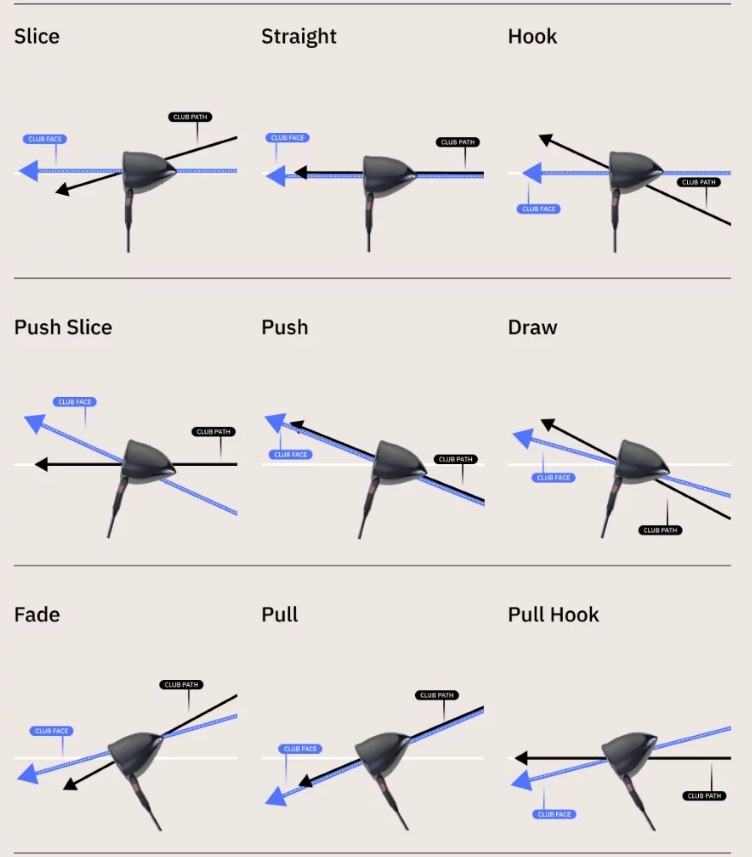
 This article may just be another thinly-veiled Golf Digest article promoting something (usually lessons, this one with a teaching pro and simulator session), but the visual chart it includes is one people may find useful.
The reason I suspect an ulterior motive is because, in the article, the writer Alex Myers purports to be on a one-year mission of daily training, practice and playing, but somehow didn’t already know what causes a hook?
Says he:
Even swings that felt good at impact were snapping so far left at the George Fazio Course at Palmetto Dunes that I did something crazy on the 18th tee: aim well right… In my first meeting with Mario, one of Golf Digest’s Best In State Instructors for New York, I told him about my big miss and that I believed it was coming from an over-the-top move…
Yeah… color me doubtful on that score, because the first thing one learns when practicing on the range, after the swing mechanics of course, should be how to shape shots.
So, I’m wondering what this gentleman has been doing on the range to not already know what causes the ball to hook or slice – I’ve never heard anyone blame their hook shot on an over-the-top move, because we all know that this is the slicer’s curse, and any ball going left with that move is a duck-hook, otherwise known as the pull-hook.
Moving on, this is the chart in question, and it’s definitely one that you should know intimately if trying to play proper golf:
So, when you’re hitting balls, the easiest way to determine your club patch at impact is to look at your divot when hitting balls off the ground, and your initial ball flight when hitting a ball off the tee.
If the ball starts left, you’re outside-in (the goes with the divot), and if it starts right, you’re inside-out with the club impact path (assuming a right-handed golf swing).
What the ball does in the air will tell you what you need to know about your club face at impact – if it turns left, the face was closed to the club path – if it goes right, the face was open to the club path.
Very basic, but very important things to know if you’re going to play serious golf.
 WAX Golf