
 It seems someone at Golf.com woke up from a decades-long slumber to discover that Bryson DeChambeau’s prodigious power and length off the tee come from basic swing fundamentals that have been around since the days of… well, forever.
In an article I came across today, there was an expectation before I clicked on the link, from the headline, that something juicy and secret was about to be shared.
Instead, Power play: Bryson DeChambeau’s best moves for more yards is nothing more than simple and basic Classic Golf Swing fundamentals that have been around… I think I’m repeating myself here.
In fact, it’s exactly what I’ve been pounding in my last few postings – the hips and legs are the engine for power production in the golf swing.
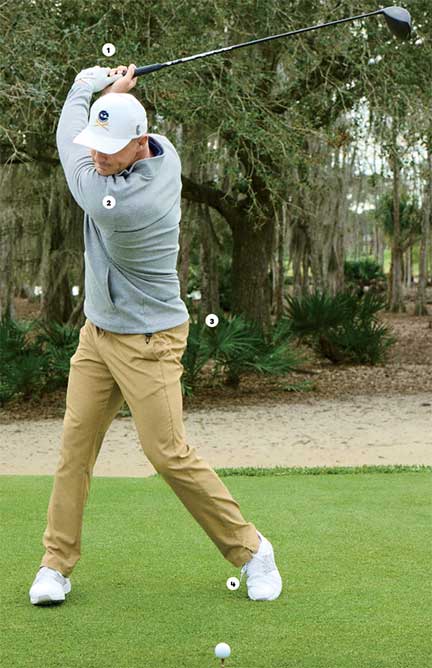
In this above image from Michael Schwartz, you see four points, three of which come from the 4th point, which means it should actually be the 1st and last point.
Those four points, according to Bryson, are:
1. Reach for it
Look how high and around my hands are. The farther I raise them from the ball, the more time and distance I have to apply force leading up to impact.
2. Torque at the top
I like to feel tension in my left shoulder at the top, just as my hips start to unwind. This rotational force is a serious power multiplier.
3. Max out your hip turn
One of my goals is to get my rear end facing the target at the top. This ensures a full turn and stops any kind of sway off the ball.
4. Raise the roof
With apologies, I have to say that this order is all wrong – the 4th point is what makes the 3rd, 2nd and 1st points in Bryson’s list here possible – without the freely lifting leading heel, you don’t get those other points, and with it, the other 3 come naturally.
I made that exact point when I mentioned in a recent posting that my leg action years ago:

… gave me effortless power which produced startling distances with swings that looked fairly easy-going.
This little bit as well from Bryson is just tragic:
I don’t really expect recreational golfers to do what I’ve done and go down rabbit holes on the power biomechanics behind the swing to the extent that I have.
But, in my research, I discovered a few key movements that the weekender can work on to reach their distance potential.
The tragedy here is that all of this is nothing close to going down rabbit holes – it’s the very first thing I discovered when I began my own swing research, which is that the Modern Golf Swing is a bogus and unsound manner in which to swing and that the Classic Golf Swing is the way to go.
How early?
Well, I began my research in the summer of 2005 and spent much of the first two years just studying the swings of every great player I could find online or record from television, from Bobby Jones to Jack Nicklaus & Tiger Woods.
I didn’t really get around to spending a lot of time actually hitting balls until the autumn of 2007 and by the end of the summer of 2008, I had made that determination.
So, about one year of hitting balls on the range with a video camera was all it took.
I’ve spent the rest of my research time trying to figure out the optimal way in which to swing in the Classic Golf Swing method, but if your research doesn’t conclude very early that Classic is really the only way to swing with mechanical soundness, then the rabbit hole is one of your own digging.
Thanks to the Modern Golf Swing-invested golf instruction and analysis industries, what should be the first thing you learn in swinging a golf club (that the hips and legs do the work and not to try to restrict them in any way) has been buried beneath a metric ton of bovine excrement.
But hey, we’re making progress, I guess.
 WAX Golf